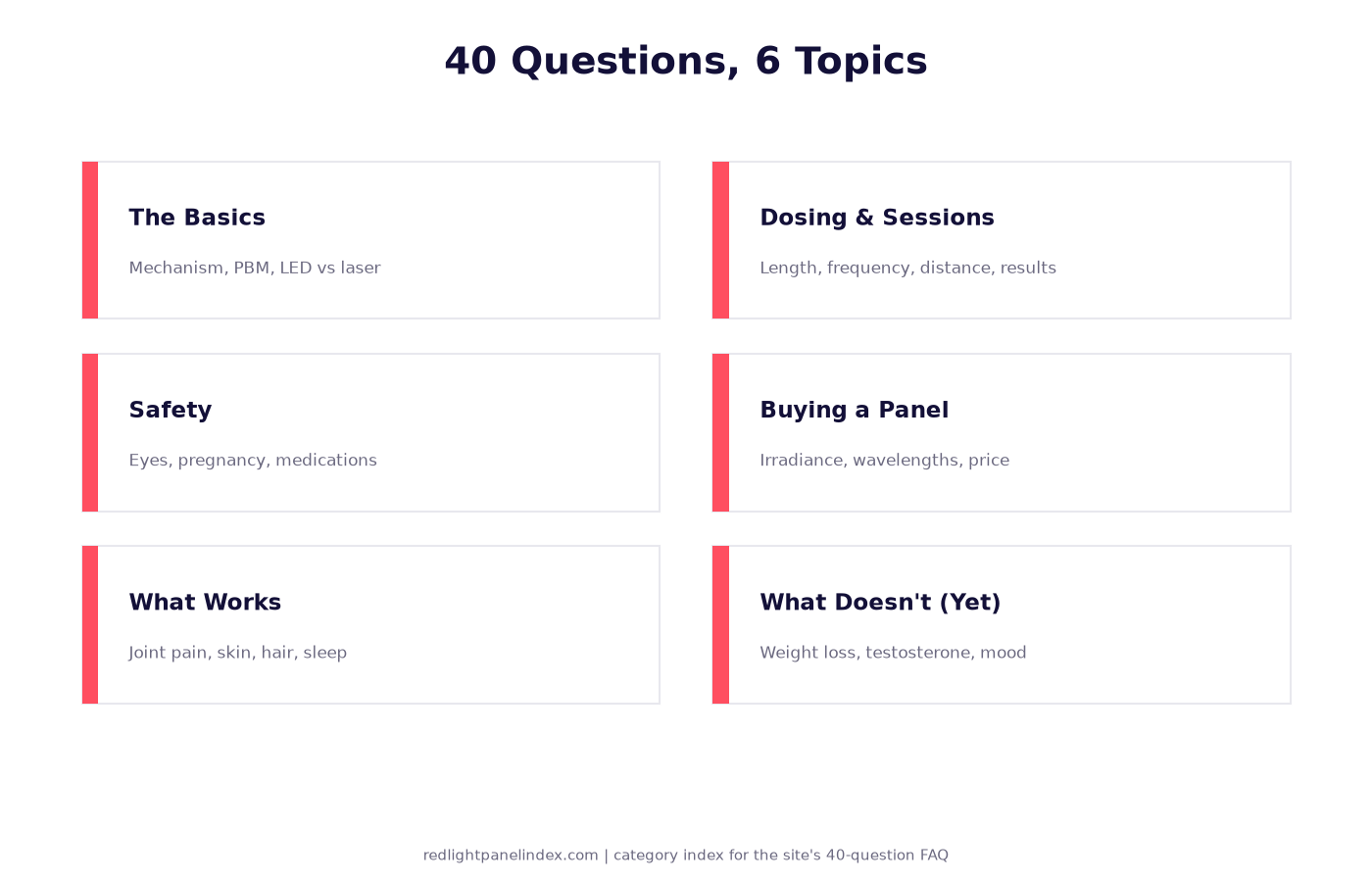
Red light therapy uses red and near-infrared LEDs to deliver a measured dose of light to skin and tissue, and most of what people ask about it comes down to six topics: how it works, how much and how often to use it, whether it is safe, what to check before buying a panel, and what the evidence actually supports for a given goal. The 40 questions below answer each one in a few sentences and link to the fuller page on this site for anyone who wants the trial-level detail.
Choosing a panel? Our ranking of the best red light therapy panels is computed from published, method-labeled specs across 188 devices. For most of the questions below, the spec that matters is irradiance stated with its instrument and distance, since that single figure decides your real dose.
The basics
What is red light therapy?
Red light therapy is exposure to red (roughly 600 to 700nm) or near-infrared (roughly 700 to 1,100nm) light from an LED panel or laser, aimed at skin or a specific body area for a set session length. It is also called photobiomodulation or, in its earlier clinical form, low-level laser therapy. Our glossary defines every term used across this FAQ in one line each.
How does red light therapy work?
The leading mechanism is absorption of red and near-infrared light by cytochrome c oxidase, an enzyme in the mitochondria, which changes mitochondrial activity and downstream cell signaling. Our photobiomodulation page covers the proposed mechanism in more depth, including where the evidence for it is strong and where it remains a working model.
What is photobiomodulation?
Photobiomodulation is the formal name for the biological effect red light therapy is built on: using red or near-infrared light to trigger a cellular response rather than to heat or cut tissue. It is a non-thermal, non-ionizing effect, distinct from a laser used for surgery or hair removal.
What is the difference between red light and near-infrared light?
Red light, roughly 600 to 700nm, is visible and absorbed more toward the surface; near-infrared light, roughly 700 to 1,100nm, is invisible and reaches deeper into tissue. Most panels combine both bands, commonly centered near 660nm and 850nm, because surface and deeper targets respond to different depths of penetration. This site's red vs near-infrared page covers which band matters more for which goal.
What is the difference between an LED panel and low-level laser therapy (LLLT)?
Both use the same red and near-infrared bands and the same underlying mechanism; the difference is the light source and how it is delivered. A laser (LLLT) concentrates light into a narrow, coherent beam applied point by point, the way several of the clinical trials on this site's evidence pages were run, while an LED panel spreads many individual diodes across a broad area for whole-region coverage at home. Our LED vs laser page covers what changes, and does not change, between the two delivery methods.
Does red light therapy hurt?
No. Sessions are non-thermal and non-ionizing at the intensities a home panel delivers; most users report gentle warmth from the panel itself rather than any sensation from the light. There is no cutting, no numbing needed, and no recovery time.
Dosing, sessions and frequency
How long should a session be?
Session length should be set by working backward from a target dose in J/cm2 and your panel's measured irradiance at your actual distance, using the dose calculator, rather than picking a round number like 10 or 20 minutes out of habit. This site's session length guide walks through the formula with two full worked examples.
How often should I use red light therapy?
It depends on the goal, because the trials behind the evidence used different schedules: twice a week for skin, every other day for hair, every other day to three times a week for joint and muscle pain, and nightly for the one small sleep study on record. The frequency guide lists exactly what each trial used, by application.
How far should I sit from the panel?
Most panels are designed for 6 to 24 inches: closer gives a stronger, more concentrated dose over a smaller area in less time, and farther trades intensity for wider coverage at a longer session. The distance guide covers how fast irradiance actually falls off across that range using real measured panel figures.
How long until I see results?
Longer than most marketing suggests. Across the skin, hair, joint and sleep trials this site reviews, the earliest reported significant result showed up at two to sixteen weeks of consistent use, and most trials only measured once, at the end of a full course, rather than checking in early. The results timeline breaks this down trial by trial, including the one exception, a single-session pre-exercise effect with no waiting period at all.
Can I use it every day?
Yes, and the short daily courses used in a couple of trials show it is tolerated, but no trial in this site's register used daily sessions for months at a time, and the one trial that compared frequencies directly found no advantage to the more frequent schedule. If you go daily, keep individual sessions short and your total weekly dose inside the range the dose calculator suggests for your goal.
Can I use red light therapy too much, or overdose on it?
The dose-response relationship in this research is biphasic (PMID 20011653, PMID 22461763): benefit rises with dose up to a point, then flattens or reverses, rather than continuing to climb the more light you add. This site's biphasic dose response explainer covers the mechanism, and the practical takeaway is to match a studied dose rather than extend a session on the assumption that more is automatically better.
What is a joule per square centimeter (J/cm2)?
J/cm2 is the unit trials use to report dose: it is irradiance (how strong the light is) multiplied by session time, and it is the number that actually determines whether a session matches what a published trial tested. The J/cm2 explainer and the dose calculator both work from the same formula.
Safety
Is red light therapy safe?
The evidence grade for safety on this site is Limited: no serious adverse events have turned up in the trials reviewed, and a systematic review found no tumor-safety signal in cancer patients using it as supportive care (PMID 31109692), but that reassurance comes mostly from trials designed to test whether the therapy works, not trials designed to test safety in specific groups. The safety and side effects page covers what is and is not known in full.
Do I need eye protection?
No regulator requires it, but 30 of the 41 brands this site tracks include eye protection in the box, and the practical rule is simple regardless: do not look directly into a running panel. Goggles matter most for facial sessions, for any panel with a blue or violet channel, and for anyone with a retinal condition or a light-sensitizing medication. The eye protection guide covers what the photobiological safety standard actually evaluates and where the one documented consumer-device eye injury on record came from (blue light, not red).
Can I use red light therapy on my face?
Yes, and facial use is one of the more heavily studied applications for skin outcomes, but wear the eyewear supplied with the panel for any close-range facial session, since that is exactly the scenario where eye protection matters most. Check the evidence page for skin and anti-aging for what the trials measured and over what timeline.
Is red light therapy safe during pregnancy?
No trial in this site's evidence register enrolled pregnant participants or tested panel use during pregnancy, so there is no dedicated data either way; an absence of documented risk is not the same as evidence of safety in that population. The safety and side effects page treats this as an open question rather than a resolved one.
Does red light therapy affect fertility, or is it unsafe near the testes?
The light itself has not been tested for this specifically, but a panel held close to the groin for an extended session is also a heat source, and elevated scrotal temperature has an established, independent link to impaired sperm production. The safety and side effects page covers this heat-based caution and why it is treated separately from the light mechanism itself.
Can I use red light therapy if I take medication?
A short list of drug classes, including tetracycline and fluoroquinolone antibiotics, thiazide diuretics, amiodarone, some NSAIDs, phenothiazines, retinoids and St John's Wort, are flagged as photosensitizing in the pharmacology literature, mostly for ultraviolet exposure rather than red or near-infrared light. If you take one of these, ask your prescriber before starting regular sessions; the photosensitizing medications guide covers each class and why the underlying evidence is almost entirely about UV, not the band a panel emits.
Does red light therapy cause sunburn or skin damage?
Red and near-infrared panels do not emit ultraviolet light, the band responsible for sunburn, so a panel session is not comparable to sun exposure in that respect. If you are on a photosensitizing medication or have very light-sensitive skin, check the treated area after your first few sessions for redness beyond the panel's usual mild warmth, covered in the photosensitizing medications guide.
Are there any side effects?
The trials reviewed on this site report no serious adverse events at the doses and frequencies they tested. The exception worth flagging is the eyes: near-infrared light is invisible and bright, so unprotected close-range viewing is the one place caution consistently applies, covered in the eye protection guide.
Is red light therapy FDA approved?
Most home panels are described as "FDA-registered," not FDA-cleared or approved, and those are different things: registration is an administrative filing, while clearance requires the FDA to review a specific application and evidence for a specific claim. Registration alone does not mean any regulator has reviewed a panel's safety or effectiveness for a condition; check this site's evidence pages for what a published trial actually studied rather than relying on a device's regulatory label.
Buying a panel
What should I look for when buying a red light panel?
Seven things, in order: your goal and its evidence grade, wavelengths that match that goal, an irradiance figure that names its instrument and distance, coverage that matches how you plan to use it, a realistic distance and mounting plan, buyer terms, and price last. The 7-step buying checklist walks through each check with real database examples.
Why do brands' irradiance numbers disagree so much?
Because many brands measure with a solar power meter, which reads roughly twice as high as a laboratory spectrometer on the same LED panel, averaging 2.11 times across a 44-panel dataset this site tracks. What a solar power meter actually measures explains why: the meter's sensor is calibrated against broad sunlight, not the narrow wavelength bands an LED panel emits, so the same fixed conversion factor does not hold.
Does a higher price mean a better panel?
Not reliably. This site's database shows panels with similar measured 6-inch irradiance figures priced from under $200 to nearly $3,000, and price tracks panel size and features like wavelength count or mounting hardware at least as much as it tracks measured strength. The buying checklist treats price as the last check, after the specs that actually predict performance.
What is the difference between irradiance and total power?
Irradiance is the light strength at one point, in mW/cm2; total power is the sum of that output across the panel's whole emitting surface. A small panel can post a higher irradiance reading than a large one while still delivering far less total light overall, because irradiance alone says nothing about area. Irradiance vs total power covers the gap with real database panels.
Do I need a full-body panel, or is a smaller one fine?
It depends on what you are treating. For a single joint or a patch of skin, a smaller panel with a strong, method-labeled irradiance reading is a reasonable and often much cheaper choice; for treating the torso or both legs in one session, total coverage starts to matter as much as the irradiance at any single point. Irradiance vs total power and this site's full-body rankings cover that distinction in more depth.
What wavelengths should I look for?
Red bands around 630 to 660nm work best for surface-level goals like skin; near-infrared bands around 810 to 850nm reach deeper tissue for joint and muscle goals; 1064nm reaches deeper still and appears on a minority of panels. This site's wavelength page also warns that a panel can list several wavelengths while concentrating most of its real output in just one or two of them, so check published density by band, not just the list of numbers on the box.
Does EMF from a panel matter?
Some brands publish a magnetic field figure from the panel's driver and fan, and where they do, it tends to sit well below general-public safety reference levels; many brands publish nothing at all. This site's EMF explainer covers which brands disclose a figure and how to read it against the reference standard.
Is a pulsed panel better than a continuous one?
Neither mode has a clear evidence-based advantage over the other for most home goals, and a pulsed panel's peak output during each brief burst is not the number to use for dosing; the average across the full pulse cycle is usually well below that peak. This site's pulsed vs continuous page covers the distinction and why it matters for the dose calculator specifically.
What the evidence actually supports
Does red light therapy work for joint pain and arthritis?
This is one of the better-supported uses: the evidence grade is Strong, with randomized controlled trials in knee osteoarthritis reporting reduced pain and improved function, particularly when photobiomodulation is paired with exercise. The joint pain evidence page covers the trials behind that grade.
Does it help with skin and wrinkles?
Yes, with an evidence grade of Strong: multiple randomized trials report improved collagen density, reduced wrinkle depth and better skin roughness scores after courses of twice-weekly sessions lasting four to fifteen weeks. The skin and anti-aging page covers each trial and its measured outcomes.
Does it help hair growth?
Yes, graded Strong: two randomized trials, one in men and one in women, using a 655nm helmet device every other day for 16 weeks, reported hair count increases of 35 to 39 percent against a matched sham device. The hair growth evidence page covers both trials in detail, including that they used scalp devices rather than panels.
Does it help acne?
The evidence grade is Limited: two randomized trials found that combining blue and red LED light reduced inflammatory acne lesions more than blue light, benzoyl peroxide or white light alone, but neither trial isolated red light on its own, and most panels sold for home use skip the blue wavelength those trials found necessary. The acne evidence page covers both trials.
Does it help muscle recovery and soreness?
The evidence grade is Moderate: trials pairing near-infrared light with exercise report reduced soreness and better strength recovery, with the clearest signal when light is applied before exercise rather than after. The muscle recovery evidence page covers the pooled trial data behind that grade.
Does it help with sleep?
The evidence grade is Limited: the only controlled sleep trial on this site's register, in 20 elite female athletes, found improved sleep quality and higher serum melatonin after 14 nights of nightly whole-body exposure against an untreated comparison group. That is one small cohort, not a broad evidence base. The sleep evidence page covers the trial's population and its limits.
Does it help wound healing?
Yes, graded Strong: this is one of photobiomodulation's oldest and best-replicated applications in the published literature. The wound healing evidence page covers the trial history behind that grade.
Does red light therapy help with weight loss?
The evidence grade is Insufficient: the published positive results are small, temporary reductions in the circumference of a treated area under clinic laser protocols, not durable fat loss and not results measured on a home panel. The weight loss evidence page covers what was and was not measured.
Does it boost testosterone?
The evidence grade is Insufficient. There is not yet a body of controlled human trials linking red or near-infrared light exposure to a measured testosterone change at doses a home panel can deliver. The testosterone evidence page covers what limited data exists.
Does it improve mood or brain function?
The evidence grade is Insufficient, and this is described on this site as the most speculative frontier of the research: the supporting data is a single small pilot study from 2009 in 10 patients, an early signal rather than established evidence. No home panel protocol is validated for a cognitive or mood claim. The brain and mood evidence page covers that study and its limits.
One more thing before you buy
None of the answers above substitute for reading the specific evidence page for your goal and the specific database page for a panel you are considering; this FAQ is a fast index into both, not a replacement for either. If a question here raised a term you do not recognize, the glossary defines all 40 terms used across this site's buying and evidence pages in one line each.