No law and no regulator requires you to wear eye protection with a home red light therapy panel, and most brands that include goggles describe them as a comfort item. The more useful answer is that you should not look into a running panel, and a pair of goggles is the cheapest way to make that a certainty rather than a resolution you keep breaking.
Choosing a panel? Our ranking of the best red light therapy panels is computed from published, method-labeled specs across 188 devices. For eye protection, the spec that matters is whether the panel emits anything below 500 nm.
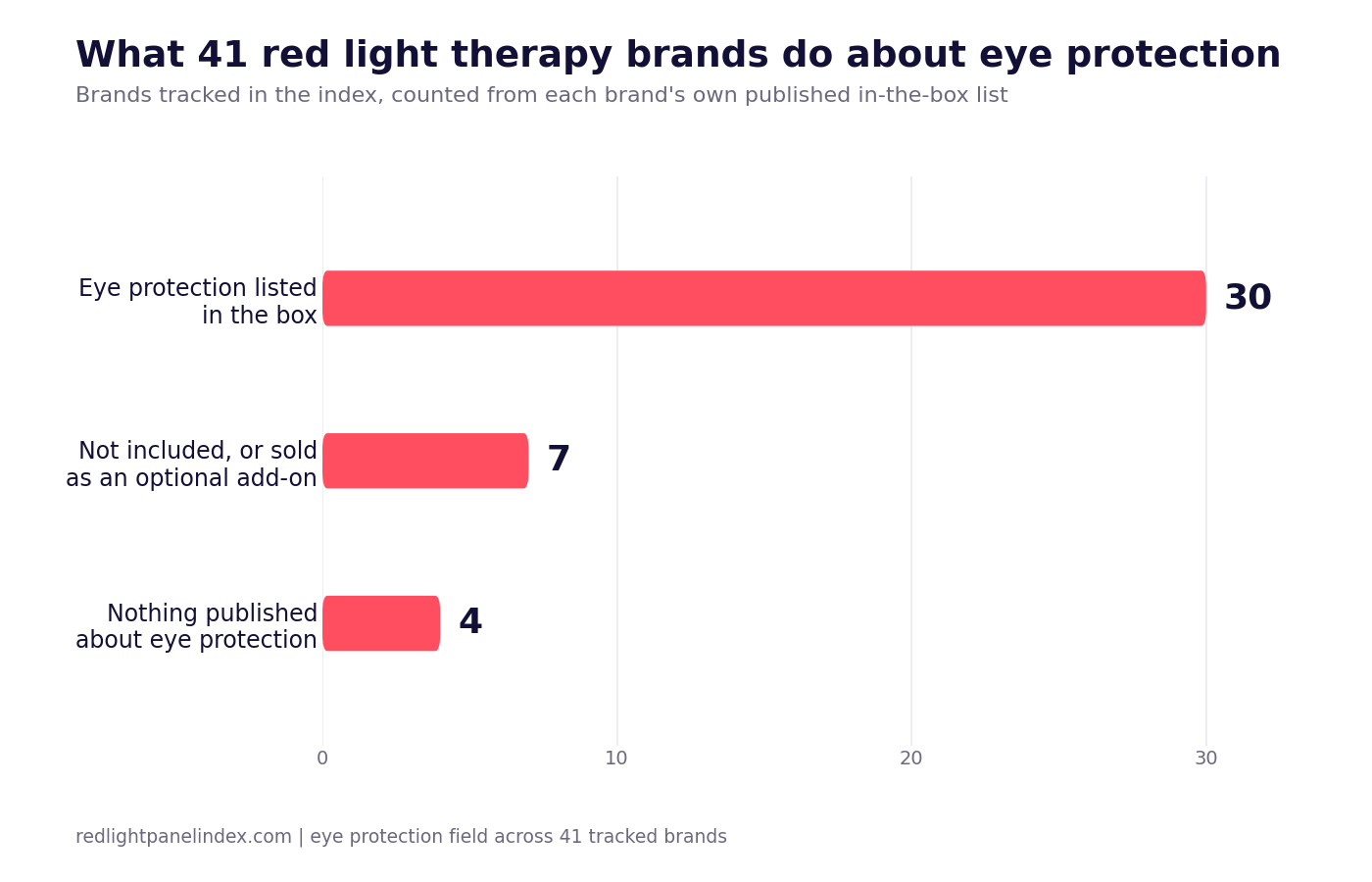
Thirty of the 41 brands tracked in this index list eye protection in the box. That is not a regulatory requirement, and it is not evidence of harm either. It is what the industry does when it has to decide what a first-time user will do with a very bright light pointed at their face.
The short version
- Closed eyes plus a turned head is adequate for most red and near-infrared panels at a normal treatment distance.
- Goggles matter most when the panel emits blue or violet light, when you are treating the face at close range, or when you take a medication or have an eye condition that changes how your retina handles light.
- Nothing about eye protection changes the dose you are aiming for. It changes only what your retina receives while you get it.
- No brand in this index publishes a photobiological risk group for its panels, so "safe for the eyes" is currently a marketing sentence rather than a measured one.
What 41 brands actually ship
The index records an eye protection field for every tracked brand, taken from the brand's own in-the-box list rather than from its marketing copy.
| What the brand publishes | Brands |
|---|---|
| Eye protection listed in the box | 30 |
| Not included, or sold as an optional add-on | 7 |
| Nothing published about eye protection | 4 |
The detail inside those groups is more interesting than the totals. Hooga, Joovv, Rouge, BON CHARGE and Kala list eyewear on their current panel pages. PlatinumLED supplies a set and describes wearing it as optional. Mito Red Light and Bestqool include goggles on some series and say nothing on others, which means the answer can change between two models from the same brand.
The brands that do not include goggles are the ones worth reading closely, because they explain themselves. GembaRed states that its products emit no ultraviolet and are not harmful to the eyes. Mitolight recommends protective glasses but notes that most customers simply close their eyes. Vital Red Light does not list goggles but says in its FAQ that eye protection should be used when the near-infrared mode is active. Infraredi advises goggles for people with sensitive eyes. None of those positions is unreasonable. They are all, however, the brand's own judgment rather than a test result.
The standard that would settle it, and why nobody cites it
Lamps and LED products are classified for eye and skin safety under IEC 62471, a photobiological safety standard. It evaluates several separate hazards, each with its own wavelength band: actinic ultraviolet from 200 to 400 nm, the blue light hazard from 400 to 500 nm, retinal thermal hazard across 380 to 1,400 nm, and an infrared hazard to the cornea and lens from 780 to 3,000 nm. A product is then placed in a risk group by how long you could look at it before the limit for a given hazard is exceeded. Risk Group 0 poses no hazard under any reasonable viewing, Risk Group 1 is safe under normal behavior, Risk Group 2 is safe because you blink and look away, and Risk Group 3 is hazardous even briefly.
Two things follow. First, the risk group of a panel depends on its measured output and the distance you sit from it, not on the brand. Second, no panel brand in this index publishes a risk group classification for its devices, which is the single most useful number that could exist for this question. Until one does, the honest position is that the hazard has not been measured for the products people actually buy. This site's glossary has a short definition of eye protection and the other buying and safety terms if any of the language above is new to you.
Blue is the band that has actually injured someone
The clearest published harm from a consumer LED skin device comes from the blue end of the spectrum, not the red. A case report in Medicine described a 37 year old woman who developed retinal injury after using a blue LED face mask, with chorioretinal lesions and destruction of the retinal pigment epithelium in the parafoveal area and leakage on fluorescein angiography. She was treated with intravitreal bevacizumab and her vision improved within four weeks (PMID 32541484).
That is a single case, it involved a mask held against the face, and it involved blue light specifically. Most red light panels emit nothing below 600 nm, which puts them outside the blue light hazard band entirely. But a growing number of panels now add a blue or violet channel for skin applications, and those are the panels where goggles stop being optional. Check the wavelength list for your own device before deciding this section does not apply to you.
Red and near-infrared do reach the retina, which is exactly the point
The argument for caution with red and near-infrared is not that it is dangerous. It is that it demonstrably gets to the back of the eye and does something there.
Shinhmar and colleagues exposed participants aged 28 to 72 to 670 nm light and measured color contrast sensitivity and rod thresholds. In people around 40 and older, blue axis color contrast sensitivity improved significantly and rod thresholds improved significantly. There was no effect in younger participants, and the red axis improved without reaching significance (PMID 32596723). The abstract does not report the energy density or the exposure schedule, so no dose figure should be taken from it.
Read that the right way round. Researchers aim 670 nm at the retina on purpose because the retina absorbs it and its mitochondria respond, which is the same photobiomodulation mechanism the rest of this site is about. A controlled, brief, low-output exposure in a study is not the same event as ten minutes of an unmeasured panel at close range. Evidence that light reaches a tissue and changes it is a reason to control the exposure, not a reason to stare. This site's eye health evidence page grades that Shinhmar study alongside three more trials on aging vision and dry macular degeneration, all using the same kind of controlled clinical device rather than a home panel.
How bright a panel is at eye level
The panels at the top of this index measure roughly 100 mW per square centimeter average at 6 inches on a laboratory spectrometer, and solar power meters read roughly twice as high as spectrometers on the same LEDs, which is why brand-published numbers and independent numbers so often disagree. The RLT Home Total Spectrum MAX sits in that top band, with third party spectrometer readings across the lineup of 98.7 to 121.62 mW per square centimeter at 6 inches.
Two consequences for your eyes. Irradiance falls steeply with distance, so the difference between 6 inches and 24 inches is large and you can see it in the dose calculator. And a figure without its instrument and distance tells you nothing, which is the whole subject of claimed versus measured output.
Practical rules
- Do not look directly at the LEDs while the panel is running, at any distance. This is the rule that does the work.
- Wear the goggles the brand supplied for any face session, and for any panel with a blue or violet channel.
- For body treatments with the panel to one side, closed eyes and a turned head are adequate.
- If you use blackout goggles, remember that they also block the light from your face, so a face session and an eye-shielded session are not the same session. Some brands supply red and near-infrared blocking glasses for this reason, which leave the skin exposed while protecting the retina.
- Keep session length and frequency where the evidence puts them. More time in front of the panel is more retinal exposure for no extra benefit.
- Stop and see an optometrist if you get afterimages that last, a blurred patch, or a change in color perception following a session.
Where RLT Home sits
RLT Home panels carry a 480 nm channel alongside the red and near-infrared wavelengths, and 480 nm falls inside the blue light hazard band described above. The brand supplies two types of eye protection, red and near-infrared blocking reading glasses and full blackout goggles, which is the appropriate response to including that wavelength. Anyone buying a panel with a blue or violet channel should treat the eyewear as part of the device rather than an accessory.
Who should be more careful
Take the conservative option if you have a retinal condition, have had recent eye surgery, or take a medication that increases light sensitivity. Several common drug classes are photosensitizing, and this site's guide to photosensitizing medications covers which classes are flagged and why that evidence is almost entirely about ultraviolet light rather than the red and near-infrared band a panel uses; the safety and side effects page covers that caution, and the testicular heat and pregnancy cautions, in more depth; none of the three has dedicated panel-specific trial data either way. The same applies to children, whose lenses transmit more short wavelength light to the retina than an adult lens does.
What is not known
No trial has compared goggles against no goggles for home red light panels, so there is no outcome data to weigh. What exists is a mechanism that clearly reaches the retina, one published injury from a blue-light consumer device, a safety standard nobody in the category has applied publicly, and an industry that ships goggles anyway. That combination supports a simple habit rather than alarm. Wear the eyewear, point the panel at the tissue you are treating, and browse the full panel database for the wavelength list of any device before you assume this question does not apply to it.