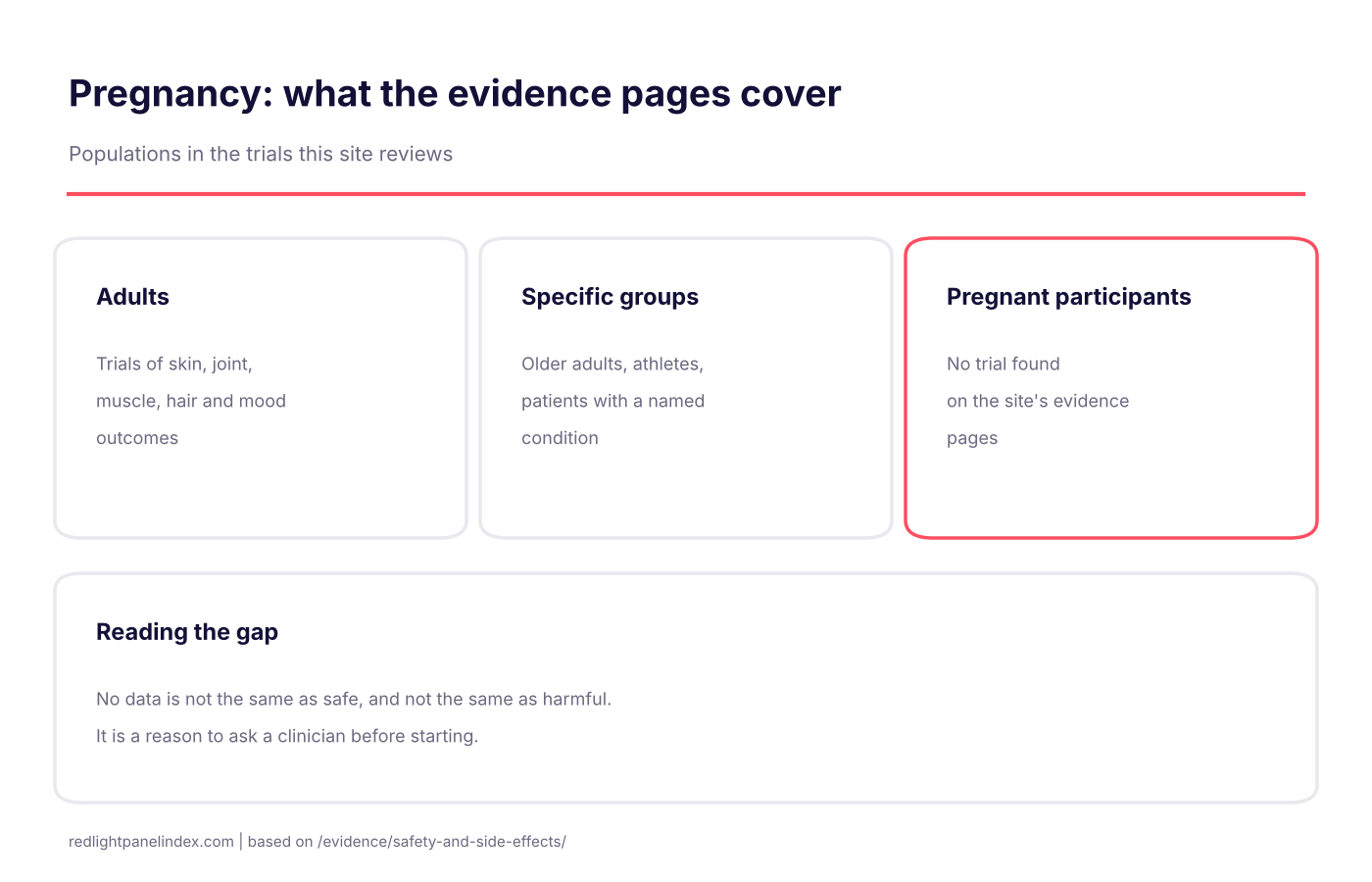
Nobody knows whether red light therapy is safe during pregnancy, because this site's evidence pages found no trial that enrolled pregnant participants. That is a gap in the evidence, not a finding of harm and not a finding of safety, and the practical answer is to ask your obstetric clinician before using a panel.
Choosing a panel? Our ranking of the best red light therapy panels is computed from published, method-labeled specs across 188 devices. If you and your clinician decide to wait, the spec worth comparing later is the method-labeled irradiance, not the headline wattage.
What "no data" actually means
The site's safety evidence page grades red light therapy safety as Limited overall, and it says the caution areas have little or no dedicated data either way. Pregnancy is one of those areas. Its wording is direct: if you are pregnant, the honest answer is that this register has no data either way. It adds that the absence of a documented risk is not the same as evidence of safety in that population.
Both halves of that sentence matter. A reader hunting for reassurance should not take "no documented harm" as "studied and fine." A reader hunting for alarm should not take "not studied" as "known to be dangerous." The evidence supports neither conclusion. What it supports is caution, and caution here is a decision rule: when the answer is unknown and the benefit is optional, many people wait or ask first.
Researchers rarely enroll pregnant participants in studies of optional treatments, and no such trial turned up in the pages this site reviewed. Reviews of the research, such as the photobiomodulation explainer, describe the mechanism and the studied uses, but none of the studies the site reviews tested the question you are asking.
Why the lack of data is not a green light
Red and near-infrared light is often described as gentle, and across the adult trials the site reviews, the safety signal is mostly quiet. That reputation is the reason this question comes up so often. But "gentle in the adults studied" does not transfer automatically to a different physiological state. Pregnancy changes blood flow, temperature regulation, hormone levels and skin sensitivity. A technology that was tested in adults with knee pain or skin aging was not tested in any of those conditions.
There is also an asymmetry in what is at stake. Most reasons people use a panel (skin tone, soreness, recovery, general wellness) are optional and can wait. If the downside of waiting is small and the downside of a mistake is unknown, waiting is a defensible choice. That is a judgment, not a medical rule, and your clinician may weigh it differently for your situation.
The abdomen question
The most common version of this question is about the abdomen: is it fine to point a panel at the belly, or at the lower back? The site has no data on this either. Near-infrared light travels into tissue, and the penetration depth page explains how wavelength affects how far light reaches, but how far light reaches is a different question from whether it matters to a pregnancy. No source the site reviewed measured that.
A practical reading: if you do not want to resolve the abdomen question, you can avoid the topic by not treating that area. But that is a layout choice, not a safety finding. A panel that lights the whole front of the body is a reason to ask your clinician first, not a reason to guess at a safe distance.
Heat is a separate, simpler issue
Panels produce some warmth, and heat exposure is its own topic in pregnancy guidance that your clinician can speak to directly. The site's safety page treats heat the same way in another context: it advises keeping sessions short and the device at a distance for men using a panel near the groin, because that advice rests on general heat-and-fertility physiology rather than a panel trial (PMID 7591190). The reasoning travels: when a body area or state is heat-sensitive, treat a panel like any other source of heat.
This site has not measured how much warmth any particular panel adds to the body at a given distance, so it cannot give you a number. If heat during pregnancy is a concern your clinician has raised, bring the panel's model to the appointment so they can judge it.
Other cautions that still apply
Several of the usual cautions are independent of pregnancy and apply to everyone, and they are worth confirming first if you are expecting:
- Medications. Some medications make skin more sensitive to light. If you take prescription or over-the-counter products, see the photosensitizing medications guide and ask your prescriber or pharmacist.
- Eyes. Bright panels are best used with eye protection or closed eyes. See the eye protection guide, and the eye health evidence page for what the research on eyes does and does not show.
- Dose. More is not better. The site's biphasic dose response page explains why very high doses can reduce effect, and the session length guide gives a way to stay within what trials used.
What to ask your clinician
You can make the conversation shorter and more useful by bringing specifics. Questions worth raising:
- Is there any reason, given my history, to avoid light therapy at all during pregnancy?
- If I wanted to use a panel on my face, hands or legs, is that treated differently from the abdomen or lower back?
- Do any of my current medications or skincare products make skin more light-sensitive?
- Would you rather I wait until after delivery or after breastfeeding, and why?
- Is there anything about warmth or session length that you want me to avoid?
Bring the device name and the settings (distance, session time, which wavelengths are on). If you are unsure how to describe them, the dose calculator converts distance and time into a figure you can share, and the how often guide shows the frequencies trials used for adults.
If you are planning ahead
Many people reading this are not pregnant yet. A reasonable plan is to treat the question as a pause point: if you are trying to conceive or you are pregnant, check with your clinician before the next session, not after. If your clinician says to wait, nothing about a panel is time-limited. The specs that make a panel a good buy, such as method-labeled irradiance and honest wavelength mix, will still be the same later, and the ranking methodology can help you compare devices when you are ready.
What was not studied
To keep the picture clear, here is what the evidence pages do not contain:
- No trial of red or near-infrared light with pregnant participants.
- No measurement of light or heat reaching the abdomen from a home panel.
- No study of a home panel (as opposed to a clinical device) in pregnancy at any dose.
- No follow-up data on breastfeeding and panel use.
When a topic has no studies at all, the honest grade is Insufficient. The site's evidence grading explainer shows how that grade is defined and what would be needed to change it. For the broader safety picture across all the studied uses, start with the safety and side effects page.
The short answer
Safety in pregnancy is unknown, not established. If you are pregnant or may be, ask your clinician before using a red light panel, bring the device details, and treat the answer as theirs to give. Nothing on this page is medical advice, and a panel's marketing page, including any "safe for everyone" language, is not evidence on this question.