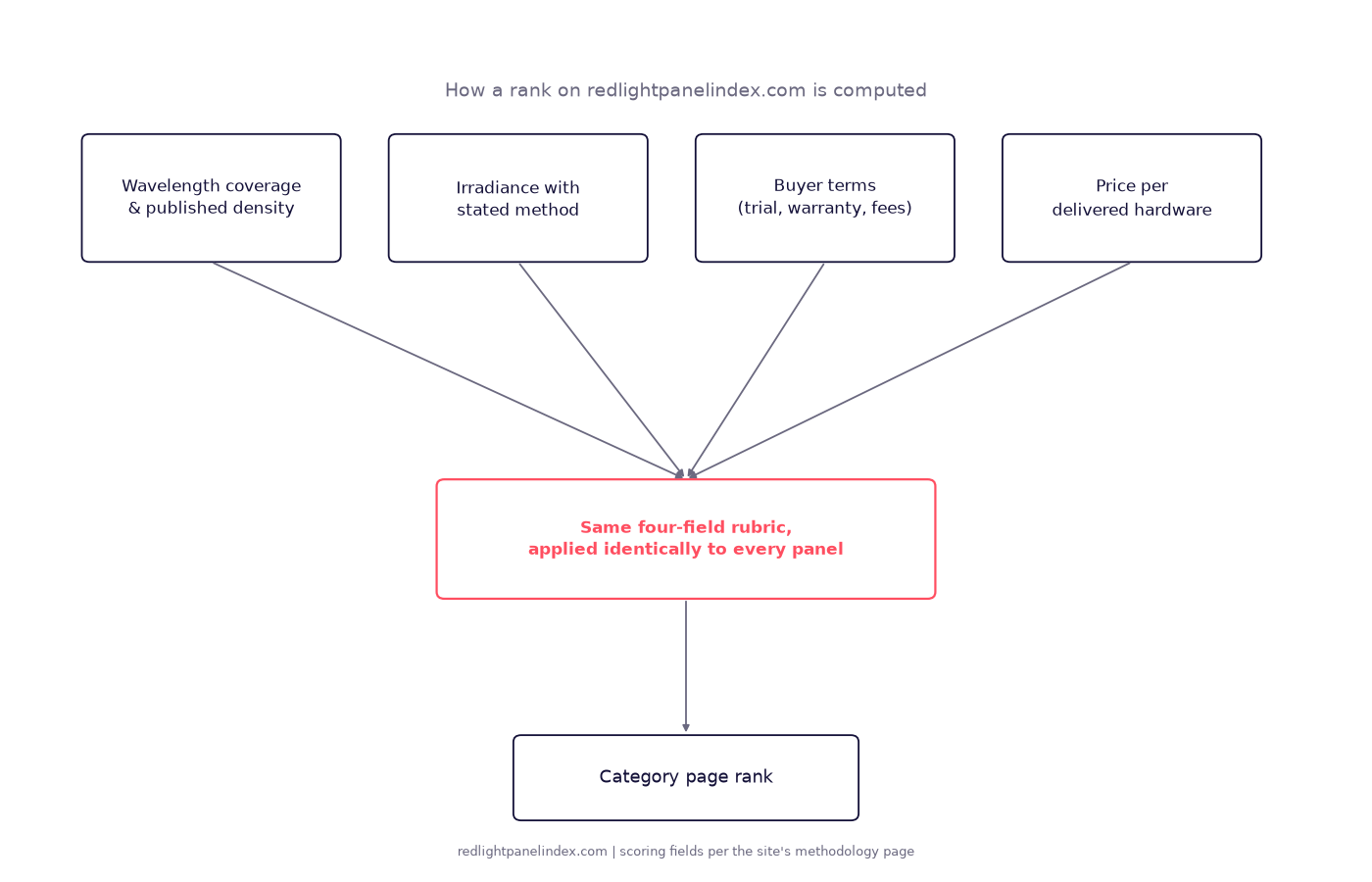
A rank on this site comes from four fields read straight off each device's database entry, wavelength coverage and published density, irradiance with its measurement method stated, buyer terms, and price per delivered hardware, applied the same way to every one of the 188 panels in the database. No brand gets a bonus for size, price tier, or how it is measured; a lower, honestly labeled number outranks a higher, unlabeled one on the irradiance field specifically, because the field is measuring transparency as much as output.
Choosing a panel? Our ranking of the best red light therapy panels is computed from published, method-labeled specs across 188 devices. The spec that decides more places in the list than any other is whether an irradiance figure names its instrument and distance.
The four fields, in the order they matter
Wavelength coverage and published density. A panel is scored on which wavelengths it actually publishes an LED count or power allocation for, not on a marketing claim that it "covers red and near-infrared." A brand that lists 480nm, 630nm, 660nm, 810nm, 830nm, 850nm and 1064nm with an LED count at each wavelength is scored on seven documented bands; a brand that says "full spectrum" without naming which wavelengths or how many diodes sit at each one is scored on what it actually discloses, not the phrase.
Irradiance with a stated method. This is the field the methodology page treats as the load-bearing one, because instrument choice changes the number by roughly double: a solar power meter reads about twice what a laboratory spectrometer records from an identical panel. A figure that names its instrument and the distance it was taken at, "100.53 mW/cm² at 6 inches, measured by Electropossible Ltd with a spectrometer," for example, is usable in the ranking math. A figure with no stated method is discounted, not because the number is necessarily wrong, but because there is no way to compare it honestly against a competitor's number taken with a different instrument.
Wavelength coverage also separates otherwise similar panels near the top of the same list: the MitoPRO 1500X publishes six documented bands (590nm, 630nm, 660nm, 810nm, 830nm and 850nm) at $1,299, while the Total Spectrum MAX publishes those same visible-and-near-infrared bands plus a seventh, 1064nm, at $1,795. Neither fact alone decides a rank, since price per delivered hardware and the other two fields still apply, but a panel that documents a wavelength and its LED allocation is scored on that band and one that does not is not, whatever its marketing copy claims about "full spectrum" coverage.
Buyer terms. Trial length, restocking fees, warranty length, and what ships in the box (stand, eye protection, timer) are pulled from each brand's own page and scored as published, not estimated. A 60-day trial with no restocking fee scores differently from a 30-day trial with a 20 percent restocking fee on a return, and both differ from a panel with no stated return policy at all.
Price per delivered hardware. Price alone is not a field; price relative to LED count, panel area, and the accessories included is. A $199 panel and a $1,795 panel are not compared on sticker price, they are compared on what a dollar buys in diodes, coverage and included accessories, alongside the other three fields.
Why a method-labeled number can outrank a bigger one
The clearest way to see the rubric work is to watch what it does with two real entries from the top of the overall panel ranking. The RLT Home Total Spectrum MAX publishes one irradiance figure, 100.53 mW/cm² at 6 inches, and names the party who measured it, Electropossible Ltd, and the instrument, a spectrometer. The Hooga HG300 publishes a lower number, 73 mW/cm² at 6 inches, but with no instrument named; the site's own comparison of Hooga's sister ULTRA360 model against an independent spectrometer test found the brand's stated figures run at roughly double what a spectrometer records, which is the signature of an unlabeled solar-meter reading rather than a lab measurement.
Both panels rank near the top of the same list, because irradiance is one of four fields, not the whole score, and the HG300 wins heavily on price per delivered hardware at $199 against $1,795. But on the irradiance field specifically, the labeled 100.53 mW/cm² figure counts as a verifiable number the ranking math can use at face value, while the unlabeled 73 mW/cm² figure is treated as a brand claim of unknown measurement basis, worth less in the comparison even though the digits printed on the page are lower. That is the practical meaning of "honestly low, spectrometer-verified numbers are treated as transparency rather than weakness": a brand that publishes a real spectrometer reading, even a modest one, is not penalized for not inflating it, and a brand that publishes an inflated, unlabeled one is not credited for the bigger digits.
Reading a category page the same way
Every "best" list on this site, budget panels, full-body panels, deep-tissue 1064nm panels, and the rest, applies the same four-field rubric to a filtered subset of the database rather than a separate scoring system. A budget-category list is not "the same panels but cheaper," it is the identical wavelength, irradiance-method, terms and price-per-hardware comparison run only against panels under a price ceiling, which is why a panel can rank near the top of a budget list and much lower on the overall list at the same time: the fields did not change, the competitor set did. Reading any ranked list on this site means checking the same four things the rubric checks, not the position number itself: what wavelengths are actually documented, whether the irradiance figure names an instrument and distance, what the trial and warranty terms actually say, and what the price buys once LED count and accessories are accounted for. The buying checklist walks through those same checks one field at a time for a single panel you are considering, rather than across a whole ranked list.
What the rubric does not do
The rubric has nothing to say about whether red light therapy works for a given condition; that question is answered separately, by the evidence grades assigned to each condition from the controlled trials behind it, not by a panel's rank. A panel can top every category list on this site and still be pointed at a use case with an Insufficient evidence grade, and a panel with a modest rank can be well suited to a Strong-graded use like joint pain if its wavelengths and irradiance match what the trials behind that grade actually used. The ranking answers "which panel is the best-documented and best-valued hardware," the evidence grade answers "does a controlled trial support using one for this," and neither substitutes for the other.
Where the numbers come from before they reach the rubric
None of the four fields is estimated at ranking time. Every irradiance figure, wavelength list, price and warranty term is pulled from a brand's own published page or a named independent test, verified on a monthly re-check pass, and re-scored automatically when the underlying figure changes; the database guide covers how those source figures are audited and rechecked before they ever reach the ranking math described here. A rank moving up or down between one monthly pass and the next almost always means a brand changed a published price, spec or term, not that the rubric itself changed.