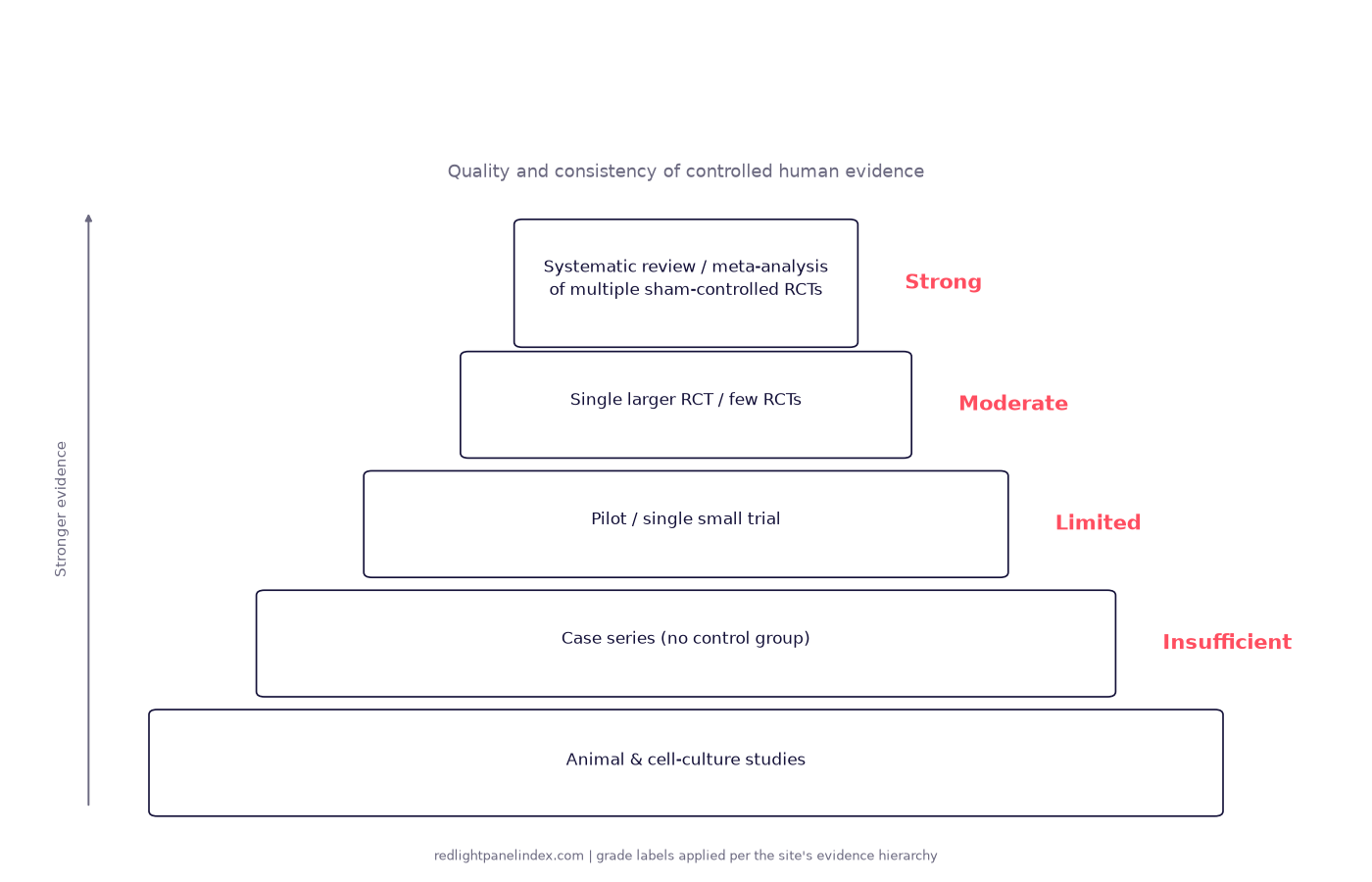
Every condition page on the evidence hub opens with one word: Strong, Moderate, Limited, or Insufficient. That word is a summary of how many controlled human trials exist for a claim, how consistently they point the same direction, and whether the doses they tested are ones a home panel can actually deliver, not a judgment about whether red light therapy "works" in general.
Choosing a panel? Our ranking of the best red light therapy panels is computed from published, method-labeled specs across 188 devices. For reading an evidence grade, the detail that matters is not the grade word itself but whether the trials behind it used a wavelength and dose your panel can reproduce.
The hierarchy behind the four words
Clinical evidence is not one flat pile of studies; it is a hierarchy, and the reason a systematic review or meta-analysis sits at the top is that it pools multiple trials rather than reporting one lab's result. Below that comes the single randomized controlled trial (RCT), then smaller pilot or feasibility trials, then case series that describe what happened to a handful of patients with no control group at all, and at the bottom, animal or cell-culture work that establishes a mechanism but says nothing about a dose in a person. A grade on this site is a statement about where a condition's best available evidence sits on that ladder, and how many independent trials occupy it.
That is also, in miniature, the same logic professional systematic reviews use to assign their own grades of recommendation. The 2018 review of LED use in dermatology (PMID 29356026) surveyed 31 randomized controlled trials published through September 2017 and assigned a letter grade to each condition based on how much and how consistent that trial evidence was: acne vulgaris, herpes simplex and zoster, and acute wound healing each earned a "grade of recommendation B," while other conditions the review covered scored lower because their trials were fewer, smaller, or inconsistent in the parameters used. The review's own stated limitations, small samples, absent blinding in some trials, missing sham arms, and inconsistent treatment parameters across studies, are the same weaknesses that push a condition down this site's scale from Strong toward Limited.
Strong: more than one controlled trial, doses a panel can match
A Strong grade means more than one controlled trial points the same way, at doses a home panel can plausibly deliver. Joint pain and arthritis is graded Strong on this basis, anchored by a 2019 systematic review and meta-analysis (PMID 31662383) that pooled 22 randomized placebo-controlled trials in 1,063 people with knee osteoarthritis. Pain fell significantly more with active low-level laser therapy than with placebo, both at the end of treatment (14.23mm on a 100mm visual analog scale, 95% CI 7.31 to 21.14) and at follow-ups one to twelve weeks later (15.92mm, 95% CI 6.47 to 25.37). When the analysis was restricted to trials using the doses the World Association for Laser Therapy recommends, the effect was larger still, peaking at 31.87mm two to four weeks after treatment ended (95% CI 18.18 to 45.56), and disability improved along with pain. No adverse events were reported across the pooled trials. The review's own conclusion names the doses that drove the effect: 4 to 8 joules per spot at 785 to 860nm, or 1 to 3 joules per spot at 904nm, figures worth running through the dose calculator before assuming a panel's default setting matches them. Hair growth, wound healing and skin and anti-aging carry the same Strong grade for the same reason: replicated controlled trials, not a single standout study. Skin is the condition the 2018 dermatology review above graded highest, alongside acne and wound healing, which is why it lines up with this site's own Strong label rather than one of the lower ones the same review gave conditions with thinner trial support.
Moderate: controlled trials that are fewer or use clinic-only devices
A Moderate grade means controlled trials exist, but there are fewer of them, they are smaller, or they used clinic devices whose wavelength, irradiance or session length differ from what a home panel offers. Muscle recovery sits here: a pooled analysis of pre-exercise phototherapy trials found real, statistically significant effects on time to exhaustion and repetitions completed, but the underlying trial base is smaller than the knee osteoarthritis literature and many of the source studies used laser devices at a single wavelength rather than the multi-wavelength LED panels this site tracks. Neuropathy is Moderate for a related reason: a recent 200-person randomized trial reported improvement across multiple outcome measures, but it is a single trial rather than a replicated finding, and the device and protocol it used are specific to that study.
Limited: pilot data or trials at parameters a panel cannot match
A Limited grade means the support is a pilot study, a single trial, or a trial run at parameters a consumer panel is not built to reach. Sleep carries this grade: a controlled trial of whole-body red light exposure before exercise reported better sleep quality and higher melatonin afterward, a real and specific result, but it is one trial in a specific athletic population rather than a replicated finding across settings. Psoriasis sits at the same grade for the mirror-image reason: the human evidence is thin enough, or built on trial designs and doses far from home-panel use, that it justifies watching the space rather than expecting a result.
Insufficient: no credible controlled evidence at consumer doses
An Insufficient grade is not a claim that an effect is impossible. It means no credible controlled human trial exists testing the claim at doses a consumer device can deliver, whatever a product listing implies. Brain and mood, weight loss, and testosterone all carry this grade on that basis: the mechanistic and animal literature for some of these claims is real, but it has not yet produced the sham-controlled human trial that would let this site move any of them up the ladder.
Why the same trial can grade a condition and not a device
A grade describes the evidence behind a claim about a condition, not a rating of any specific panel. The Stausholm knee osteoarthritis meta-analysis behind the Strong grade above pooled laser devices, not LED panels, and the 790nm WALT-dose study review on this site walks through exactly how far one of those trial devices sits from a typical home panel in wavelength, irradiance and treatment time. A sham-controlled design is what makes a trial's result trustworthy in the first place; the grade on a condition page is what tells you how much of that kind of trustworthy evidence exists, and at what doses, before you look at whether your own panel can reproduce them.
Grades move when the trial base does
None of these four labels is permanent. A condition graded Limited today can move to Moderate if a second, better-powered controlled trial replicates the pilot finding that earned it the lower grade, and a condition graded Insufficient can gain a grade the moment the first sham-controlled human trial at a plausible consumer dose is published and verified. The reverse can also happen: if a large replication trial contradicts an earlier positive result, the grade comes down, because the label describes the current weight of controlled evidence, not a permanent verdict. That is also why every PubMed ID cited on this site runs through the same verification step before it can support a claim, so a grade only ever moves on the strength of a trial someone can actually read.
Reading a grade before reading a marketing claim
A grade word is a shortcut, not a substitute for the studies behind it. Every condition page on this site lists the PubMed IDs, wavelengths, doses and session counts of the trials that earned its grade, and every study review linked from those pages reports what was actually measured, not just whether the result was statistically significant. The practical habit is the same one this site's methodology page describes for the device database: check the grade, then check what is actually behind it, before deciding a panel's marketing claim matches the science.