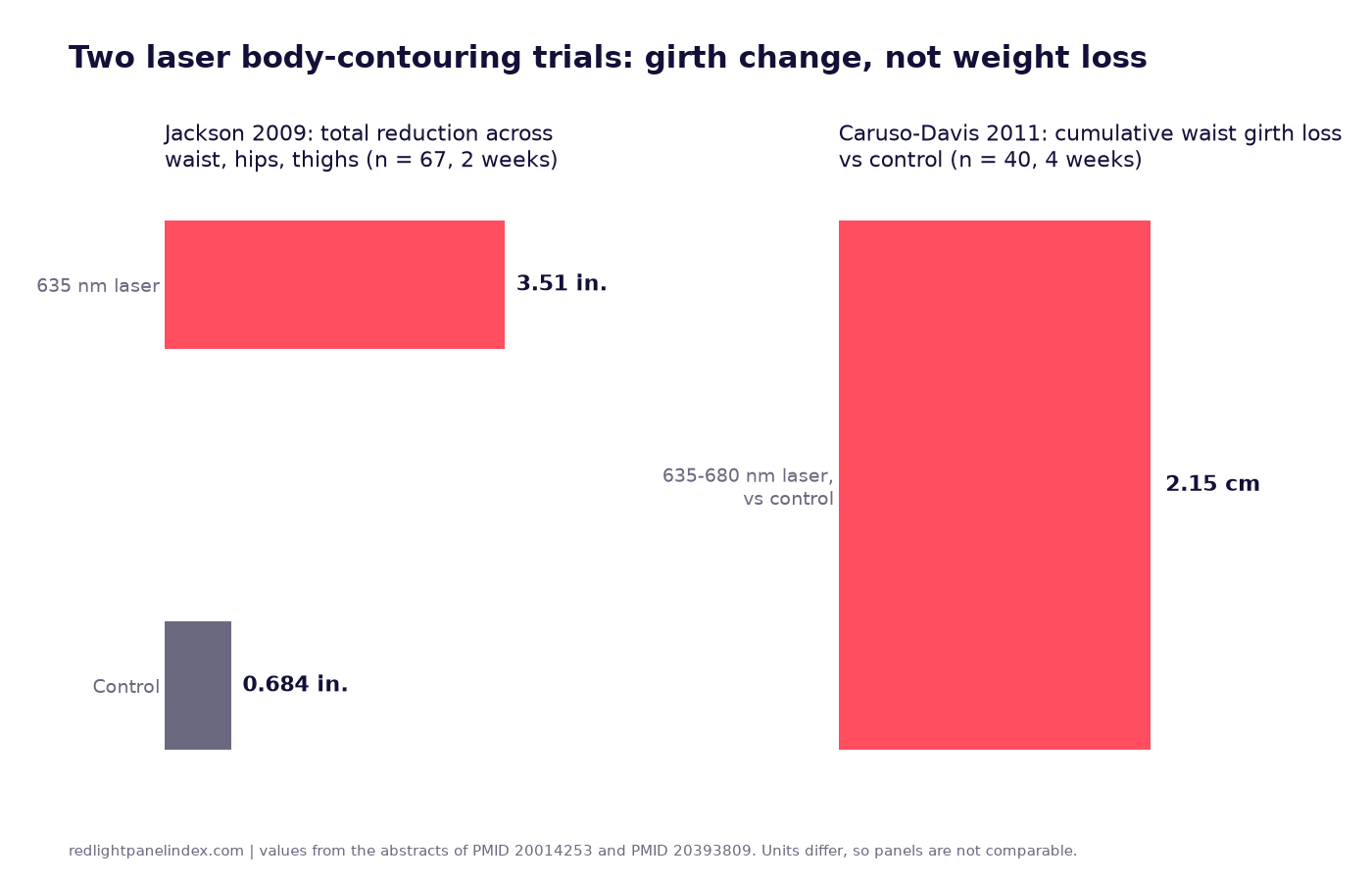
Two randomized trials sit behind most "red light for fat loss" marketing: Jackson 2009 (PMID 20014253) reported a larger drop in combined waist, hip and thigh circumference after 635nm laser sessions than in controls, and Caruso-Davis 2011 (PMID 20393809) reported a cumulative waist girth loss of 2.15 cm against control over four weeks. Both measured how big a treated area was, not how much fat or body weight a person lost, and both used clinic laser devices rather than a home panel.
Choosing a panel? Our ranking of the best red light therapy panels is computed from published, method-labeled specs across 188 devices. For body contouring, the spec that matters is whether a panel publishes irradiance with a stated method, because neither trial reports a dose a panel could be matched to.
What the studies asked
Both trials asked a narrow, cosmetic question: can low-level laser light applied to the skin over a body area reduce the circumference of that area? The Jackson team framed the work around a proposed mechanism. Their abstract describes electron microscope images showing transitory pores in fat cell membranes followed by collapse of the cells after 635nm irradiation, and the trial tested whether that translated into measurable circumference change in people (PMID 20014253).
The Caruso-Davis team asked the same outcome question and added a mechanism question. Their abstract says scientific studies of how laser light causes loss of fat from fat cells were lacking, so they paired a human trial with lab assays measuring cell lysis, glycerol and triglyceride release (PMID 20393809). Neither trial asked whether a person weighs less afterward.
Who was studied
Jackson 2009 enrolled 67 participants, randomized to laser treatment or a control group, and treated the waist, hips and thighs. The abstract summary available for this review does not give ages, sex or body mass index, so those are not described here.
Caruso-Davis 2011 randomized 40 healthy men and women aged 18 to 65 with a body mass index below 30 kg/m2 to laser or control treatment. That is a lean to overweight, non-obese group by design, and it matters for what the result can mean: these were not people with obesity, and the trial was not built to test treatment of it.
Device and parameters as stated
Both trials used laser devices at red wavelengths. Jackson used 635nm. Caruso-Davis used 635 to 680nm. The Jackson treatment ran over two weeks. Caruso-Davis treated the waistline for 30 minutes, twice a week, for four weeks (PMID 20393809).
The abstracts available for this review do not report irradiance in mW/cm2, energy per point, spot size or distance from the skin. That gap is the practical problem for anyone trying to reproduce the trials. Without an irradiance and an area, the site's dose calculator cannot turn either protocol into a session length for a panel, because a dose in J/cm2 needs both. It is also a reminder that clinic lasers and panel LEDs are different tools; the LED vs laser explainer covers how beam, power and spot differ.
What was measured and found
Jackson 2009 reported that the treatment group showed an overall reduction in total circumference across the three sites of 3.51 in. (P < 0.001), compared with a reduction of 0.684 in. in control subjects. By site, the treatment group's reductions were 0.98 in. at the waist and 1.05 in. at the hips, with the two thighs at 0.85 in. and 0.65 in. (PMID 20014253). The authors concluded that low-level laser therapy can reduce circumference measurements of specifically treated regions.
Caruso-Davis 2011 analyzed participants whose weight fluctuated by no more than 1.5 kg. In that group each treatment produced 0.4 to 0.5 cm of waist girth loss, and cumulative loss after four weeks was 2.15 cm compared with control (p < 0.05). A blinded evaluation found a statistically significant cosmetic improvement. The lab work suggested that the laser increased release of triglycerides from fat cells without inducing lipolysis or cell lysis (PMID 20393809). That last point is notable: it is a different picture from the cell-collapse mechanism the Jackson abstract describes.
The chart at the top of this page plots the two headline figures. They are in different units (inches summed over four sites, and centimeters at the waist) and come from different protocols, so the two bars are not comparable with each other.
Limitations
- The outcome is circumference. A tape measure captures how much a body area measures, and it can change with fluid shifts, posture and measurement technique as well as with fat. Neither abstract reports body weight loss, fat mass or a body composition scan as an outcome.
- Short courses. Two weeks and four weeks are short. Neither abstract reports a follow-up showing how long the change lasted. This site's weight loss evidence page notes that regain of circumference began within weeks in the Jackson trial; that is worth reading in full before treating any reduction as durable.
- Small samples. 67 and 40 participants, and in Caruso-Davis the main analysis was restricted to participants with stable weight, which is a subgroup of the 40.
- Conflicting mechanisms. The two abstracts describe different explanations for how fat cells respond. Both are proposed, and a lab finding in a dish does not establish what happens in a person.
- Control conditions. Whether the control arms received a sham light matters for blinding, and the abstracts used here do not describe it in detail. The site's explainer on sham-controlled trials covers why that detail changes how much weight a result deserves.
- Device class. Both used clinic lasers. No home LED panel was tested.
What this means for a home panel
The honest reading is that two small controlled trials of clinic lasers reported modest reductions in girth of a treated area over a few weeks. That is a real, limited, cosmetic finding. It does not show weight loss, and it does not show that a home panel reproduces it.
Three gaps stand between the trials and a panel. First, the abstracts do not give the dose, so nobody can match it. Second, laser and LED delivery differ in power density and beam, which is why the dose calculator asks for a panel's published irradiance and your distance rather than assuming any two devices are equivalent. Third, neither trial tested a panel at all.
If you still want to experiment, the sensible rule is to treat any body-contouring result as unproven, avoid stacking claims onto a tape-measure change, and read a panel's irradiance method before trusting a marketing number. The site's evidence grade for weight loss is Insufficient for this reason: the grade means no credible controlled human trial exists testing the claim at doses a consumer device can deliver. The related question of cellulite is not covered by a page here yet.
Bottom line
Jackson 2009 and Caruso-Davis 2011 are the two trials most often cited for laser body contouring, and both are worth reading for what they measured: circumference over days to weeks, with clinic lasers, in small groups. They do not support a claim that red light causes weight loss, and neither tested a device you can buy for your home.