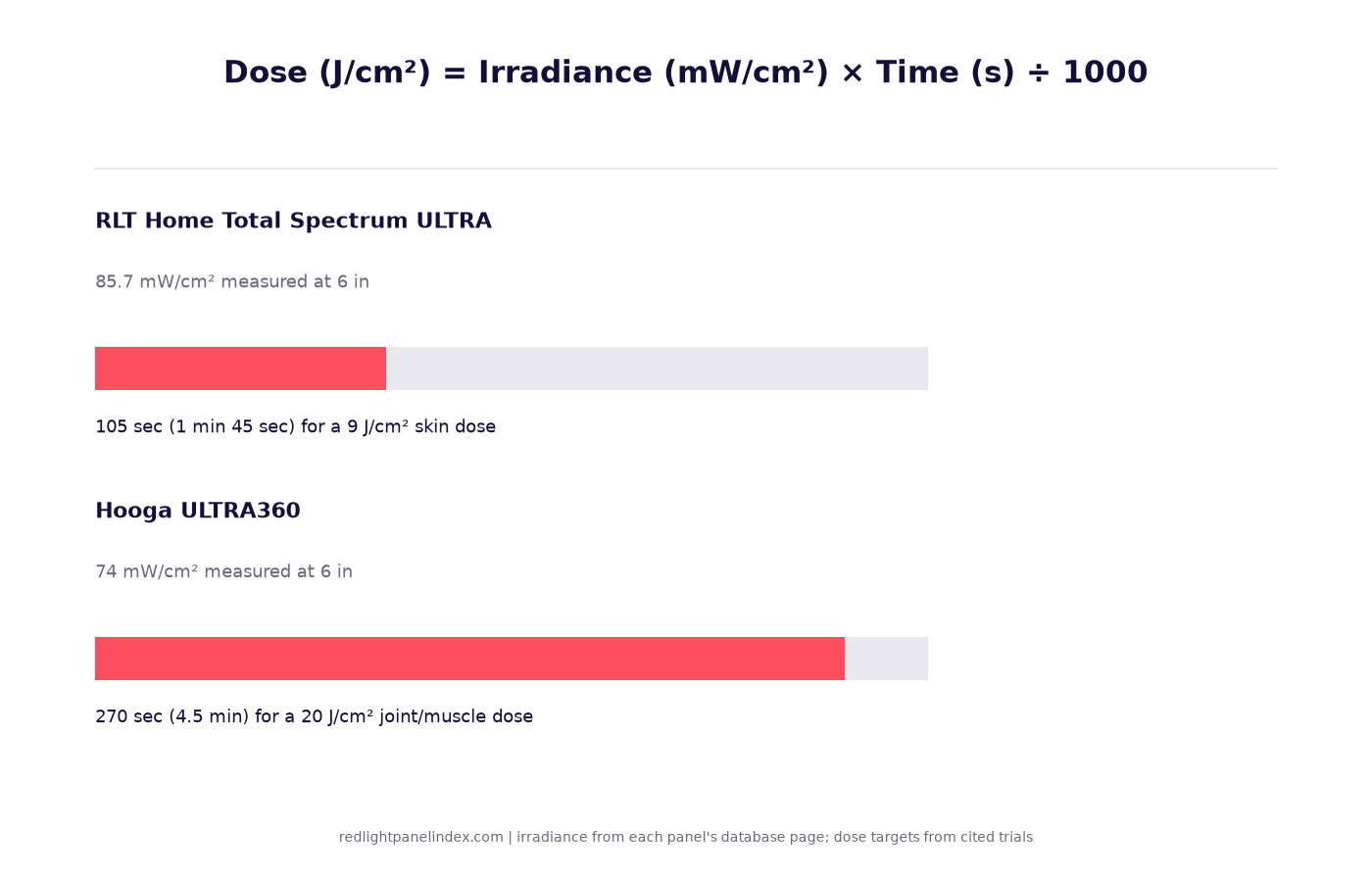
Joules per square centimeter, written J/cm2, is the unit red light therapy trials use to report how much light a treatment area actually received: irradiance in milliwatts per square centimeter multiplied by exposure time in seconds, divided by 1000. It is the dose in red light therapy the way milligrams is the dose in a pill, a single number that lets a short session under a strong panel and a longer session under a weaker one count as delivering the same amount of light, as long as the math works out the same.
Choosing a panel? Our ranking of the best red light therapy panels is computed from published, method-labeled specs across 188 devices. For dose, the spec that matters is the measured irradiance at a stated distance, since that is the number the J/cm2 formula actually runs on.
The formula
Dose in J/cm2 equals irradiance in mW/cm2 times the session length in seconds, divided by 1000. This site's dose calculator runs that formula directly: enter a panel's irradiance and a session length, and it returns the dose in J/cm2, or run it in reverse to find the session length a target dose requires at a given irradiance. Milliwatts per square centimeter measures how strong the light is at your skin at a given distance; seconds measures how long you sit in it; the division by 1000 converts the product from millijoules to joules. Every part of that formula depends on getting the irradiance figure right, which is where dosing usually goes wrong before the arithmetic ever does. This site's irradiance page covers what that figure means and why the instrument used to measure it, spectrometer or solar meter, changes the number. On a panel with a pulsed setting, the irradiance that belongs in this formula is the average output over the full session, not the higher peak output the diode reaches during each pulse; this site's pulsed versus continuous comparison covers why those two numbers diverge and how much a low duty cycle can lower the average.
Two worked examples
RLT Home Total Spectrum ULTRA. This panel's database page states a measured average irradiance of 85.7 mW/cm2 at 6 inches, tested with an Electropossible Ltd spectrometer. Targeting a 9 J/cm2 dose, the figure used in the largest skin trial this site cites: 9,000 divided by 85.7 is about 105 seconds, roughly 1 minute 45 seconds, at that distance.
Hooga ULTRA360. This panel's database page states a measured irradiance of 74 mW/cm2 at 6 inches, tested by Light Therapy Insiders. Targeting a 20 J/cm2 dose, inside the range most of the trials below actually used: 20,000 divided by 74 is about 270 seconds, 4.5 minutes.
Both figures come from the panels' own database pages, not a manufacturer's headline claim; this site's claimed vs measured page found that across 44 panels where both numbers exist, the claim runs a median 2.18 times the spectrometer reading. Running the same 9 J/cm2 target off a claimed irradiance figure instead of a measured one would understate the session length needed by roughly half, which is the practical reason the formula is only as good as the irradiance number that goes into it.
Why the dose target itself changes by tissue
A 2018 review of photobiomodulation parameters looked at the range of wavelength, power density, energy density and duration used across published studies, and reported a general working range of power density under 100 mW/cm2 with an energy density of 4 to 10 J/cm2 delivered at the target tissue, while noting that as much as 50 J/cm2 might be applied at the skin surface to account for how much of it is absorbed before reaching a deeper target (PMID 30550048). The same review found that tissues with higher numbers of mitochondria, including muscle, brain, heart and nerve, tended to respond to lower doses than tissues with fewer mitochondria, including skin, tendon and cartilage, and that ineffective results in the high-mitochondria tissues were more often explained by over-dosing than under-dosing. That is one reason a joint or muscle target and a skin-level goal are not necessarily dosed the same way even at the same wavelength, and why "more light is better" does not hold as a general rule.
Where reporting dose this way comes from
A 2012 review tracing the field from its laser-only origins to the broader set of red and near-infrared LEDs used today ties the practice directly to what is now called the biphasic dose response, or the Arndt-Schulz curve: the idea that too little light does nothing, a middle range works, and too much either does nothing or works against the effect (PMID 22045511); this site's explainer on that curve covers the mechanism behind it in more depth. Reporting dose in J/cm2, rather than just naming a wavelength or a session length, is what lets one trial's protocol be compared to another's, and lets a home session be compared to either. Without a shared unit, "20 minutes under a red light panel" says almost nothing about whether that session matches what a published trial actually tested.
Doses actually used in the trials on this site
Trial protocols vary by target and wavelength, but most of the published doses this site's evidence pages cite fall in a fairly narrow band once laser point-doses, which cannot be converted to J/cm2 without a stated spot size, are set aside.
| Target | Dose | Wavelength | Trial |
|---|---|---|---|
| Skin, fine lines and collagen | about 9 J/cm2 | red plus near-infrared | PMID 24286286 |
| Skin, session-frequency comparison | 8.05 J/cm2 | red LED | PMID 40167796 |
| Periocular wrinkles | 3.8 J/cm2 per side | 660nm vs 590nm | PMID 36780572 |
| Hair, scalp | 67 J/cm2 per session | 655nm | PMID 24078483 |
| Diabetic neuropathy | 3.1 J/cm2 | 632.8nm | PMID 40090424 |
| Whole-body pain, LED bed | 25.2 J/cm2 | red plus near-infrared | PMID 36369323 |
| Knee osteoarthritis, WALT-dosed | 4 J per point (laser; not convertible to J/cm2 without spot size) | 790nm | PMID 40545487 |
The skin, hair growth and neuropathy doses above sit closer to the review's 4 to 10 J/cm2 target-tissue range; the whole-body pain trial's 25.2 J/cm2 sits well above it, delivered at a low 28 mW/cm2 irradiance over a full 20-minute session rather than a short, strong one. The dosing explained guide walks through more worked examples using these same figures, and the session frequency guide covers how often, not just how much, these same trials dosed their subjects.
Where the numbers break down
Two mistakes turn a real dose figure into a meaningless one. The first is running the formula on a claimed irradiance instead of a measured one, which this site's claimed vs measured page shows overstates most panels' actual output. The second is mixing units: a laser trial that reports "4 joules per point" delivered a fixed amount of energy to one small spot, not to a full square centimeter, and there is no way to convert that figure into J/cm2 without knowing the exact spot size the laser covered, a detail abstracts frequently leave out. A panel's published irradiance, by contrast, is already stated per square centimeter, so the conversion to J/cm2 only requires a session length. Treat the two kinds of figures as different measurements aimed at a similar idea, not as interchangeable numbers.
Using this for your own sessions
Once you know a panel's measured irradiance at your working distance, from its database page or your own spectrometer reading, the dose calculator turns any of the trial doses above into a session length in seconds. Matching a trial's total J/cm2 is a more defensible target than matching its minutes, since two panels at different strengths sitting for the same number of minutes can deliver very different doses. None of the figures above establish that hitting a specific number cures anything; they only show what the published trials this site cites actually delivered, so a home session can be compared to a real protocol rather than a guess.