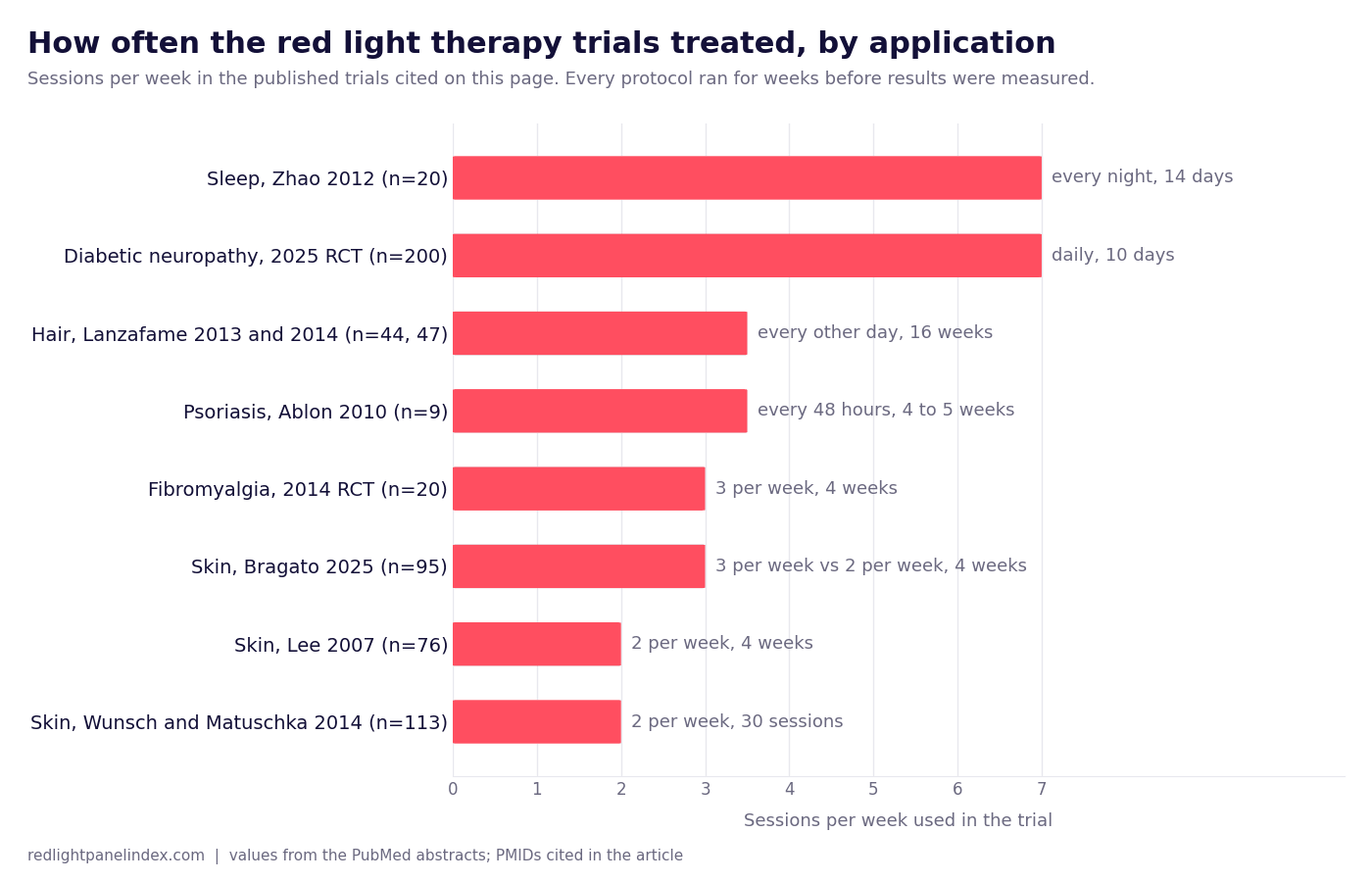
There is no single correct frequency for red light therapy, because the trials that produced the evidence did not use one. Skin studies mostly treated twice a week. Hair studies treated every other day. The one controlled sleep study treated every night. The honest answer to "how often" is "it depends what you are using it for," and the most useful thing this guide can do is show you exactly what each trial did, so you can copy a schedule that has actually been tested rather than one that has been guessed.
Choosing a panel? Our ranking of the best red light therapy panels is computed from published, method-labeled specs across 188 devices. For frequency, the spec that matters is method-labeled irradiance at your working distance, because it sets how long each of those sessions needs to be.
Two rules apply across everything below. First, frequency and dose are linked: the same weekly energy can be delivered in two long sessions or five short ones, and the dose calculator will tell you how long a session needs to be on your panel to reach a given dose; how that J/cm2 figure is actually calculated is covered separately. Second, more is not better past a point. Photobiomodulation has a biphasic dose response (PMID 22461763), meaning that beyond an optimal range the effect flattens and can reverse, so doubling your sessions is not a way to double your results.
The short answer by goal
- Skin and face: two sessions a week, for at least four weeks before judging. This is the only schedule with a head-to-head trial behind it (see below).
- Hair: every other day, for sixteen weeks.
- Joint and muscle pain: every other day to three times a week, in courses of four weeks or more.
- Sleep: nightly, in the evening, red only, and treat it as an experiment because the evidence is one small study.
- Daily use: tolerated in the short courses that tested it, but no trial used daily sessions for months. If you go daily, keep sessions short and the weekly dose in the calculator's range.
What the trials used, by application
| Application | Trial | Frequency | Session | Duration |
|---|---|---|---|---|
| Skin (fine lines, collagen) | PMID 24286286, 113 treated adults | Twice a week | Varied by group, about 9 J/cm2 | 30 sessions (about 15 weeks) |
| Skin (wrinkles, split-face) | PMID 17566756, 76 adults | Twice a week | Not stated | 4 weeks |
| Skin (frequency comparison) | PMID 40167796, 95 women | Twice vs three times a week | 21 minutes, 8.05 J/cm2 | 4 weeks |
| Skin aging (LED mask) | PMID 37522497, 20 women | Twice a week | 12 minutes | 3 months |
| Hair (men) | PMID 24078483, 44 men | Every other day | 25 minutes | 16 weeks (60 treatments) |
| Hair (women) | PMID 25124964, 47 women | Every other day | 25 minutes | 16 weeks (60 treatments) |
| Sleep (athletes) | PMID 23182016, 20 athletes | Every night | 30 minutes | 14 days |
| Fibromyalgia pain | PMID 24801056, 20 patients | Three times a week | Per-point laser | 4 weeks |
| Diabetic neuropathy | PMID 40090424, 200 patients | Daily | 9 minutes | 10 days |
| Psoriasis (pilot) | PMID 19764893, 9 patients | Every 48 hours | 20 minutes | 4 to 5 weeks |
A few things stand out. Nothing here was daily for months. The longest protocols, skin and hair, ran at two to three and a half sessions a week. The daily protocols were short courses of ten to fourteen days. And every trial, regardless of frequency, ran for weeks before measuring results, so the first question is not just how often but for how long before you judge whether it is working.
Skin: twice a week is the tested schedule, and one trial tested it head to head
The largest skin trial in the register is the Wunsch and Matuschka study (PMID 24286286), which enrolled 136 volunteers and treated 113 of them twice a week with red or red-plus-near-infrared light for 30 sessions, normalized to about 9 J/cm2 in the red band. Collagen density, skin roughness, and blinded photographic assessments all improved against untreated controls. Our full review of that trial covers its two light sources, what was and was not blinded, and why the broader spectrum showed no advantage over red light alone. The earlier Korean split-face study (PMID 17566756) used the same twice-a-week rhythm over four weeks with 633nm, 830nm, or both, and measured wrinkle reductions of up to 36% and elasticity gains of up to 19% against baseline. A 2023 LED mask study (PMID 37522497) also used two sessions a week, 12 minutes each, for three months.
The most useful study for this question is a 2025 sham-controlled trial that set out to test frequency directly (PMID 40167796). Ninety-five women aged 45 to 60 used a 660nm LED mask at 8.05 J/cm2 for 21 minutes, either three times a week or twice a week, for four weeks, against a sham group. Both light groups improved on measured wrinkle length and on satisfaction compared with sham, and the three-times-a-week group did not do measurably better than the twice-a-week group. The authors' conclusion is the one this guide adopts: two weekly sessions appear to be sufficient.
Four separate skin trials converging on twice a week, one of them a direct comparison, is about as clear a signal as this field gives. If you are using a panel for skin, two sessions a week is the schedule with evidence behind it, and the results in these trials were measured after four to fifteen weeks, not after four days. The wavelengths those trials used, and what they mean for panel choice, are on the skin and anti-aging evidence page.
Hair: every other day, for months
Both Lanzafame trials (PMID 24078483 in men, PMID 25124964 in women) used the same protocol: a 655nm helmet device worn at home every other day for 25 minutes, for 16 weeks, which works out to 60 treatments at a stated 67 J/cm2 per session. Hair counts rose by 35% to 39% in men, depending on the analysis reported (the full trial design and result are broken down in our review of the men's RCT), and by 37% in women relative to the sham group (see our review of the women's RCT for the full numbers and how the two trials compare). This is a more frequent schedule than the skin trials, and a longer one; hair follicles cycle slowly, and 16 weeks is the minimum these studies allowed before counting.
Note that these were scalp devices, not panels. A panel can deliver red light to the scalp, but the dose per session will differ, which is where the dose calculator earns its keep. The full hair evidence, including the device class question, is on the hair growth evidence page.
Sleep: nightly, but the evidence is thin
The only controlled sleep study in the register (PMID 23182016) gave 10 elite female basketball players 30 minutes of whole-body red light every night for 14 days and compared them with 10 untreated teammates. Sleep quality scores, serum melatonin, and endurance all improved. It is one small cohort study, so treat "every night" as the tested schedule rather than a proven one. The practical point for evening use is less about frequency and more about the light itself: red does not suppress melatonin the way blue does, so a red-only evening session is unlikely to work against you even if the direct sleep benefit turns out to be modest. See the sleep evidence page for the grade and the caveats, and our full review of that trial for the population, the schedule, and what the abstract does not report.
Pain: three times a week in the trials, with a catch
The fibromyalgia trial (PMID 24801056) treated three times a week for four weeks and found significant improvements over placebo on the Fibromyalgia Impact Questionnaire, McGill Pain Questionnaire, and pain scale. The catch is that this was a laser applied point by point to 18 tender points, not a panel. A more recent triple-blinded fibromyalgia trial used the same three-times-a-week, four-week rhythm in a whole-body LED bed instead of a point laser, and reported a pain reduction that was still present two weeks after the last session. The knee osteoarthritis trials in the register (PMID 31144070, PMID 40545487) were also clinic laser protocols; the first ran 16 sessions paired with a leg-strengthening exercise program (see our review of that trial), and the second followed WALT dosing recommendations. What carries over from these to a home panel is the rhythm, roughly every other day, and the multi-week course. What does not carry over is the dose per point, which a panel delivers very differently. The diabetic neuropathy trial (PMID 40090424) is the outlier: a daily 632.8nm laser course at 3.1 J/cm2 for nine minutes on each foot surface, for ten days, with improvements measured four weeks later; see our full review of that trial for its design and limitations. The trial details and grades are on the joint pain and neuropathy evidence pages. A separate line of evidence looks at timing rather than frequency: a 2015 meta-analysis of exercise-performance trials found the clearest results when phototherapy was applied before a workout rather than after, a pattern this frequency table does not otherwise capture; see our review of that meta-analysis for the pooled results.
Turning a trial schedule into a home schedule
Three steps.
- Pick the application and copy its frequency from the table. Skin: twice a week. Hair: every other day. Pain and recovery: every other day to three times a week. Sleep: nightly, in the evening, red only.
- Set the session length from dose, not from habit. Enter your panel's irradiance and your distance into the dose calculator and it will give you the minutes needed for a target dose; for the formula behind that calculator and three worked examples, see dosing explained, and how long a session should actually run walks through the arithmetic in more depth. Read the irradiance figure carefully first: a solar-meter figure can overstate output by roughly double compared with a spectrometer, as the claimed vs measured dataset shows, and how to read the irradiance labels on this site explains which figure you are looking at. If you sit farther from the panel than the distance that figure was measured at, expect the real dose to run lower than the calculator shows; what distance to sit from a panel covers how much that matters and how to estimate it.
- Commit to the trial's duration before judging. Four weeks for skin at minimum, sixteen for hair, two for sleep. Stopping at ten days because nothing has changed is stopping before any of the trials measured anything.
This site's beginner's 30-day protocol walks these same three steps into a printable four-week calendar, with a worked week-by-week schedule for each goal above.
Can you use it every day?
You can, and the short daily courses in the neuropathy and sleep trials show it is tolerated. But no trial in the register used daily sessions for months, the one trial that compared frequencies found no advantage for the more frequent schedule, and the biphasic dose response means daily use on a high-output panel at close range can push you past the useful range. If you want to use a panel every day, keep sessions short, keep the total weekly dose in the range the calculator suggests, and treat the extra days as convenience rather than a way to speed things up. Two properly dosed sessions a week beat seven overdosed ones.
Can you do too much?
Yes, in the sense that more light stops helping. The trials above reported no adverse effects at the frequencies they used, and red and near-infrared light at panel intensities is non-thermal and non-ionizing, so the risk is wasted time rather than harm. The exception is the eyes: near-infrared is invisible and bright, so follow the manufacturer's guidance on eye protection, particularly at close range. This index's safety and side effects page covers the broader adverse-event picture, including the areas, like photosensitizing medications and pregnancy, where the register has no data either way.
What this guide cannot tell you
The trials were run on specific devices at specific settings, and most were lasers, helmets or masks rather than the full-body panels sold today. The frequencies transfer; the exact doses do not. Match the schedule, calculate your own session length, and give it the trial's duration. If you are choosing a panel, the filterable panel database lets you sort by measured irradiance so the session length you calculate is based on a real number, and the best panels ranking explains how those numbers were weighed.