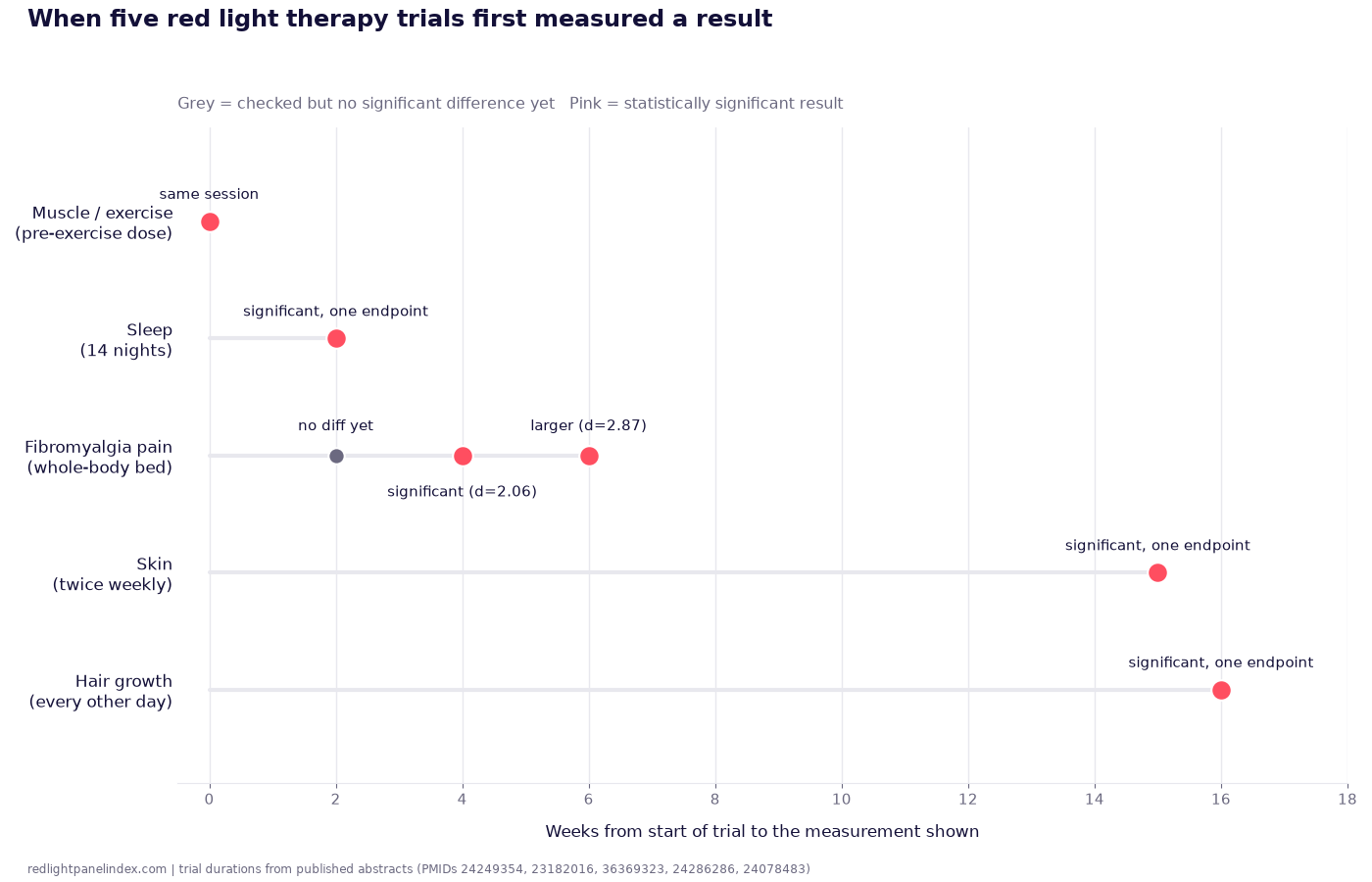
The honest answer is weeks, not days. Across the skin, hair and pain trials this site cites by name, the earliest reported significant result showed up at 15 to 16 weeks of consistent use in two of them, and the one trial in this group that checked partway through found nothing measurable at the halfway point before a large effect appeared at the end of the course.
Choosing a panel? Our ranking of the best red light therapy panels is computed from published, method-labeled specs across 188 devices. For timing your expectations, the spec that matters is your device's published dose at a stated distance, since a slower or weaker session stretches every one of these timelines further.
What these trials actually measured, and when
Most trials in this literature run a set course and compare a single measurement at the end against baseline. They do not check in at week two, four, or eight to report how much of the eventual change had already happened. That matters for anyone hoping for an early signal: for most of the conditions below, no published trial data exists on how much visible change, if any, shows up before the full course is complete.
Skin: 15 weeks to the only reported checkpoint
The largest skin study in this index's register treated 113 people twice weekly for 30 sessions, roughly 15 weeks, and measured collagen density and skin roughness once, at the end (PMID 24286286). The trial reported statistically significant improvement in complexion, roughness and collagen density at that single endpoint compared with untreated controls, but the abstract gives no reading at week four or week eight, so there is no published basis for expecting a visible change earlier than the full 15-week course this site's review of the trial covers in more depth. Use your panel's dose calculator figure to hold a consistent session length across that full stretch rather than judging results at week two or three.
Hair growth: 16 weeks, every other day
The trial behind most home hair-growth claims put 44 men through a 655nm LED and laser helmet every other day for 16 weeks and measured hair count once, at the 16-week endpoint, against a matched sham device (PMID 24078483). The active group showed a 39% increase in hair count at that single checkpoint, a statistically significant result, but again the paper reports no interim count at eight or twelve weeks. A companion trial in women ran the identical device and schedule and likewise checked only at the 16-week endpoint, reporting a 37% increase over sham. This site's guide to how often to use red light therapy treats every-other-day for at least 16 weeks as the tested floor for this specific goal, not a schedule that can be shortened based on how things look at week six.
Knee osteoarthritis plus exercise: 16 sessions, weeks not stated
A four-arm trial testing photobiomodulation layered onto a leg-strengthening exercise program in women with knee osteoarthritis ran a course of 16 sessions and found a significant pain reduction in the light-treated groups compared with placebo light, whether or not exercise was also happening (PMID 31144070). The full review of this trial covers the split result on pain versus function, but on timing specifically, the abstract states the session count without stating how many weeks those 16 sessions spanned or how often a session happened relative to the exercise routine. That gap means this particular trial cannot be used to estimate a weeks-to-result figure at all, only a session count; readers looking for joint pain more broadly should see this site's joint pain evidence page, where other trials in the register do report a weekly schedule.
Sleep: 14 nights, one endpoint
A small placebo-controlled trial in elite female basketball players tested whole-body red light exposure for 30 minutes nightly over 14 consecutive nights and reported better sleep quality and higher serum melatonin than a matched placebo group at that single 14-night checkpoint (PMID 23182016). Like the skin and hair trials above, this is a single before-and-after comparison, not a night-by-night tracking of when the improvement started; the trial's own study review covers why the population, a young single-sex group of trained athletes, and the missing wavelength and irradiance figures limit how far this specific timeline generalizes to an adult using a panel for general sleep support. Fourteen nights is the shortest course among the trials in this article, but it is still two weeks of nightly use, not a one-off session.
Muscle and exercise performance: no waiting required
Not every use case in this literature runs on a weeks-long clock. A 2015 meta-analysis pooling 13 higher-quality trials found that a single phototherapy session applied immediately before exercise increased time to exhaustion and repetition count compared with placebo, an effect measured in the same workout session as the light exposure, not after a course of daily or weekly use (PMID 24249354). The full review of that meta-analysis covers which parameters were tied to the most consistent results across the pooled trials. This is the one entry in this article where "how long until it works" has a different kind of answer: the tested protocol is a pre-exercise dose on the day of the activity, not a course measured in weeks, which makes it a poor comparison point for anyone timing a skin, hair or joint pain course against it.
The one trial that checked partway through
A triple-blinded trial that put 42 women with fibromyalgia in a whole-body 660nm and 850nm LED bed is the exception in this set: it measured pain at baseline, after six sessions, immediately after the full 12-session course, and again two weeks later (PMID 36369323). Pain showed no significant difference between the active and sham groups at the six-session halfway mark. By the end of the four-week course it was significantly lower in the active group, a large effect (Cohen's d = 2.06), and the gap had grown slightly larger two weeks after treatment stopped (d = 2.87). This site's review of that trial has the full outcome set; the timing point worth taking from it is that a real trial checked early and found nothing yet, which argues against reading too much into the absence of change in your own first few sessions.
What this means if you are timing your own results
None of the four trials above support expecting a visible change inside the first two or three weeks; the one trial that actually looked for an early effect did not find one until the course was nearly finished. If you are running a fixed course to compare against one of these trials, match the schedule as closely as your panel allows, twice weekly for around 15 weeks for a skin goal, every other day for 16 weeks for hair, and hold your session length steady using the dose calculator rather than adjusting it week to week based on how things look. Judging a course too early is functionally the same mistake as skipping sessions: neither gives the light enough cumulative exposure to reach the endpoint these trials actually tested. "You'll see results within days" is one of the claims this site's myths-checked guide grades against these same trials, and it does not hold up.
What was not studied
None of these four trials, or any other trial this site has reviewed, report a dose-response curve across time within a single course, meaning there is no published figure for what fraction of the eventual result should be visible at, say, the two-thirds mark. Nor does any trial here compare a shorter course against a longer one on the same population to isolate how much of the effect is time-dependent versus session-count-dependent. Anyone extrapolating a week-by-week progress curve from these numbers is filling a gap the trials themselves do not address.