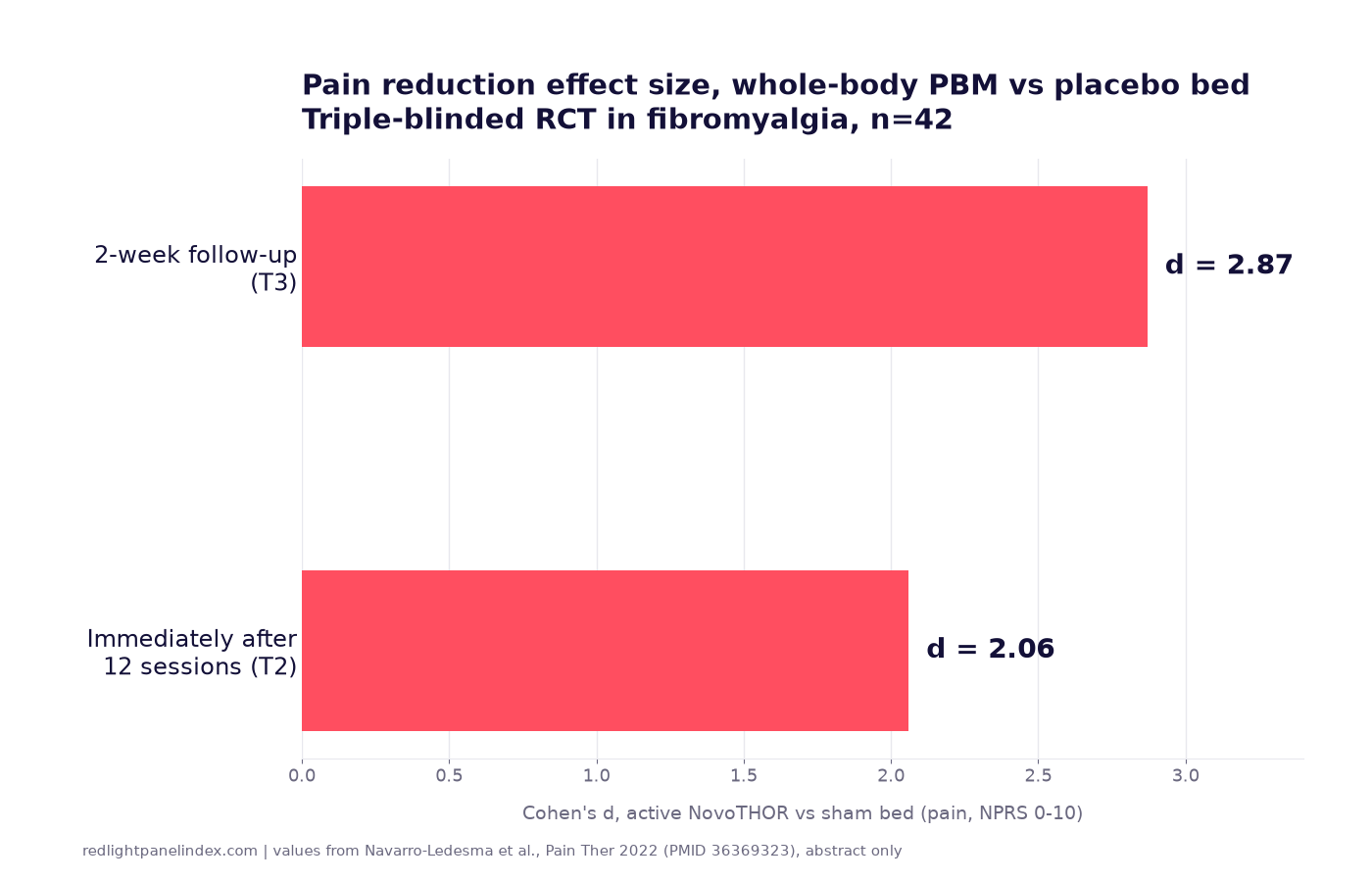
A 2022 triple-blinded, placebo-controlled randomized trial in Pain and Therapy put 42 women with fibromyalgia through 12 sessions in a whole-body 660nm and 850nm LED bed and reported a large reduction in pain compared with a matched sham bed, an effect that was still present two weeks after the last session (PMID 36369323). It is one of the more tightly controlled trials in this index's pain literature, with a real placebo arm and blinding on both the participant and assessor side, and it is also one of the hardest to translate directly to a home device, since the delivery hardware bears little resemblance to anything sold for home use.
Choosing a panel? Our ranking of the best red light therapy panels is computed from published, method-labeled specs across 188 devices. For a whole-body protocol like this one, the spec that matters is how much of the body a device actually covers at once, not just its wavelength list.
What the study asked
The authors note that photobiomodulation had already shown pain-relieving effects delivered locally with handheld lasers or small panels, but that no trial had tested a whole-body light bed in people with fibromyalgia, a condition defined by widespread rather than localized pain. The question was whether treating the entire body at once, rather than one joint or muscle group at a time, would move pain, quality of life, and the psychological factors that often travel with chronic widespread pain, and whether any change would still be there two weeks after the course ended.
Who was studied
Forty-four women with a fibromyalgia diagnosis were recruited and 42 completed the trial, split evenly into 21 in the active group and 21 in a sham group. Mean age was 52.83 years (SD 8.04). The trial was randomized, and both participants and outcome assessors were blinded to group assignment, which is the stronger triple-blind design compared with the single-blind, sham-controlled trials more common in this literature.
Device and parameters as stated
- Device: NovoTHOR XL whole-body light bed (a clinic device, not a panel sold for home use)
- Wavelengths: 660nm and 850nm in a 50:50 ratio
- Output: 2,880 LEDs, 967 W total power, continuous wave (not pulsed)
- Irradiance: 0.028 W/cm2 (28 mW/cm2)
- Fluence: 25.2 J/cm2 per session
- Session length: 20 minutes, lying supine in minimal attire
- Schedule: 12 sessions, 3 per week, over 4 weeks
- Control: a visually identical sham bed run on the same schedule
Both wavelengths sit inside the ranges most home panels also carry; a reader can check how much of their own device's output falls near 660nm or 850nm on its published wavelength mix. What does not carry over is the geometry: the bed surrounds the body from multiple angles at once for a fixed 20 minutes, while a panel illuminates whatever surface faces it from a working distance, one side of the body at a time.
What was measured and what was found
Participants were assessed at baseline (T0), after 6 sessions (T1), immediately after the full course (T2), and again 2 weeks later (T3). The outcome set combined a pain scale with measures of quality of life, activity, and psychological factors associated with chronic pain:
- Pain: Numeric Pain Rating Scale, 0 to 10 (NPRS)
- Quality of life: Visual Analog Scale, 0 to 10 (VAS)
- Physical activity: Leisure Time Physical Activity Instrument (LTPAI)
- Kinesiophobia: Tampa Scale of Kinesiophobia (TSK-11)
- Pain catastrophizing: Pain Catastrophizing Scale (PCS)
- Self-efficacy: a self-efficacy questionnaire
Pain showed no significant between-group difference at T0 or T1, then a large difference in favor of the active bed at T2 (p <= 0.001, Cohen's d = 2.06) that grew slightly larger by the T3 follow-up (p <= 0.001, d = 2.87). Quality of life, physical activity, and kinesiophobia all showed significant between-group differences from T1 onward, with large effect sizes at T2 and T3 (d values from roughly 1.25 to 2.70 in magnitude). Self-efficacy reached significance at T2 (p = 0.034, d = -0.73) and grew stronger by T3 (p < 0.001, d = -1.33). Pain catastrophizing was the one measure that did not separate the groups at any timepoint, with p values ranging from 0.32 to 0.859 across the trial.
The abstract reports p-values and Cohen's d for each measure rather than the raw scale scores or the size of the between-group difference in scale points, so those are the only numbers used here; no percentage improvement or point-value change is stated in the source and none is estimated in this review.
Limitations
- First trial of its kind. The authors describe this as the first trial of a whole-body PBM bed in fibromyalgia and caution against extrapolating the results to other populations.
- No active comparator. The trial isolated the light itself; it did not test the device against, or alongside, other interventions such as pain education that a clinic might normally combine with treatment.
- Sample size tied to one outcome. The trial was powered around its primary outcome, so the other measures were not independently powered, which can inflate how confident a reader should be in effect sizes for the secondary measures.
- Short follow-up. T3, the last assessment point in this paper, is 2 weeks after the final session. Whether the pain reduction holds, fades, or reverses further out is not addressed by this publication.
- One measure did not move. Pain catastrophizing showed no group difference throughout, a reminder that not every construct linked to chronic pain responded even where pain itself did.
- A single-sex, narrow-age sample. All participants were women with a mean age in the low 50s, so the results say the least about men or about substantially younger or older patients with fibromyalgia.
- Widespread pain, not localized pain. Fibromyalgia is defined by pain across the whole body, a different clinical picture from a single-region complaint like chronic low back pain, where the trial evidence comes from lasers aimed at specific spinal points rather than a whole-body bed; the two conditions should not be assumed to respond the same way to the same device.
What this means for a home panel
The joint-pain evidence page already notes that fibromyalgia photobiomodulation trials to date have mostly used point-applied lasers rather than panels; this trial adds a whole-body light bed to that picture, which is a closer analog to a home panel than a handheld laser but still not the same thing. The site's dedicated fibromyalgia evidence page puts this trial next to the point-laser RCT and 2019 meta-analysis for the full picture of what has and has not been tested. The device delivered a fixed 25.2 J/cm2 to the entire body surface at once from multiple angles in 20 minutes. A single home panel cannot reproduce that geometry; it treats one side of the body, at whatever irradiance it actually measures at your working distance. The closest home equivalent this index tracks is a full-body panel sized to cover an adult lying down, though even the largest of those illuminates from one side rather than surrounding the body.
If you want to approximate the trial's per-session dose on a panel you own, use your device's method-verified irradiance in the dose calculator to work out how long a comparable 25.2 J/cm2 would take at your working distance, then treat the front and back of the body as two separate sessions rather than assuming one pass covers both. Matching the trial's 12-session, three-times-a-week schedule is more realistic for a home routine than matching its exact geometry.
None of this means a home panel will reproduce what a whole-body bed delivered in a blinded, sham-controlled trial. It means that of the fibromyalgia literature currently in this index, this is the trial with the strongest design, and also one where the honest answer is that the device tested is not the device most readers own.