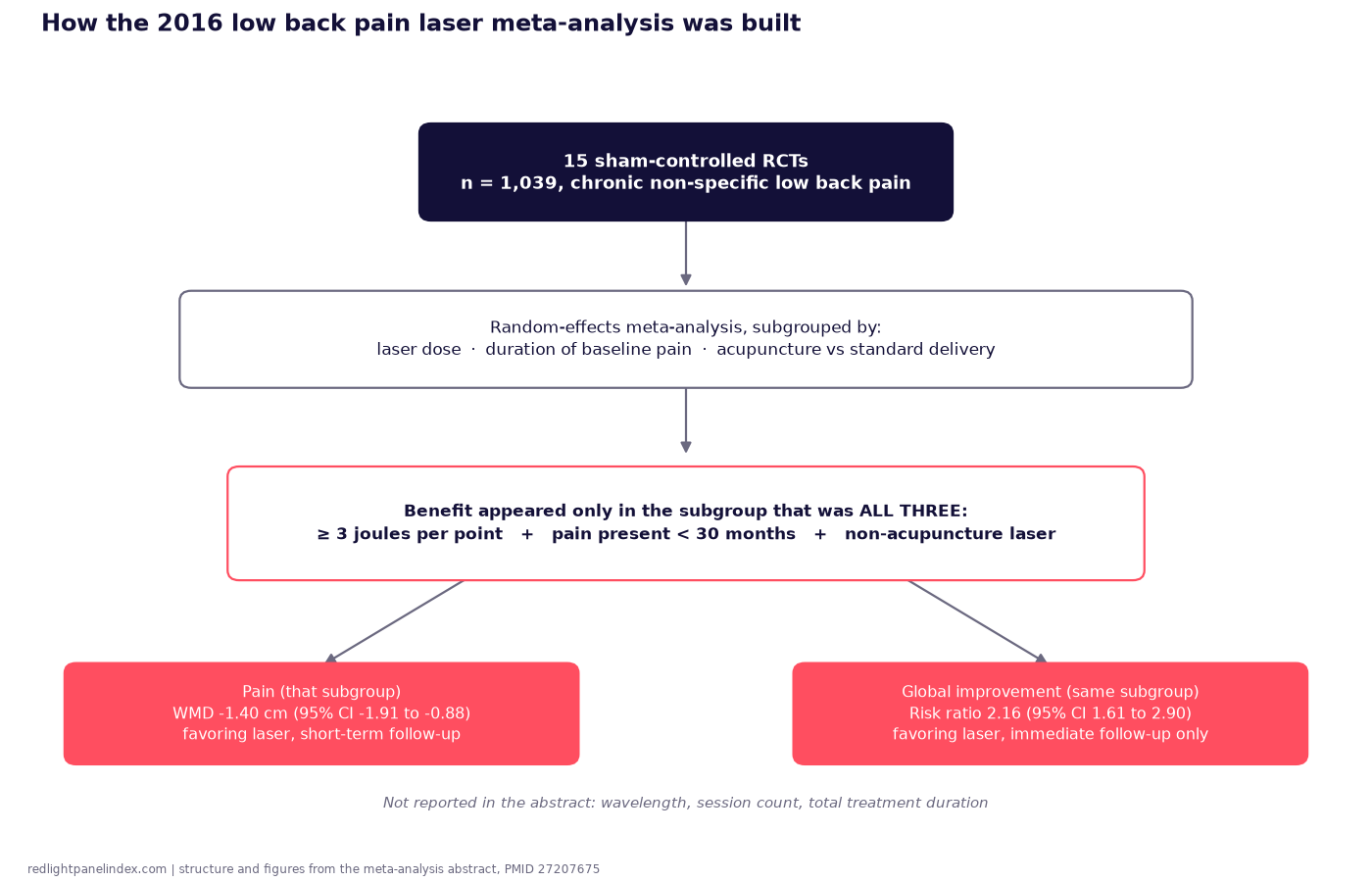
Moderate: a 2016 meta-analysis of 15 sham-controlled trials in 1,039 people with chronic non-specific low back pain found short-term pain relief from low-level laser therapy, but the benefit only held up in trials that used a high enough laser dose per point and in people whose pain had not lasted as long, using medical lasers rather than the LED panels this site tracks (PMID 27207675).
Choosing a panel? Our ranking of the best red light therapy panels is computed from published, method-labeled specs across 188 devices. For back pain, the spec that matters is a method-labeled irradiance figure at the distance you can actually hold against your lower back, since the trials behind this grade delivered their dose to fixed points, not a broad area.
The trial base: what the meta-analysis pooled
The review searched for randomized trials that used sham controls and blinded outcome assessment to test low-level laser therapy, including laser acupuncture, in adults with chronic non-specific low back pain. Fifteen studies met that bar, covering 1,039 participants in total. The primary outcomes were pain and a patient-rated global assessment of improvement, tracked up to short-term follow-up; disability, range of back movement, and adverse effects were tracked as secondary outcomes, though the abstract does not report specific results for those three. The authors ran subgroup analyses splitting trials by laser dose, how long a participant's back pain had already lasted, and whether the laser was applied as acupuncture or as straightforward point-by-point treatment.
What was measured and found
Pooled across the higher-dose, non-acupuncture trials with shorter-duration baseline pain, laser treatment produced a weighted mean difference in pain of up to -1.40 cm on what the trials used as a pain scale (95% confidence interval -1.91 to -0.88 cm), favoring laser over sham. That benefit showed up specifically "in trials using at least 3 joules per point," with baseline pain under 30 months, and only in non-acupuncture-style laser trials; it did not hold up as clearly across the full pooled set once dose, pain duration, and acupuncture status were ignored. Patient-rated global improvement told a similar story: a risk ratio of 2.16 (95% CI 1.61 to 2.90) favoring laser over sham in the same higher-dose, shorter-duration subgroup, at immediate follow-up only, not sustained short-term follow-up. The authors themselves concluded there was "moderate quality of evidence (GRADE) to support a clinically important benefit in LLLT" for chronic non-specific low back pain in the short term, explicitly tying that conclusion to the higher-dose subgroup rather than to laser therapy at any dose.
What was not studied
The abstract that this grade rests on does not report a wavelength for the pooled trials, an important gap since "low-level laser therapy" spans a range of red and near-infrared wavelengths across the 15 included studies, and none is named as more or less effective here. It does not report a session count or a total treatment duration in weeks, so there is no published schedule from this review to replicate directly; this site's results timeline guide covers what other trials in this index report about how long a course typically runs, though none of them treated back pain specifically. It does not report the actual disability, range-of-movement, or adverse-event results, only that those outcomes were tracked, so this page does not claim a finding for them. And every trial in the pool used a laser, a device that concentrates light into a narrow, high-intensity beam aimed at specific points along the spine, not a broad LED panel illuminating an area of skin from a working distance; no trial in this meta-analysis tested that panel geometry against sham for back pain.
What the subgroup result means, and does not mean
A random-effects meta-analysis like this one pools trials that differ from each other in laser type, dose, and patient population, then looks for a combined effect while allowing for that underlying variation. When the authors ran subgroup analyses splitting the 15 trials by laser dose, baseline pain duration, and acupuncture-style delivery, the benefit concentrated in one combination: higher dose, shorter-duration pain, and standard point-by-point laser rather than laser acupuncture. That is a more specific and more useful finding than "laser therapy helps back pain" on its own, because it tells a reader which version of the intervention the evidence actually supports, but it also means the headline pain and global-assessment numbers above describe that specific subgroup, not the full 1,039-participant pool at any dose or duration. The GRADE "moderate quality" rating itself reflects this: it is one step below "high quality," typically because of some combination of study limitations, inconsistency across trials, or imprecision in the pooled estimate, rather than the near-certainty a "high quality" GRADE rating would imply. This site's full study review of the meta-analysis walks through the same pooled numbers and subgroup split in more detail, including the limitations the review itself flags.
Where this sits next to other joint and pain trials in this index
The dose pattern here echoes what shows up elsewhere in this site's joint pain register: knee osteoarthritis trials pooled in a separate meta-analysis found larger pain reductions in trials using 4 to 8 joules per point at 785 to 860nm, or 1 to 3 joules per point at 904nm, again a dose-dependent result rather than an any-dose result. The back pain meta-analysis's "at least 3 joules per point" threshold is not directly comparable to those knee figures, since the wavelengths differ and neither review states a spot size to convert either into a J/cm2 density, but the shared pattern, that an underdosed laser trial tends toward a null result while an adequately dosed one does not, is consistent across both conditions. A separate whole-body pain trial in this index, a triple-blinded LED bed trial in fibromyalgia, used a very different device and delivery method but likewise reported no benefit at a partial checkpoint before a large effect appeared at the end of its course (PMID 36369323); the full review of that trial covers a condition defined by widespread rather than localized pain, but its dose-and-timing lesson, that an inadequate look too early or too weak a dose can look like a null result even when a real effect exists at the right dose and duration, applies to reading the back pain literature as well. The fibromyalgia evidence page rounds up that bed trial alongside a point-laser RCT and a 9-trial meta-analysis for anyone comparing the two conditions' literatures side by side.
Using a panel for back pain: what the dose gap means
The "at least 3 joules per point" threshold behind the significant results is a per-point laser dose, not a J/cm2 figure a panel's spec sheet reports, and converting between the two requires knowing the exact spot size the laser covered, a detail this abstract does not give. This site's dosing guide covers that same conversion problem for the joint pain literature, where trials report near-infrared point doses of 4 to 8 joules per point that also cannot be dropped directly into a panel's J/cm2 output. Panels sold today mostly publish 660nm and 850nm as their two core wavelengths, a pairing found on 93% of the devices in this site's database, which sits inside the general red-and-near-infrared range this literature covers without matching any single wavelength the back pain meta-analysis names. If you are using a panel for back pain, the most defensible approach is to use a method-labeled irradiance figure from your panel's database page and the dose calculator to hold a consistent session length and distance over several weeks, in line with how this site's joint pain evidence page treats other laser-to-panel extrapolations, rather than trying to reproduce the exact per-point dose from a laser trial you cannot replicate with a flat-panel device.
Cautions
This evidence supports light being associated with short-term pain reduction in a specific, higher-dose laser subgroup; it does not support a claim that red light therapy cures or heals back pain, and the review itself frames the benefit as short-term rather than a lasting resolution. Chronic non-specific low back pain, the population this meta-analysis studied, specifically excludes pain from an identifiable structural cause such as a fracture, tumor, infection, or nerve compression; back pain accompanied by numbness, weakness, fever, unexplained weight loss, or loss of bladder or bowel control falls outside what this evidence addresses and needs clinical evaluation, not a panel session. This site's safety and side effects page covers the general caution list for anyone starting light therapy, including photosensitizing medications and other conditions worth checking against before adding a new light-based routine.