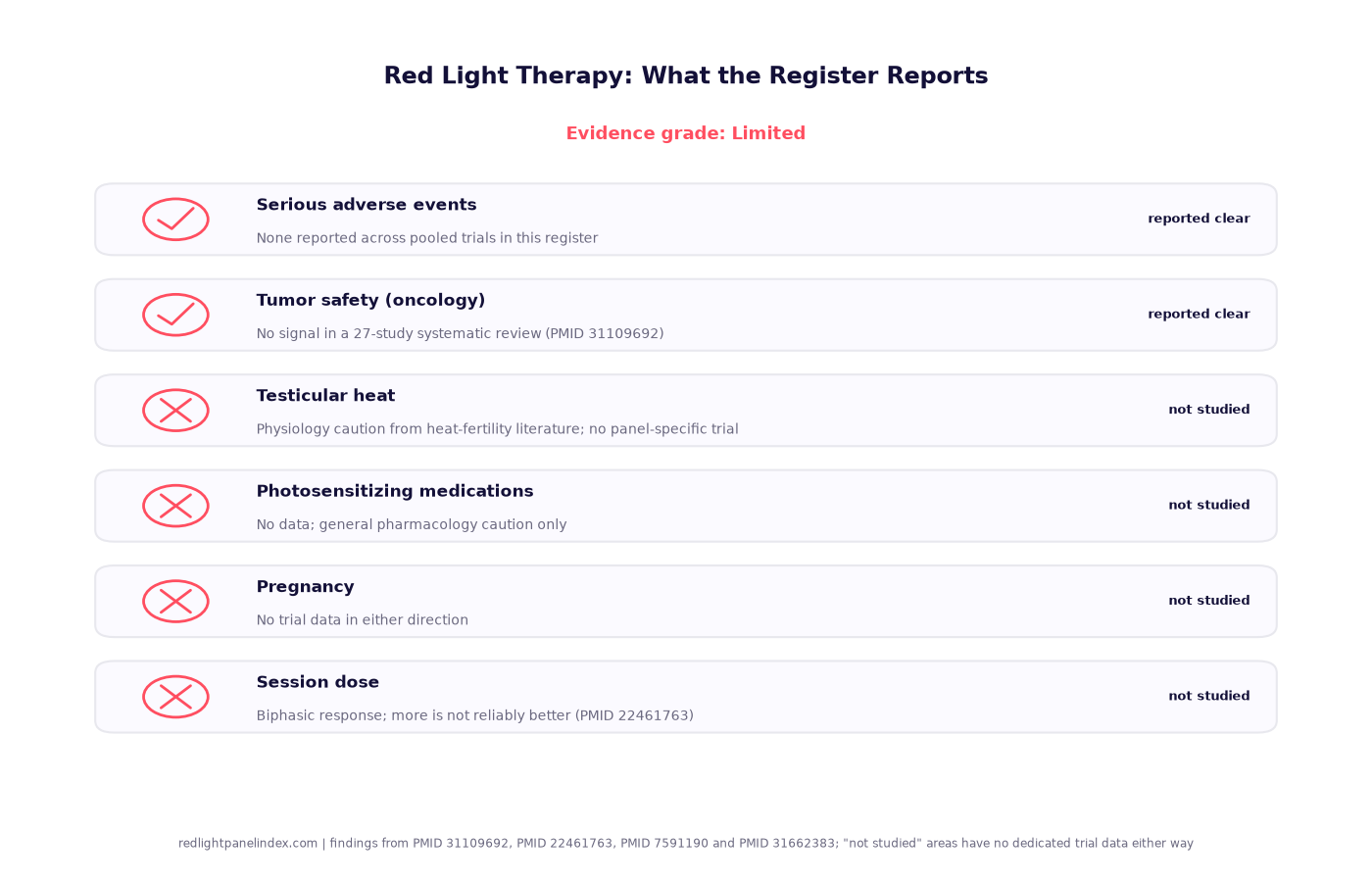
The evidence grade for red light therapy safety is Limited: no serious adverse events have turned up in the trials this index has reviewed, and a systematic review found no tumor-safety signal in cancer patients using it as supportive care, but that reassurance comes almost entirely from studies designed to test whether the therapy works, not from studies designed to test whether it is safe for specific groups. The caution areas that matter most, heat near the testes, eye exposure, photosensitizing medications and pregnancy, have little or no dedicated data either way.
Choosing a panel? Our ranking of the best red light therapy panels is computed from published, method-labeled specs across 188 devices. For safety, the spec that matters is session dose, since going well past a studied protocol is the one variable a user actually controls.
What the studies report
A systematic review by de Pauli Paglioni and colleagues examined the safety profile of photobiomodulation therapy used to prevent and manage side effects of cancer treatment, pooling 27 studies covering supportive care for oral mucositis, lymphedema, radiodermatitis and peripheral neuropathy in cancer patients (PMID 31109692). The review's specific concern was tumor safety, whether light therapy given to a cancer patient could theoretically promote residual tumor growth, and it reported no evidence that photobiomodulation therapy led to tumor safety problems across the pooled studies. This is one of the more direct pieces of reassurance available: a body of oncology literature that would be expected to flag a tumor-growth signal if one existed did not find one.
Reported adverse events in the general photobiomodulation literature run the same direction. This index's knee osteoarthritis page, covering a meta-analysis of 22 randomized placebo-controlled trials with 1,063 participants, notes that no adverse events were reported in the pooled set (PMID 31662383). That pattern, trials run for an efficacy question that also track adverse events as a secondary measure and come back with nothing serious to report, is the shape of most of the safety evidence available for panels used at home. It is genuine evidence of an absence of common, moderate side effects in supervised clinical settings. It is not the same as a trial built specifically to test safety in the populations this page covers below.
One mechanism is worth naming directly because it explains why more light is not simply safer. Huang and colleagues, reviewing the biphasic dose response documented across low-level light therapy research, describe how key cellular mediators, including ATP production and mitochondrial membrane potential, follow a biphasic curve: benefits rise with dose up to a point, then decline, and in the case of reactive oxygen species the response is triphasic, with a second, disadvantageous peak at higher doses (PMID 22461763). A transcranial low-level light therapy study in mice with traumatic brain injury, cited in the same review, showed the same biphasic pattern in beneficial neurological outcomes. The practical read for a home user is not that overdosing on a panel is dangerous in the way a burn or a chemical exposure is dangerous; it is that stacking extra sessions or extra minutes on the theory that more energy means more benefit runs against the dose-response curve the mechanism literature actually describes.
The testicular heat caution
The one caution in this set with a real, if indirect, evidence base is heat near the testes. Mieusset and Bujan's review of testicular heating and its contribution to male infertility lays out why the testes are a special case: they sit outside the body cavity specifically because spermatogenesis is temperature-sensitive, and the review's documented concern is that elevated scrotal temperature, however it is caused, can impair sperm production (PMID 7591190). That review predates consumer LED panels and says nothing about them directly. It is cited on this page, and by extension anywhere this index discusses red light therapy for men, because it establishes the underlying physiology: a panel held close to the groin for an extended session is a heat source in addition to a light source, and the heat pathway is the one with an actual mechanism behind it, independent of whatever the light itself is doing. This index's testosterone page grades the light-and-hormones question Insufficient on its own terms; the heat caution here is a separate, physical concern layered on top of that gap.
What was not studied
- Panels used specifically over the testes. No trial in this index's register tested an LED panel held at a working distance over the groin for a defined session length and measured resulting scrotal temperature or fertility markers. The caution above is inferred from general heat-and-fertility physiology, not measured on a panel.
- Photosensitizing medications. Certain antibiotics, retinoids and other drugs are known to increase skin sensitivity to light in general, but no trial in this register tested red or near-infrared panel light specifically against a photosensitizing medication list.
- Pregnancy. No trial in this register enrolled pregnant participants or tested panel use during pregnancy. The absence of a documented risk is not the same as evidence of safety in that population.
- Long-term daily home use over years. The supervised trials behind the safety signal above ran for weeks to a few months. Nothing in this register speaks to daily use sustained over years the way a home owner might actually use a panel.
- Eye exposure from red and near-infrared panels specifically. This index's eye protection guide covers the separate literature on bright-light eye exposure in more depth; this page does not repeat those figures. The related clinical research on 670nm light and vision, none of it run on a home panel, is graded separately on this index's eye health page.
The practical version
Two things follow from the biphasic dose-response finding above, and both are things a user actually controls. First, more sessions per week or more minutes per session is not a way to get more benefit once a protocol is already landing in the range trials have tested; the session frequency guide covers how published protocols are typically structured, and stacking well past that range works against the dose curve rather than with it. Second, the dose calculator converts your panel's method-verified irradiance and your session length into joules per square centimeter, which is the number worth keeping inside a studied range rather than maximizing. Understanding why the dose curve bends the way it does starts with the mechanism itself, covered on this index's photobiomodulation page.
Cautions
If you are male and use a panel for a goal that has you holding it close to the groin, treat the session like any other heat exposure to that area: keep sessions short and the panel at a working distance rather than pressed against skin, on the physiology the heat-and-fertility review above describes, not because any panel-specific trial has flagged a problem.
If you take a photosensitizing medication, a class that includes some antibiotics, retinoids and other prescriptions, ask the prescriber before starting regular light therapy sessions; this site's guide to photosensitizing medications lists the classes most often flagged and explains why nearly all of that evidence concerns ultraviolet exposure rather than a red or near-infrared panel. This is a reasonable precaution given the general pharmacology, not a documented panel-specific risk, because no trial in this register has tested the interaction directly.
If you are pregnant, the honest answer is that this register has no data either way, and that absence of data is a reason for caution rather than reassurance in either direction.
Eye exposure deserves its own read rather than a summary here; see this index's eye protection guide for that specific caution. And whatever your goal, the biphasic dose-response literature above is a reason to follow a studied session length rather than assume that doubling it doubles the benefit.