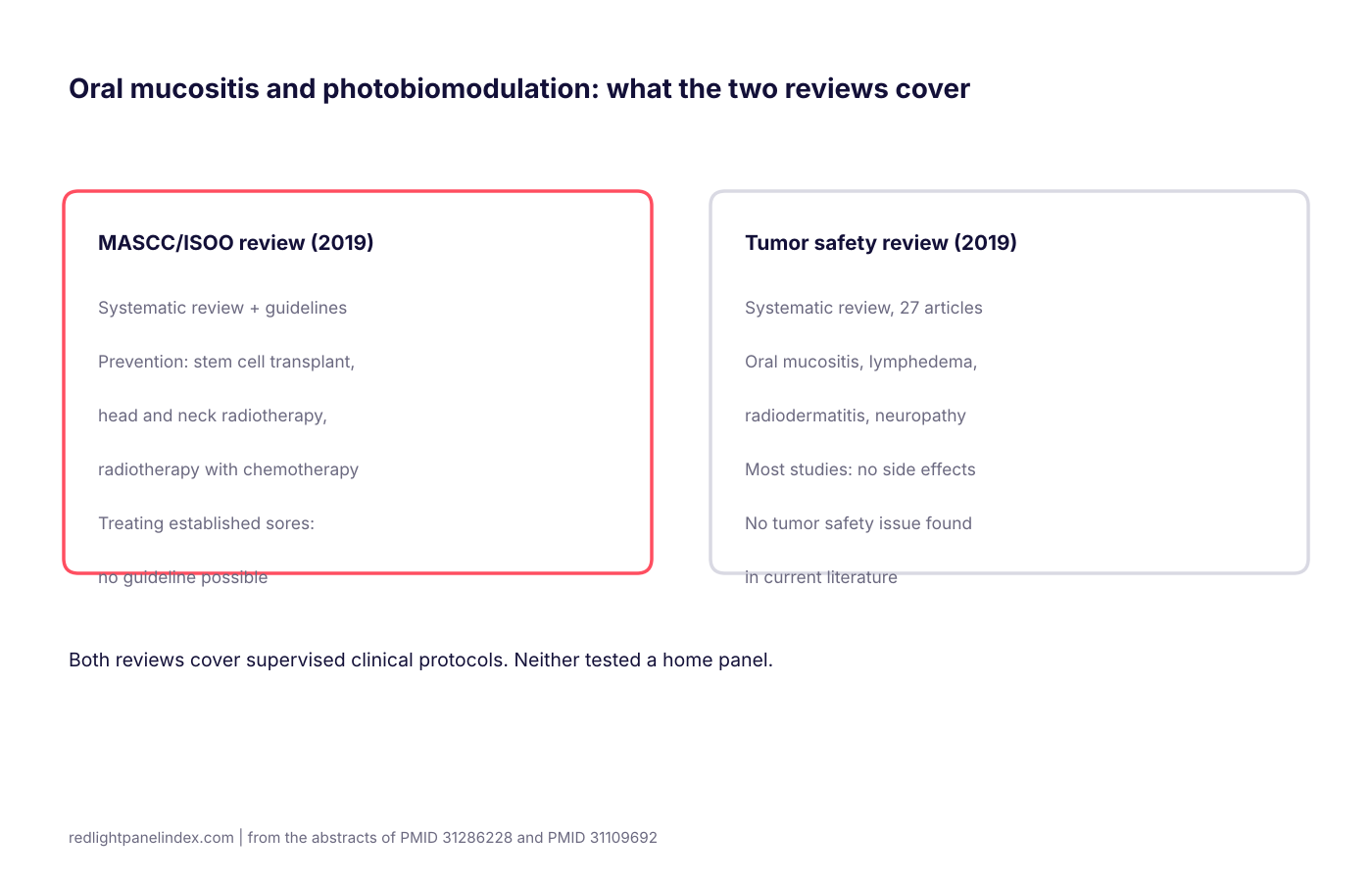
The evidence grade is Strong for one narrow use: photobiomodulation delivered by clinicians to help prevent oral mucositis in specific cancer-treatment settings, because a 2019 guideline review from the MASCC/ISOO Mucositis Study Group made prevention recommendations for those settings (PMID 31286228). It is Insufficient for any home panel, because neither review in this page tested one, and anyone in cancer treatment should take this to their oncology team rather than a device.
Choosing a panel? Our ranking of the best red light therapy panels is computed from published, method-labeled specs across 188 devices. For oral mucositis, the spec that matters is not on a panel at all, because the guideline concerns supervised clinic protocols; for general use, wavelength and irradiance with a named method are the figures to check.
What oral mucositis is
Oral mucositis is the painful inflammation and sores in the mouth that chemotherapy and radiation can cause. It is a toxicity of cancer treatment, not a skin or muscle condition, and the people affected are patients under active oncology care. That context is why this page is graded differently from the other entries in the evidence hub (for gum disease, see the periodontitis page): the studies come from clinic settings with trained staff, not from consumer devices.
The grades follow the scheme explained in evidence grades explained. Strong here refers to the quality of the guideline process for clinic use. It does not carry over to a wall or stand panel.
The guideline review
The MASCC/ISOO Mucositis Study Group, with 17 named authors, updated its clinical practice guidelines on photobiomodulation for oral mucositis in cancer patients (PMID 31286228). The group searched PubMed and Web of Science following MASCC methods and assigned a level of evidence to each intervention in each cancer-treatment setting.
What the abstract reports:
- Prevention recommendations were made for hematopoietic stem cell transplantation, for head and neck radiotherapy alone, and for head and neck radiotherapy with chemotherapy.
- For treating established oral mucositis, and for chemotherapy-related oral mucositis, the group concluded "No Guideline Possible" because the evidence was inadequate.
- Variable clinical settings limited how well the data could be combined.
- The group concluded that specific photobiomodulation settings support preventing oral mucositis in specific patient populations, and that the guidelines are subject to ongoing updates.
The abstract does not state wavelengths, doses or session counts, so none are quoted here. The full text of the guideline holds the parameter tables; a clinic follows those, not a consumer device label. The difference between clinic devices and panels is covered in the LED versus laser page.
The tumor safety review
A natural question in cancer care is whether light could stimulate residual malignant cells. A 2019 systematic review in Oral Oncology looked at exactly that (PMID 31109692). It searched Scopus, MEDLINE/PubMed and Embase and included 27 articles on oral mucositis, lymphedema, radiodermatitis and peripheral neuropathy.
Most of the included studies reported no side effects. The authors concluded that, on the current literature, photobiomodulation used for these toxicities does not appear to create tumor safety issues. They describe the review as possibly the first systematic review of that question. That is a reassuring finding, but it concerns clinic use under oncology supervision and is a statement about the literature to date, not a guarantee. The broader picture is on the safety and side effects page, and a related cancer-care topic is covered under chemotherapy neuropathy.
How to read the grade
A grade of Strong on this page rests on three things taken from the abstracts: the review is systematic, it follows a stated method (PubMed and Web of Science searches, MASCC methods, a level of evidence assigned per setting), and it ends in actual recommendations for named settings. That is a higher bar than most pages on this site meet. The same abstract also says "No Guideline Possible" for treating established sores, so the grade applies to prevention in the listed settings and nowhere else.
The grade also says nothing about consumer hardware. The evidence hub for oral health reaches the same conclusion from the other direction, grading home use of a panel on the mouth as Insufficient because the reviews covered lasers and clinic devices applied inside or directly against the mouth.
Prevention versus treatment
The two ideas are easy to blur. Prevention means applying light before or during cancer treatment, in a setting where sores are expected. Treatment means applying it to sores that already exist. The guideline group could make recommendations for the first in three settings (stem cell transplantation, head and neck radiotherapy alone, and head and neck radiotherapy with chemotherapy) and could not for the second. A reader who sees "photobiomodulation helps mouth sores" in a headline should check which of those is meant, and in which patients.
Why a panel is a different tool
Clinic devices used in these protocols are applied close to or inside the mouth by trained staff, and the settings are chosen for a specific patient and treatment course. A panel is built for a different job: a wide, even field aimed at skin or muscle from a set distance. Its published irradiance is measured at a stated distance, and, as the irradiance page explains, that number tells you little about light delivered to tissue inside the mouth. Nothing in the two reviews links a panel's output to mucositis outcomes, so a buyer has no evidence-based way to convert a guideline into a home session.
There is also the matter of who is affected. People with oral mucositis are in the middle of cancer treatment, often with blood counts, infection risk and swallowing problems that a clinical team monitors. Those reasons alone make this a supervised-care topic, whatever the grade says about the research.
What was not studied
- Home panels. Neither review is about a consumer panel aimed at the face or mouth.
- Treatment of established sores. The guideline group found the evidence inadequate to make a recommendation.
- Chemotherapy-related mucositis as a treatment target. Same conclusion: no guideline possible.
- Parameters you could copy. The abstracts give no wavelength, dose or schedule, so there is nothing here to enter into a calculator.
- Long-term outcomes. The abstracts do not report them.
Practical section for readers
If you or someone you care for is in cancer treatment, ask the oncology team whether their clinic offers photobiomodulation and under what protocol. The guideline concerns supervised delivery, and the team knows the treatment setting that the recommendations depend on.
For general understanding, the photobiomodulation overview explains the mechanism, and the wavelength guide and the pages on 660nm and 810nm cover the bands most panels list. If you use a panel for other purposes, the dose calculator turns irradiance and time into a dose, but it should not be used to design a mouth protocol for a cancer patient. Nothing in these reviews supports that.
Other oral topics with their own grades are on the oral health page and the TMJ page.
Cautions
- This page describes research, not medical advice, and it is not a protocol.
- People in cancer treatment should not add a device to their routine without their oncology team's agreement.
- Eye protection matters with any bright light source; see the eye protection guide.
- A guideline for prevention in named settings does not extend to other settings, and the same group found no basis for a recommendation on established mucositis.