Most of the older photobiomodulation evidence base was built on lasers, and most panels sold for home use are LED, so it is a fair question whether that swap changes anything: the photon and its wavelength appear to matter for tissue outcomes, coherence has not been shown to, but dose delivery differs between the two technologies in ways that do not transfer without recalculation.
Choosing a panel? Our ranking of the best red light therapy panels is computed from published, method-labeled specs across 188 devices. For an LED panel, the spec that matters is its method-labeled irradiance at your working distance, not a comparison to laser peak power.
What coherence and collimation actually mean
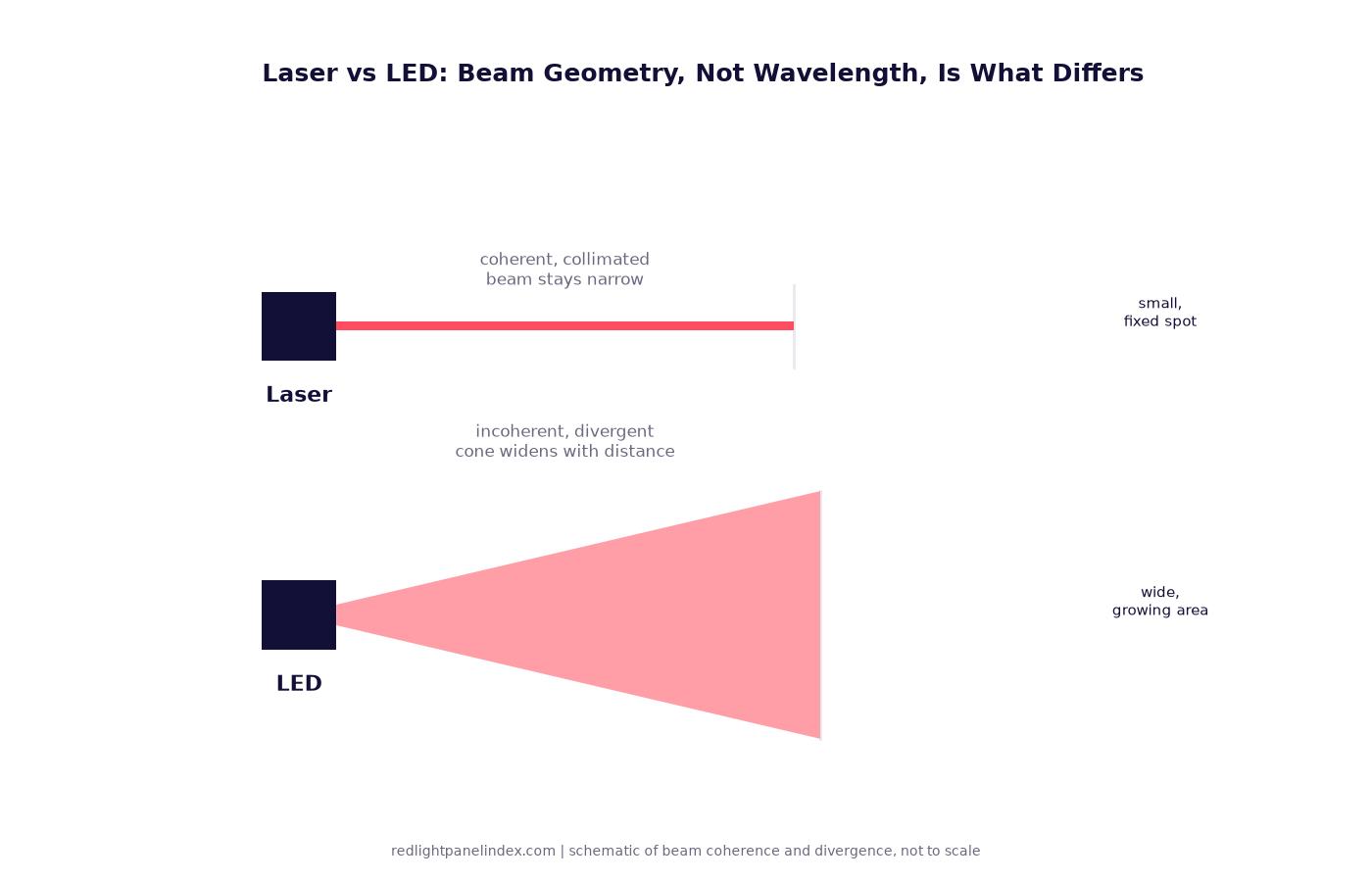
A laser produces coherent light: every photon leaves in phase with the others, at the same wavelength, traveling in the same direction. That coherence is what lets a laser stay collimated, a narrow, parallel beam that spreads very little over distance, the property behind a laser pointer's tight dot from across a room. An LED works differently. It is a semiconductor junction that emits photons in essentially random phase relationships and in a spread of directions at once, an incoherent, divergent source. This site's beam angle explainer covers the practical result: an LED panel's light cone widens with distance in a way a collimated laser beam does not, which is why panels are rated by beam angle and worked at a stated distance rather than treated as a point source.
For decades, that physical difference was baked into the field's name: low-level laser therapy, or LLLT, implied the laser itself was doing something a non-laser source could not. That assumption started to give way once LED sources were tested directly against the outcomes lasers had already shown.
The 2015 terminology shift
A short 2015 editorial addressed the naming question directly, arguing that "low-level laser therapy" carried two claims in its name that had turned out to be misleading: that a laser specifically was required, and that a single "low" dose threshold applied universally (PMID 25844681). The authors proposed "photobiomodulation therapy" as a replacement term precisely because it does not specify a light source, only the biological effect: light-driven modulation of cell activity. This site's own photobiomodulation explainer traces that same history, from Endre Mester's 1971 laser wound-healing work through NASA-funded LED research in the early 2000s that reported comparable outcomes without a laser at all. The terminology shift did not happen because someone ran a laser-versus-LED trial and declared a winner; it happened because the accumulating evidence stopped supporting coherence as a necessary ingredient, and the field's own name changed to stop implying it.
A separate, broader 2012 review of the field's mechanisms and clinical applications makes a related point from the mechanism side: photobiomodulation research had already broadened to include light-emitting diodes and other sources well beyond the original laser work, with the review summarizing mechanisms at the cellular and tissue level, common light sources, and clinical dosimetry across that expanded source list rather than treating laser as the only device worth reviewing (PMID 22045511). Between the two papers, the shared thread is that the field's working model for how the light acts on tissue, principally photon absorption by mitochondrial chromophores such as cytochrome c oxidase, does not depend on whether the photons arrived coherent or not.
What has not been shown to matter
Neither paper reports a controlled trial isolating coherence itself as a variable, meaning one that holds wavelength, irradiance and dose fixed and only changes whether the source is coherent. That is worth stating plainly: the case for "coherence probably does not matter for tissue outcomes" rests on the pattern that LED-sourced studies have reproduced laser-sourced findings across many conditions and outcomes, not on a single head-to-head trial that isolated the coherence variable alone. A tissue's chromophores absorb photons based on wavelength, not on phase relationship between photons, which is the physical basis for why coherence would not be expected to change the absorption event itself. But "not shown to matter, and no plausible mechanism identified for why it would" is a different, weaker claim than "proven not to matter," and this article does not overstate it into the latter.
What does differ between the two sources
Coherence aside, LEDs and lasers deliver light differently in ways that do carry real dosing consequences:
- Beam geometry. A laser's collimated beam concentrates a fixed power into a small, largely constant spot regardless of distance within reason; an LED's beam angle means irradiance falls off with distance and coverage area grows, so the same panel delivers very different J/cm2 at 6 inches versus 18 inches.
- Coverage area. A single laser is typically used as a point or small-spot device, often moved across multiple treatment points in one session; an LED panel illuminates a broad area at once, which is why panel-based protocols are usually described in irradiance over an area rather than joules delivered to one point.
- Dose reporting convention. Laser trials, including the low back pain literature this site's back pain evidence page covers, often report dose as joules per treatment point; panel trials and manufacturer specs report irradiance in mW/cm2 and total dose in J/cm2 over a session. Converting a per-point laser dose into an equivalent panel session is not a straightforward unit conversion, since the treated area itself is different.
- Driver electronics. An LED panel's output depends on its driver circuitry, which is also the source of any unwanted flicker, an issue that does not arise the same way with a continuous-wave laser diode.
None of this is a coherence effect; it is a consequence of how each source's light is shaped and reported, and it means a dose figure from a laser trial should not be typed directly into a panel session-length calculation without adjusting for the treated area and delivery pattern.
Reading marketing claims about coherence
Some panel listings describe their output as "laser-like" or emphasize a tight beam angle as though it were evidence of therapeutic superiority. Given everything above, a narrow beam angle is a coverage and irradiance-at-distance property, covered on this site's beam angle page, not a sign that the LED source has become coherent; LEDs do not produce coherent light regardless of how narrow their optics make the beam angle. A tighter beam concentrates more of a panel's total output into a smaller area at a given distance, which raises irradiance there and can shorten the session needed to reach a target J/cm2, and that is a real, useful property worth knowing before buying. It is a different claim from coherence itself changing how tissue responds to the light, which is the claim this article does not find support for. A buyer comparing two panels is better served by comparing their method-labeled irradiance and beam angle side by side than by a brand's coherence language.
The honest verdict
The wavelength and the dose delivered to tissue appear to be what the evidence tracks, not whether the source producing that wavelength was coherent. That supports treating LED panels as a legitimate delivery method for the outcomes this evidence base covers, provided the panel's actual measured output is known. It does not support assuming a laser trial's dose applies unchanged to a panel session: the delivery geometry, treated area and reporting convention differ enough that translating a laser protocol to a panel requires working from the panel's own method-labeled irradiance, run through the dose calculator, rather than copying a joules-per-point figure from a laser study onto a session timer. The LED chip page covers how a panel's diode design affects its own output profile, which is the more useful comparison for a panel buyer than laser-versus-LED coherence.