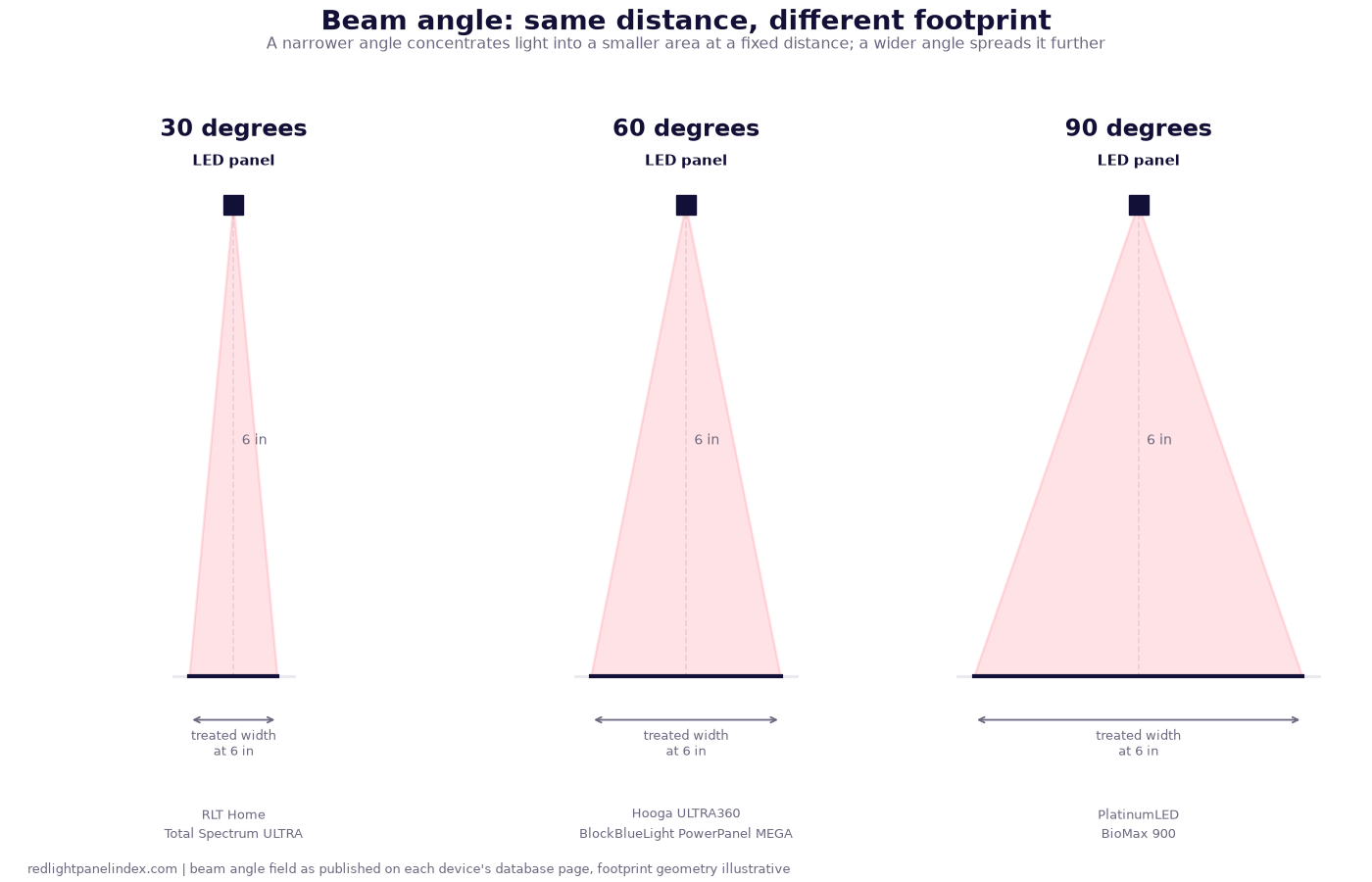
Beam angle is the angular spread of light coming off an LED panel's lens, published in degrees, and it determines how concentrated or spread out that light is once it reaches your skin at a given distance. A narrow beam angle, around 30 degrees, keeps most of a panel's output packed into a smaller area close up; a wide beam angle, closer to 90 degrees, spreads the same output over a bigger area and loses some of that concentration.
Choosing a panel? Our ranking of the best red light therapy panels is computed from published, method-labeled specs across 188 devices. For beam angle, the spec that matters is the published degree figure alongside a method-labeled irradiance reading at the same distance, since one without the other tells you little.
What beam angle actually measures
The figure describes how much an individual LED's light cone spreads before it overlaps with its neighbors, and by extension how tightly the whole panel's array of LEDs concentrates its combined output. A single LED with a narrow 30-degree lens throws most of its light in a tight column; the same LED with a 90-degree lens spreads that same total output across a much wider area. Panels build their overall beam angle from the lens choice across every LED in the array, so it is a single published number even though it summarizes hundreds of individual emitters.
This is a separate spec from wavelength, irradiance or total power, and manufacturers do not always publish it: some database pages here show a specific degree figure, and others show "not published" because the brand never disclosed it. Beam angle is also a distinctly LED spec; a collimated laser beam does not spread the same way, one of the practical differences this site's LED vs laser comparison covers between the two source types.
Why a narrower angle raises irradiance close to the panel
Total optical power is fixed by a panel's LED count and driver current; beam angle decides how that fixed amount of light gets distributed across an area at any given distance. Concentrate the same total output into a 30-degree cone instead of spreading it across a 90-degree cone, and the light lands more densely per square centimeter directly in front of the panel, which is what a higher irradiance reading, in mW/cm2, actually reflects. This site's irradiance page covers how that figure is measured and why the instrument used to measure it matters, but the beam angle is one of the underlying reasons two panels with a similar total power rating can post noticeably different irradiance numbers at the same working distance.
The tradeoff runs the other way for coverage. A wide 90-degree beam angle sacrifices some of that close-up concentration in exchange for lighting up a bigger patch of skin from the same panel and the same distance, which matters more for a full-body session than a single joint.
The geometry, worked out at a common 6-inch distance
Beam angle is an angle, so simple trigonometry turns it into an actual footprint width at a given distance: width equals twice the distance times the tangent of half the beam angle. Run that on the three published angles in this site's database at the 6-inch distance most brands use for their headline irradiance figure, and the spread is stark. A 30-degree beam angle, like the RLT Home Total Spectrum ULTRA's, works out to a roughly 3.2-inch-wide cone of concentrated light at 6 inches. A 60-degree angle, shared by the Hooga ULTRA360 and the BlockBlueLight PowerPanel MEGA, spreads to about 6.9 inches. A 90-degree angle, like the PlatinumLED BioMax 900's, reaches roughly 12 inches, close to quadruple the narrow panel's footprint from the same single point of light.
Those figures describe the geometry of a single emitter's cone, not a measured footprint any brand publishes; a real panel is an array of many LEDs side by side, so its actual illuminated area also depends on the panel's physical length and width, not the beam angle alone. What the math does show plainly is why doubling a beam angle does not just modestly widen coverage, it compounds through the tangent function, which is the underlying reason a 30-degree panel and a 90-degree panel of similar total output can feel like different classes of device up close even when neither number alone says so.
How beam angle interacts with distance
A narrow beam and a wide beam do not diverge at the same rate as you move away from the panel. This site's inverse-square law page explains why irradiance falls off faster than a straight-line guess would suggest once you are far enough from a panel for it to behave like a point source rather than a flat array, and a narrower beam angle reaches that point-source behavior differently than a wide one does: a tightly focused 30-degree beam keeps concentrating light into a smaller column for longer, so its irradiance advantage over a wider beam is largest close to the panel and tends to shrink at greater distances as both cones spread out and start to overlap the same area. That interaction is one more reason the guide to distance recommends checking a panel's own measured irradiance at the distance you actually plan to sit rather than assuming a spec sheet's 6-inch figure holds at 18 or 24 inches.
Which brands publish it
Not every brand discloses beam angle, and the ones that do are not always consistent about whether the number is measured independently or simply stated by the manufacturer. Driver quality is an even less transparent spec in the same category: this site's flicker explainer covers why no database page here currently states a measured percent-flicker figure at all, so beam angle and irradiance stay the specs worth checking first. A few examples from this site's database:
| Panel | Beam angle | Price |
|---|---|---|
| RLT Home Total Spectrum ULTRA | 30 degrees | $2,895 (verified 2026-09-12) |
| Hooga ULTRA360 | 60 degrees | $399 (verified 2026-09-12) |
| BlockBlueLight PowerPanel MEGA | 60 degrees | $1,500 (verified 2026-09-12) |
| PlatinumLED BioMax 900 | 90 degrees, per a Light Therapy Insiders beam-angle test | $1,299 (verified 2026-08-13) |
| PlatinumLED BioMax 300 | not published | $659 (verified 2026-08-13) |
The spread across just these five panels covers close to the full range this spec takes: a tightly focused 30-degree column, a common 60-degree middle ground shared by two otherwise different brands, and a 90-degree wide-angle panel at the far end, with one model that simply does not publish the figure at all. That last case is common enough that beam angle should be treated as a bonus spec to check when it is available, not a field you can assume every database page will have; the site's full database of 188 panels shows exactly which pages carry a published figure and which do not.
Picking a beam angle for your goal
A narrow beam angle suits a spot treatment where you want a smaller, stronger patch of light aimed at one joint or muscle from a short working distance, and it is one reason a device built for that use case can post a strong irradiance number despite a modest total power rating. A wide beam angle suits full-body or larger-area sessions, where covering more skin per session matters more than squeezing out the last few mW/cm2 at the panel's face, and it usually pairs with the longer working distances this site's guide to distance recommends for full-body coverage.
Neither angle is a defect on its own. A 30-degree panel used at typical full-body distance simply treats a narrower strip per session than a 90-degree panel of similar size would, and a 90-degree panel used close up for a single knee delivers less concentrated irradiance at that spot than a narrow-beam panel would at the same distance. The published beam angle figure, read alongside a method-labeled irradiance reading at the distance you actually plan to use, tells you which tradeoff a given panel is built around before you buy it, rather than after.