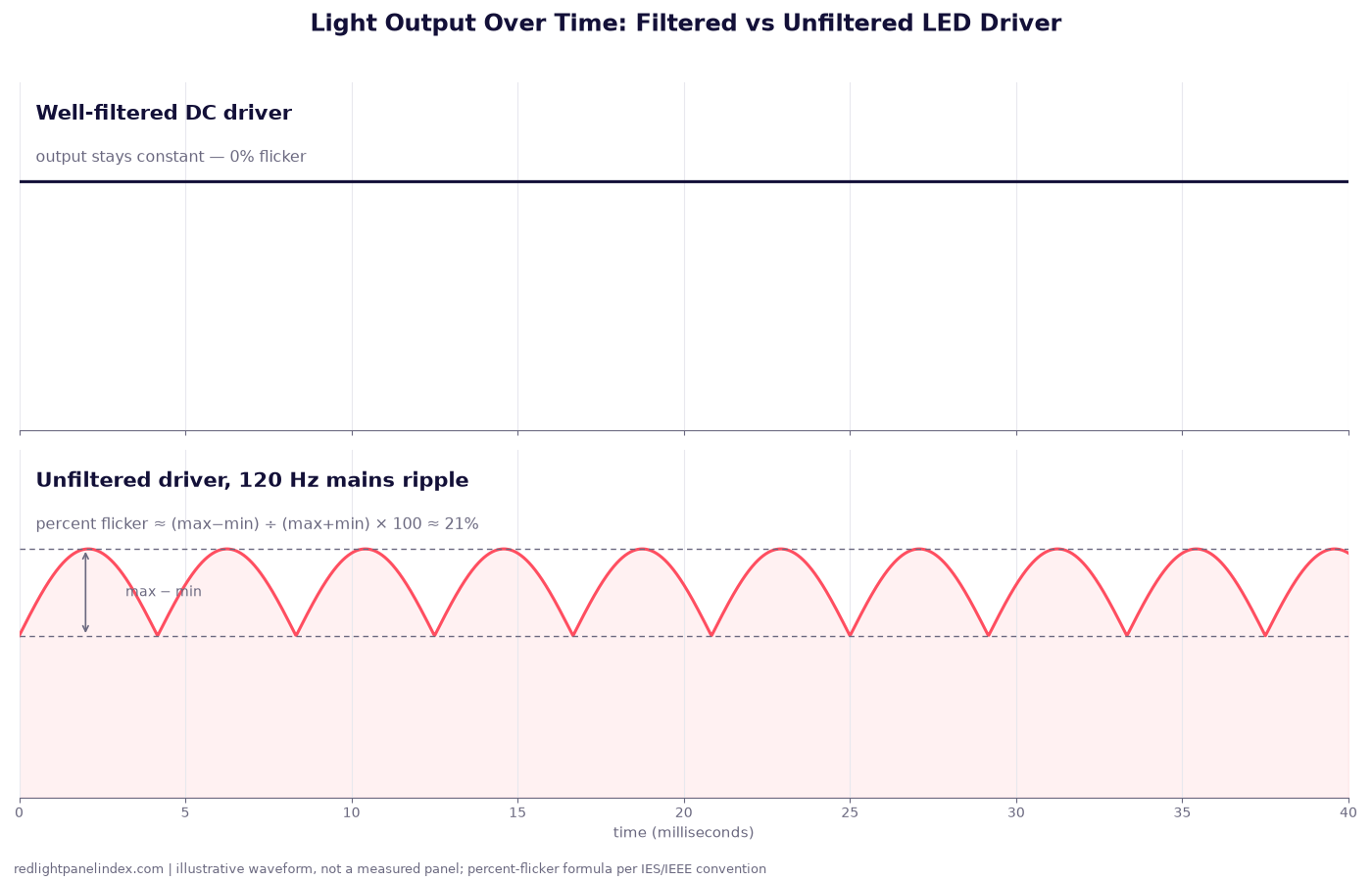
Percent flicker is how much an LED's brightness swings between its highest and lowest point within each cycle, calculated as the difference between the maximum and minimum output divided by their sum, times 100. Flicker index is a related but stricter measure that also accounts for the shape of that swing over time, not just its size, so two lights with the same percent flicker can still have different flicker indexes depending on how long each light pulse sits near its peak versus near its trough.
Choosing a panel? Our ranking of the best red light therapy panels is computed from published, method-labeled specs across 188 devices. For flicker, the spec that matters is whether a brand states a driver type or a measured percent-flicker figure at all, since most spec sheets are silent on it.
Why flicker happens in the first place
An LED only lights up while current is flowing through it, so anything that makes that current waver makes the light waver with it. The most common source is the driver, the circuit that converts wall power into the steady current an LED string needs. A cheap or poorly filtered driver rectifies alternating current from the wall but does not fully smooth out the ripple that rectification leaves behind, so the LED's brightness dips and rises at twice the mains frequency, 100 Hz on a 50 Hz mains supply or 120 Hz on a 60 Hz supply common in the US. A well-designed driver, whether it runs the LEDs on filtered direct current or on a pulse-width-modulated signal fast enough to sit above where the eye or a photosensitivity response can register it, keeps that ripple small enough that the output reads as effectively constant. This site's LED chip page covers how driver current also sets a panel's total optical power output; flicker is a separate question about how steady that current stays moment to moment, not how much of it there is on average.
The diagram above, read literally
The top waveform in the diagram is a well-filtered DC driver: the line stays flat, at 0 percent flicker, because the current reaching the LEDs barely varies. The bottom waveform is an unfiltered driver riding a 120 Hz mains ripple: the brightness rises and falls twice per mains cycle, and the gap between its peak and its trough, plugged into the percent-flicker formula, works out to roughly 21 percent in this illustrative example. A real panel's number depends on its own driver design and could sit anywhere from near zero to well above that, but no brand in this site's database currently publishes a measured percent-flicker or flicker-index figure for any model, so a buyer cannot look this spec up the way they can look up wavelength or irradiance today. The full device database is the place to check first if that changes.
The comfort question versus the therapeutic question
Flicker sits in a category by itself, separate from the mechanism this site's photobiomodulation page covers for how red and near-infrared light interact with cytochrome c oxidase in cells. That mechanism runs on the light energy delivered over a session, the same total-dose logic behind the site's average-irradiance approach to dosing, not on whether the light arrived as a perfectly flat stream or a rapidly ripple. Nothing in the photobiomodulation literature ties treatment effectiveness to a driver's percent-flicker figure, and no study this site has found tests a panel at two flicker levels and compares therapeutic outcomes. Whether flicker matters is a question about comfort and safety during the session, not about whether the treatment worked.
On that comfort question, the strongest established evidence is narrow and specific: visible flicker between roughly 3 and 65 Hz is a recognized trigger for seizures in people with photosensitive epilepsy, with peak sensitivity around 15 to 25 Hz, a finding built on decades of clinical and laboratory work in that population (PMID 42635523). A 2026 review of temporal light modulation from LED lighting draws a sharper line around everything past that established finding: it notes that direct evidence tying typical LED flicker, especially the much higher and often invisible modulation frequencies used by modern PWM drivers, to seizures in the general population is still missing, and it argues that future research should prioritize softer, more measurable outcomes such as headache, eyestrain and visual discomfort before attempting to establish anything about seizure risk from ordinary LED products (PMID 42635523). Read plainly, that puts flicker discomfort in the same bucket as fluorescent-light headaches that many people already recognize from office lighting: a real but individual sensitivity, strongest at low visible frequencies, with a much thinner evidence base once the frequency climbs into the tens of kilohertz range most PWM drivers actually use.
How this differs from a panel's pulse setting
It is worth separating driver flicker, an unwanted electrical artifact, from the deliberate pulse setting some panels offer as a chosen mode. This site's pulsed-versus-continuous review covers that second, intentional kind of on-off cycling, typically run at frequencies a user selects and that a brand states as a feature, built around a hypothesis that pulsing might change a therapeutic outcome. Driver flicker is the opposite: an unintended byproduct of a cheap power supply, present whether or not the panel even has a pulse mode, and never advertised as a benefit. A panel running in continuous-wave mode can still flicker if its driver is poorly filtered, and a panel with a well-filtered driver will not flicker even while running a deliberate pulse program, because the pulse program is switching current on and off on purpose at a frequency the brand controls, not letting mains ripple leak through unfiltered.
Why beam angle and coverage specs do not tell you about flicker
A panel's other published specs do not predict its flicker behavior. This site's beam angle explainer and its irradiance page both cover specs that describe how a panel's light spreads and how strong it reads on a meter, figures that come from the LED array and lens, not the driver circuit behind them. A panel with a tightly concentrated beam and a strong, method-labeled irradiance figure can still run on a poorly filtered driver, and a wide, lower-irradiance panel can run on a clean one; nothing about beam angle, wavelength mix or total irradiance implies anything about how steady the current supplying those LEDs actually is.
What to do without a published number
Since no database page here currently states a measured percent-flicker figure, the practical options are limited. A brand's stated driver type, when it is disclosed at all, is the closest available proxy: a driver described as constant-current or DC-regulated is less likely to leak mains ripple than one with no description at all, though a stated driver type is not the same thing as an independently measured flicker figure and should be read with the same caution this site applies to any unlabeled spec. For anyone who notices eye strain or a headache during or after a session and suspects flicker rather than the light exposure itself, the simplest check is a smartphone camera pointed at the panel with the room lights off: a rolling band or visible strobe moving across the video preview, especially when panning the camera slowly, is often a sign of flicker the eye alone does not register directly, because most phone camera sensors scan fast enough to catch a ripple the eye smooths over. That is not a substitute for a real flicker meter, but it costs nothing and can distinguish an obviously flickering panel from one that plainly is not.
The bottom line
Percent flicker and flicker index describe how much an LED panel's brightness wavers within each cycle, driven by driver quality and mains frequency rather than by anything about wavelength or dose. It has no established connection to photobiomodulation's therapeutic mechanism, but it is a real comfort and, in a narrow and well-defined population, safety issue, strongest at low visible frequencies and thinnest in the evidence once frequencies climb into the invisible range most modern drivers actually use. Because no brand in this site's database yet publishes a measured figure for it, flicker remains one of the few common specs a buyer currently has to take on faith, or check with a camera, rather than compare on a page. A related driver spec, the panel's EMF reading, fares slightly better on disclosure: a handful of brands do publish a measured figure, though most stay silent on that too.