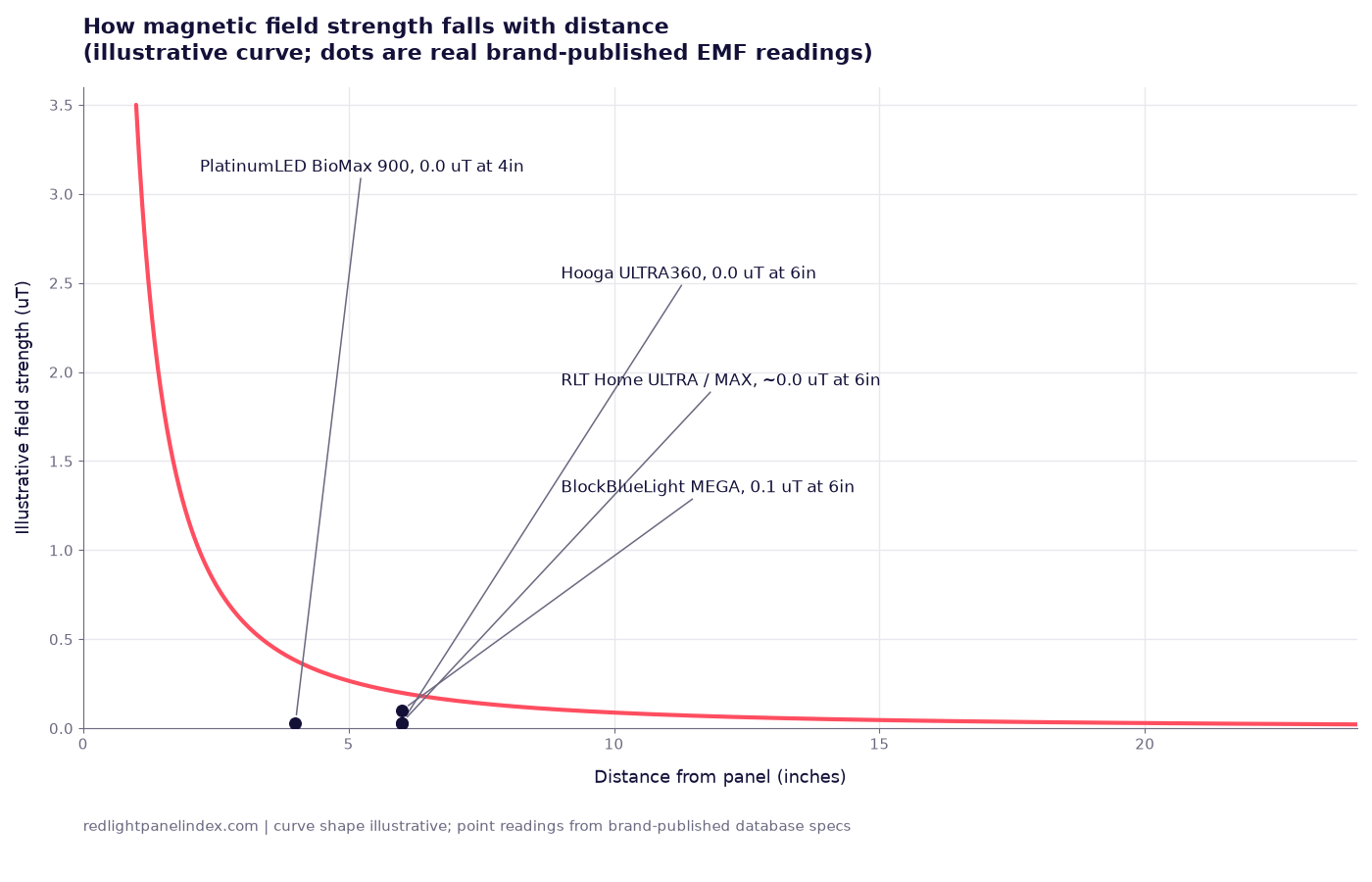
EMF, electromagnetic field, on a red light panel's spec sheet refers to the low-frequency magnetic field given off by the panel's internal power supply and cooling fan, not to the red or near-infrared light itself. It is measured in microtesla or milligauss at a stated distance from the panel with a dedicated meter, and only a handful of brands in this site's database publish that figure at all.
Choosing a panel? Our ranking of the best red light therapy panels is computed from published, method-labeled specs across 188 devices. For EMF specifically, the spec that matters is a measured microtesla or milligauss figure at a stated distance, not a bare "low EMF" marketing claim with no number behind it.
What kind of EMF a panel produces
A red light panel plugs into mains AC power and converts it, through an internal driver board, into the low-voltage current that runs dozens or hundreds of LEDs, plus whatever current runs the cooling fan on models that have one. Any current-carrying wire and any switching transformer gives off a low-frequency alternating magnetic field nearby, at the mains frequency (50 or 60Hz) and at the driver's own higher switching frequency. That is a separate physical quantity from the panel's light output: it is not photons and it is not irradiance in mW/cm2, and it is measured with its own instrument, a gaussmeter or dedicated EMF meter, not a spectrometer or solar meter. It is also not the same thing as the radiofrequency (RF) signal a phone or a WiFi router emits; a panel's driver and fan produce a near-field, extremely-low-frequency magnetic field, a different part of the electromagnetic spectrum measured on a different scale entirely.
How it falls with distance
A magnetic field from a compact source like a driver board or a fan motor weakens quickly as you move away from it, faster than most people expect and faster than the panel's own light output falls off with distance under the inverse-square relationship that governs irradiance. In practice this means an EMF reading taken a few inches from a panel's housing, where the driver and fan actually sit, can be meaningfully higher than the same reading taken a foot away, which is also why every brand-published EMF figure in this site's database is a single number at a single stated distance rather than a curve. No brand here publishes a second reading at a longer distance, so the shape of that decay for any specific panel is not public data; the diagram on this page illustrates the general pattern, not a measured curve for any one model.
How much EMF a given panel produces in the first place has more to do with driver design and internal shielding than with price or panel size. A larger panel does not automatically run a noisier driver, and a fanless panel is not automatically lower-EMF than a fan-cooled one; the fan itself is a small motor and, depending on its design, can be a meaningful source in its own right, separate from the driver board entirely. None of the brands in this site's database break their published EMF figure down by source, fan versus driver versus LED circuitry, so a buyer cannot tell from the spec sheet alone which component a given reading reflects.
How brands measure and report it
Where a brand publishes an EMF figure at all, it is stated the same way an irradiance figure is: a number, a unit, and a distance, the same discipline this site's claimed-vs-measured comparison applies to irradiance claims generally. Readings appear in microtesla (uT) or milligauss (mG); 1 uT equals 10 mG, so the two units describe the same physical quantity at different scales. Because the stated distance varies between brands, a 4-inch reading and a 6-inch reading are not directly comparable without accounting for that gap, the same caution this site gives for irradiance figures measured at different working distances.
What the database shows, brand by brand
| Model | Published EMF | Distance |
|---|---|---|
| RLT Home Total Spectrum ULTRA | ~0.0 uT | 6 in |
| RLT Home Total Spectrum MAX | ~0.0 uT | 6 in |
| PlatinumLED BioMax 900 (classic 9th gen) | 0.0 uT | 4 in |
| Hooga ULTRA360 | 0.0 uT | 6 in |
| BlockBlueLight PowerPanel MEGA | 0.1 uT | 6 in |
| Joovv Solo 3.0 | not published | - |
| MitoPRO 1500X | not published | - |
| Bestqool BQ40 | not published | - |
| Helio Cure Helio Blaze | not published | - |
Every model here that does publish a figure lands at or right below the resolution floor of a typical consumer EMF meter, 0.0 to 0.1 uT. For scale, the International Commission on Non-Ionizing Radiation Protection's 2010 guideline sets a general-public reference level of 200 uT for continuous exposure to 50/60Hz magnetic fields; even the highest of the five published readings here, the PowerPanel MEGA's 0.1 uT, sits roughly 2,000 times below that reference level. What the table also shows is the gap in reporting itself: four of the nine models checked here, including the Helio Blaze, the top-ranked pick on this site's full-body rankings, publish no EMF figure at all, so for those models there is no public number to weigh against a brand's own "low EMF" language, whatever that language claims.
What this means for a buyer
For most buyers, the practical takeaway is that every EMF figure this site could find published stays far below the general-public guideline level cited above, whether the reading is 0.0 uT or 0.1 uT. A buyer who is specifically sensitive to electromagnetic fields, or who identifies as electromagnetically hypersensitive, has a narrower set of options: only the five models above give a public number to check at all, and even those numbers were measured at one fixed distance rather than at the working distance that buyer might actually use. This site's guide to distance from a panel covers how light output changes with standing distance; the same logic, that moving farther away lowers exposure, applies to a panel's EMF, though without a published curve there is no way to say by how much for any specific model. No study on this site's evidence pages examines EMF exposure from a red light panel itself; the research this site cites elsewhere addresses the light exposure, not the electronics, so a published EMF figure, where one exists, remains the only concrete data point a buyer can check before comparing panels on the wavelength and irradiance grounds this site covers everywhere else.
EMF sits alongside a small group of specs on this site that describe a panel's electronics rather than its light output, the same category as driver flicker, the rapid on-off ripple a poorly filtered power supply can leave in the light itself. The two are measured differently and come from different parts of the same driver circuit, but both are the kind of spec a brand can choose to publish or leave off the page entirely, and both currently have far fewer database entries than a panel's wavelength mix or irradiance, the two figures most brand pages treat as standard. A buyer who wants the fullest picture of a panel's electronics, not just its light, has to check for both figures separately rather than assuming a panel transparent about one is transparent about the other; nothing in this site's database ties the two together, and a brand publishing a clean EMF number says nothing about whether that same brand also publishes a flicker figure, or the reverse.