Most red light panels are designed to be used somewhere between 6 and 24 inches from the skin. Sit closer, around 6 to 12 inches, for a stronger, more concentrated dose on a smaller area in a shorter session; sit farther, 18 to 24 inches, to cover more of the body at once at a gentler intensity, with a longer session needed to reach the same dose.
Choosing a panel? Our ranking of the best red light therapy panels is computed from published, method-labeled specs across 188 devices. For distance, the spec that matters is irradiance measured at the distance you actually plan to sit.
Why distance changes so much
Irradiance, the light landing on each square centimeter of skin, falls fast as you move away from a panel. This site's irradiance page and claimed-versus-measured dataset track panels almost entirely at a single distance, 6 inches, because that is the distance most brands choose to publish, and it is also close enough that a flat panel does not yet behave like the simple point-of-light the inverse square law describes. What that means practically: the number on a spec sheet is only accurate at the one distance it was measured, and moving even a few inches changes your actual dose more than most buyers expect.
What brands actually publish
Across this site's database, the pattern is consistent: brands publish one irradiance figure, almost always at 6 inches, and stop there. None of the panels checked for this guide publish a second figure at 12, 18, or 24 inches, so there is no brand-supplied table showing how a specific panel's output falls off as you back away. The claimed-versus-measured dataset also shows why the 6-inch figure itself needs a second look before you use it: across 44 panels with both a brand claim and an independent spectrometer reading, the claim runs a median 2.18 times the measured figure, because most brands report a solar meter reading rather than a spectrometer reading, and a solar meter reads roughly twice as high on the same panel.
Estimating irradiance at other distances
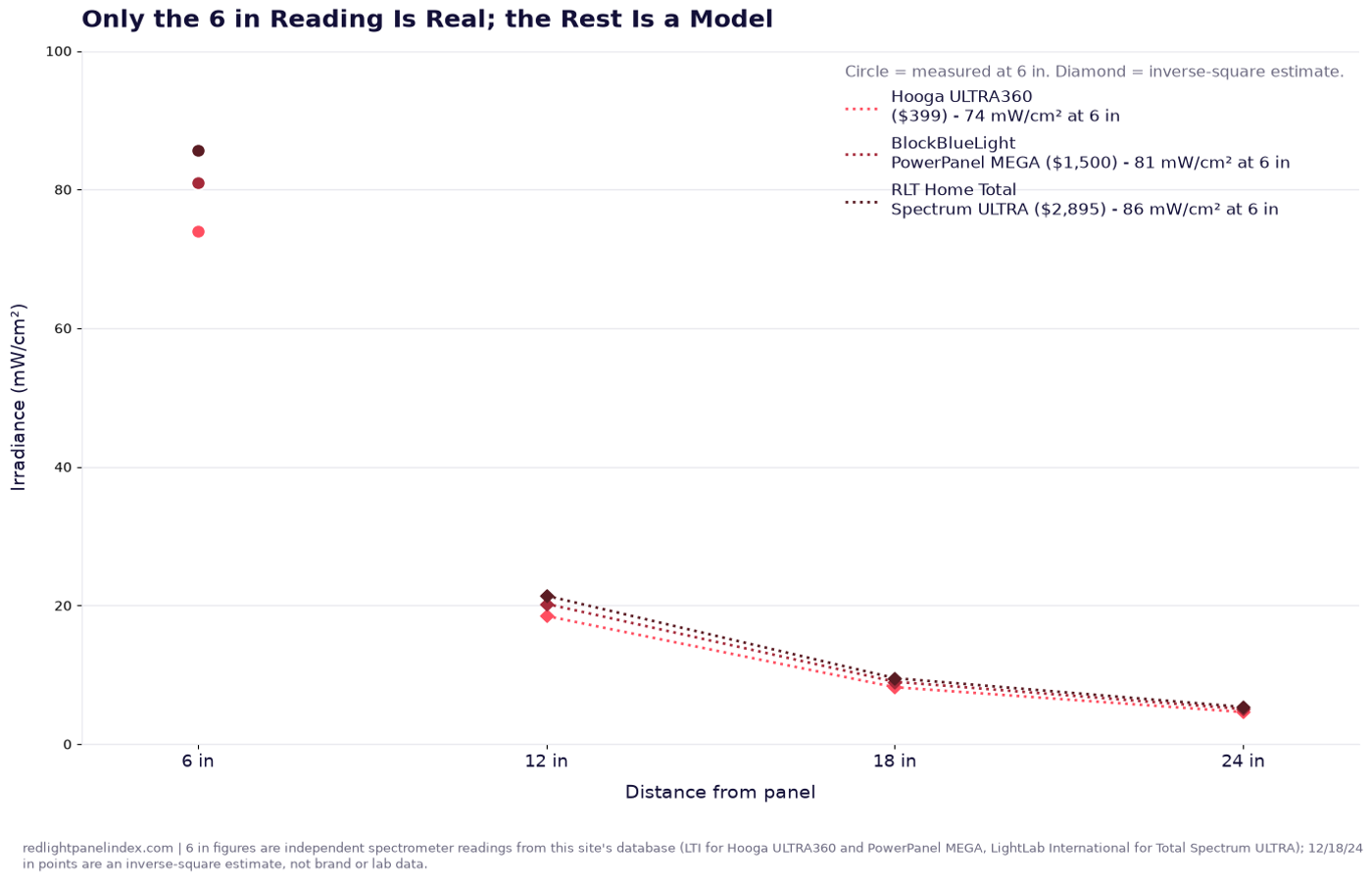
<img src="/assets/img/uploads/distance-from-panel-20260917.webp" alt="Chart of measured irradiance at 6 inches for three database panels, with modeled falloff at 12, 18 and 24 inches">
The chart above starts from three real, independently measured 6-inch figures in this site's database: the Hooga ULTRA360 at 74 mW/cm² (LTI spectrometer, $399), the BlockBlueLight PowerPanel MEGA at 81 mW/cm² average (LTI Gen5, $1,500), and the RLT Home Total Spectrum ULTRA at 85.7 mW/cm² average (LightLab International, $2,895). The 12, 18, and 24-inch points on the chart are not measurements; they are modeled from the 6-inch figure using the inverse square law, marked with a different shape so they are not mistaken for real data. As the inverse square law explainer covers, that model likely understates a real panel's output at 12 inches, because a flat panel falls off more gently than a point source does at short range, so treat the modeled points as a conservative floor rather than an exact prediction.
The practical takeaway is the same regardless of exactly how steep the real curve is: irradiance drops fast enough between 6 and 24 inches that a session length calculated for one distance will noticeably underdose or overdose you at another, and price does not track this at all. The cheapest of the three panels here, the ULTRA360 at $399, actually posts a higher measured 6-inch figure than nothing in this set, and the gap between the three panels' 6-inch readings, 74 to 85.7 mW/cm², is far smaller than the sevenfold price difference between the cheapest and most expensive.
Picking a distance by goal
For a single joint, a patch of skin, or any spot treatment, sit closer, 6 to 12 inches, so you can use the panel's strongest, most reliably measured reading and reach a useful dose in a shorter session. This is also the range where most of the independent spectrometer figures in this site's database were actually taken, so it is the distance you can be most confident about.
For anything closer to full-body use, standing far enough back to have the beam cover the torso or both legs at once, you will typically end up 18 to 24 inches away simply because that is how far back a person has to stand for a panel's width to cover that much of the body. Expect a real drop in irradiance at that range compared with the 6-inch figure on the spec sheet, and plan for a longer session rather than assuming the published number still applies. A panel's beam angle affects that math too: a narrower angle needs more standing distance to spread across the same width than a wide-angle panel of similar size does, so two panels with the same physical dimensions can call for different working distances to cover the same area.
Using the dose calculator
Once you know your working distance, the dose calculator turns an irradiance figure and a session length into joules per square centimeter, the unit most trials report doses in, with a typical therapeutic range of roughly 10 to 60 J/cm². Feed it the irradiance figure closest to your actual distance, not a number you have adjusted by guesswork, and lean toward the lower end of an estimated range if the figure you are using was modeled rather than measured. For the full formula behind that calculator, including three worked examples at real measured irradiance figures, see dosing explained, or how long a session should actually run for the arithmetic on its own. If a brand only publishes a 6-inch figure and you plan to sit farther away, that is the clearest case for treating the calculator's output as an upper bound rather than a guarantee.
Distance also affects heat and eye exposure, not just dose
Sitting very close to a high-output panel for a long session can make the skin uncomfortably warm well before you reach an unsafe dose, since the light itself at panel intensities is non-thermal and non-ionizing but the panel's own housing and LEDs still generate heat. If a session feels too warm at 6 inches, back off to 10 or 12 inches and lengthen the session rather than pushing through discomfort at close range. Near-infrared wavelengths are also invisible and can be bright enough to be uncomfortable up close, so follow the manufacturer's guidance on eye protection at whatever distance you settle on, and be more cautious the closer you sit.
Matching distance to a stand or mount
A panel bolted to a wall or a fixed stand only gives you one practical distance unless you also move your body, so the decision above is worth making before you mount it, not after. If you expect to use a panel for both a quick spot treatment and an occasional full-body session, an adjustable stand that lets you move between roughly 8 and 20 inches covers both uses without needing a second panel, though every distance in that range still needs its own irradiance figure, real or estimated, before you trust a calculated session length.
Once you have settled on a working distance, this site's beginner's 30-day protocol shows how to hold that same distance, plus a matching frequency and session length, steady across a full four-week course.
A distance that changes without you moving
It is also worth checking that your working distance has not quietly drifted between sessions. A panel mounted on an adjustable stand, or used freehand at different times, can easily put you 4 inches closer or farther than you were the last time you calculated a session length, and given how steeply irradiance falls near the panel, that alone can shift your dose by a meaningful margin. Measuring your actual sitting distance once, rather than estimating it by eye each time, is a small step that keeps the number you plugged into the calculator honest.