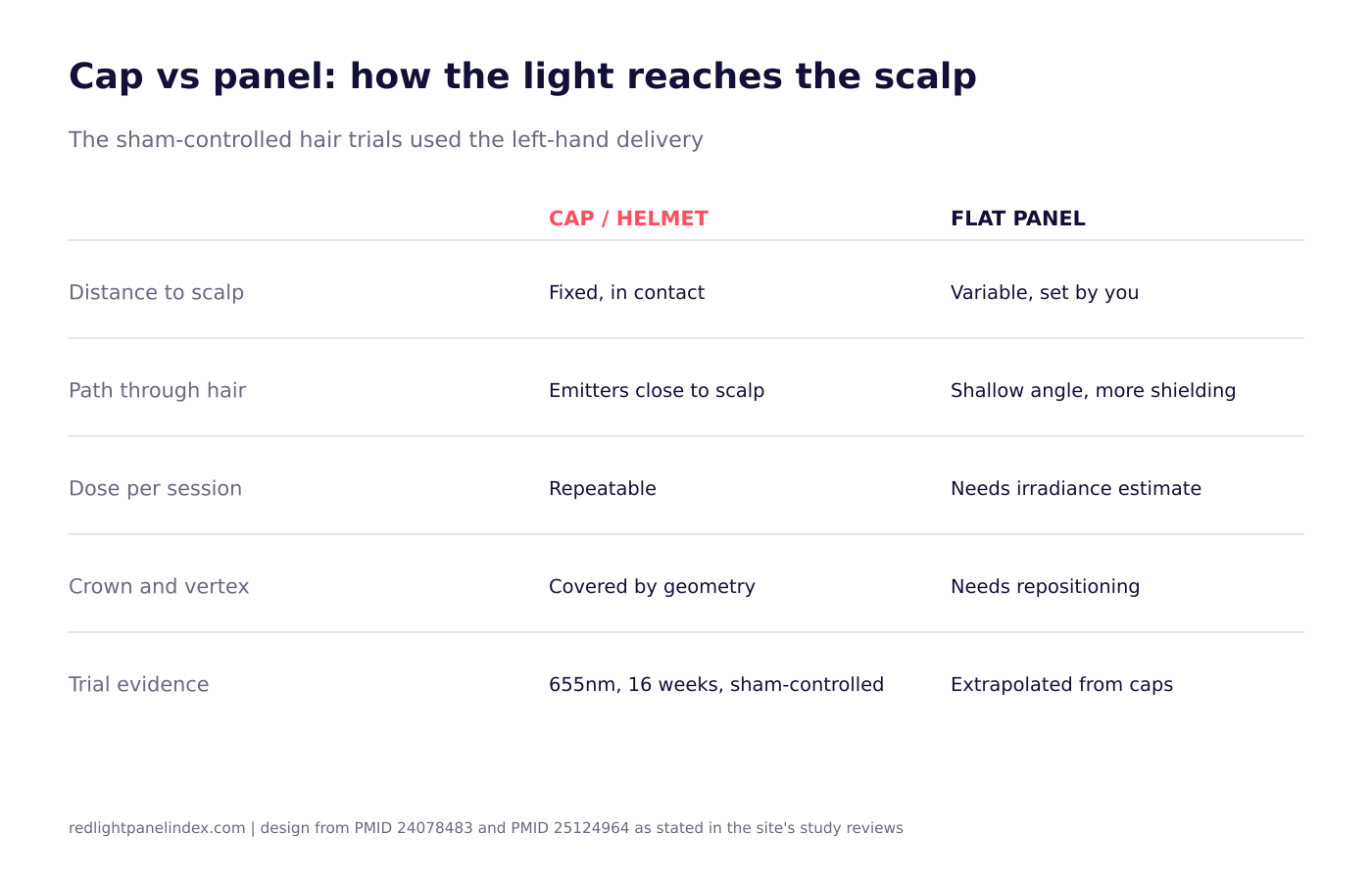
For pattern hair loss, the published sham-controlled evidence belongs to head-worn devices that hold 655nm emitters against the scalp, so a cap or helmet matches the evidence and a flat panel is an extrapolation from it. A panel can still put red light on the scalp, but it gives up the fixed contact, the fixed dose and the clear path through hair that the trials relied on.
Choosing a panel? Our ranking of the best red light therapy panels is computed from published, method-labeled specs across 188 devices. For hair growth, the spec that matters is a red band near 655nm and a dose you can actually control at the scalp.
What the trials actually tested
The two best-known trials were run by the same group on the same device. The men's trial reported a significant hair count increase versus sham after 16 weeks (PMID 24078483), and the women's trial reported a comparable result (PMID 25124964). Our study review of the men's trial and the women's trial review give the full design. The parts that matter for this comparison are about delivery, not outcome: For women specifically, see the evidence page on female pattern hair loss.
- The device was a helmet-style unit with 21 laser diodes at 655nm and 30 LEDs at about 655nm.
- It was worn at home every other day for 16 weeks, 25 minutes per session, 60 treatments in total.
- The emitters sat in fixed positions around the head, so every session delivered a similar dose to the same scalp areas.
- The comparison group wore an identical-looking unit that emitted only incandescent red light.
That last point is easy to miss. The trial result is a result for a specific delivery system, not for "red light on the scalp" in general. Our hair growth evidence page is graded Strong, and it limits that grade to pattern hair loss, roughly 650-655nm and dedicated scalp devices. A review of the mechanisms and patient selection for photobiomodulation in alopecia (PMID 31686888) frames the same body of work and is a reasonable next read for the biology.
Where a cap or helmet has the advantage
Contact and distance. A head-worn device removes the biggest uncontrolled variable in panel use, which is how far the scalp is from the light. Irradiance falls with distance, and the distance guide shows how quickly a panel's output changes between a few inches and a few feet. A cap does not move between sessions.
Hair as a barrier. The target is the follicle in the skin, and hair on the way in absorbs and scatters some light. Devices built for this job place emitters close to the scalp, often in a layout that lets light pass between strands. A panel aimed at the top of the head has to get through the same hair at a shallow, changing angle.
Dose repeatability. The trials reported a fixed per-session dose. With a cap you can repeat that protocol. With a panel you have to estimate irradiance at your scalp, then calculate time, which the dose calculator can do but only as well as the irradiance figure you feed it. Our guide to how often to use red light therapy covers the schedule side.
Coverage of the right areas. Pattern loss is concentrated at the crown, vertex and temples. A helmet geometry covers these together. A panel facing you covers the forehead and front hairline well and the crown poorly unless you tilt your head or use a second position.
Where a panel has the advantage
One device, many uses. A panel can treat skin, joints and recovery as well. If hair is a secondary goal, that flexibility may matter more than matching the trial geometry. The targeted device vs full panel guide explains the broader trade-off.
Area and wavelength range. Panels cover a large area and typically include near-infrared bands. Whether those extra bands add anything for hair is not established by the trials above, which tested red light only.
Comfort and session handling. A panel can be used hands-free from a chair without wearing hardware, though you then have to hold still at the right distance for the whole session.
What the site's database shows
The database tracks no dedicated hair caps or helmets across its 41 brands, so a like-for-like cap comparison from database fields is not possible here. The best hair growth devices ranking therefore ranks panels only, on method-labeled irradiance, 660nm share, price, warranty and trial terms. Two points from the database matter for this guide:
- The iRestore Apex panels are flat LED panels, even though the brand also sells hair products. The iRestore listing notes that the brand's FDA-cleared hair-growth devices are a different product, and that the Apex panels are 510(k)-exempt and registered, not cleared. The Apex Elite 2160 page lists 660nm among its wavelengths, but the brand does not publish the share of output at each wavelength, and its 200 mW/cm2 at 6 inches is brand-stated with no named instrument.
- The Hooga HG300 is a panel with a claimed irradiance that independent testing measured at roughly half. On this site, an irradiance figure without a stated method is treated as unverified. See irradiance methods for how the labels work.
A panel at 660nm sits close to the 655nm used in the trials, and the 660nm page explains why that band is the most studied red wavelength. Close is not identical, and neither the wavelength nor the distance has been tested head to head against a cap in a published trial that we have read.
Side by side
| Factor | Cap or helmet | Flat panel |
|---|---|---|
| Matches the sham-controlled trials | Yes, same delivery type | No, extrapolation |
| Distance to scalp | Fixed, contact | Variable, you set it |
| Light path through hair | Emitters close to scalp | Shallow angle, more shielding |
| Dose control | Repeatable per session | Needs irradiance estimate and timing |
| Crown and vertex coverage | Built in | Needs repositioning |
| Other uses | Hair only | Skin, joints, recovery |
| Database tracking on this site | None | Many models |
Verdict by use case
- Hair is the main goal: a cap or helmet is the better match to the evidence, because it reproduces the delivery the trials used. Check for the wavelength, the number of sessions per week and the stated session time, and compare against the 655nm, every-other-day, 16-week protocol.
- You already own a panel and want to try it on the scalp: it is a reasonable low-cost experiment, with caveats. Stay close, part or clip your hair, rotate the head to expose the crown, and keep a fixed distance and time so you can judge change over months. Use the dose calculator with a measured or conservative irradiance, not the brand's headline figure.
- You want one device for several goals: a panel makes sense, with hair as a bonus rather than the reason to buy.
- You want evidence-grade confidence: neither option removes the need for patience. Our results timeline guide shows why the first meaningful checkpoint in the trials was 16 weeks, and the benefit reportedly faded when use stopped.
Cautions
Hair loss has several causes, and a sudden or patchy pattern warrants a medical evaluation before any device. Protect your eyes when light is directed near the face, as the eye protection guide describes. None of the trials covered here compared a cap with a panel directly, so any claim that one is better than the other for hair goes beyond what has been published.