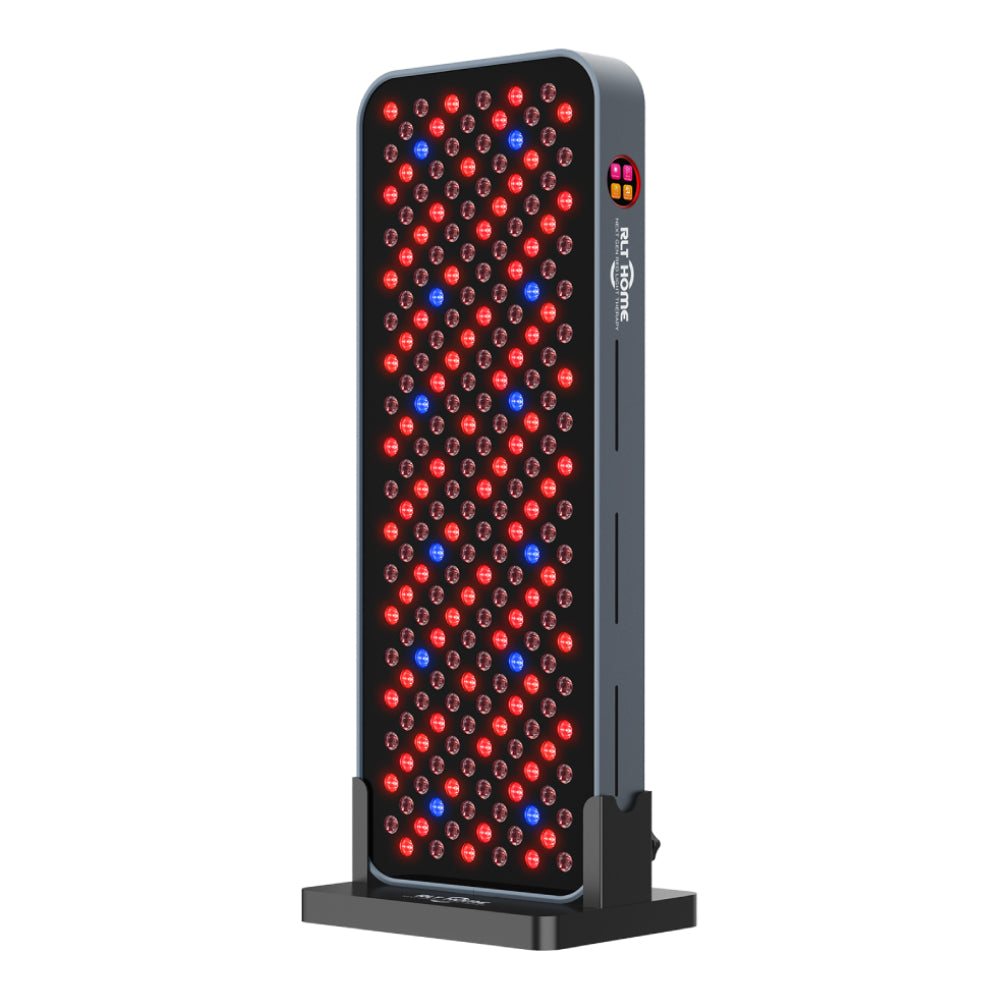
The two sham-controlled trials this site's hair growth evidence review grades Strong both used a sealed 655nm helmet worn directly on the scalp, not a flat panel, and this site's database currently tracks zero dedicated hair caps or helmets across its 41 brands; the two iRestore models listed under "caps" marketing are themselves flat panels, so this ranking compares the panels that come closest to the trial's wavelength and positioning, not a like-for-like match to the device the trials actually tested.
Choosing a panel? Our ranking of the best red light therapy panels is computed from published, method-labeled specs across 188 devices. For hair growth specifically, the spec that matters is 660nm share and a way to hold the scalp at a fixed distance, not total irradiance.
What the trial evidence actually tested
A 2013 sham-controlled trial in 44 men found a 39% hair-count increase in a marked scalp patch after 16 weeks of every-other-day use of a 655nm LED and laser helmet delivering 67.3 J/cm2 per session (PMID 24078483), and a companion 2014 trial in women using the same TOPHAT655 device and 16-week schedule reported a comparable result (PMID 25124964); this site's study review of the men's trial and the women's trial cover both in full. A separate 2014 review of the wider LLLT-for-hair-loss literature summarizes the same pattern across other controlled trials in men and women, describing the working mechanism as stimulation of epidermal stem cells in the hair follicle bulge that shifts follicles into the growth phase, while noting that the optimum wavelength, coherence and dose for this specific use are still not settled across the field (PMID 23970445).
What that evidence has in common is the device class: a helmet that holds 655nm emitters in constant, close, all-around contact with the scalp for a 25-minute session, delivering a dose well above what most panel protocols aim for elsewhere on the body. None of the devices ranked below reproduce that geometry. A flat panel held a few inches from the head faces two problems the helmet does not: hair itself blocks some of the light before it reaches skin, and distance and angle vary session to session in a way a sealed helmet's fixed geometry avoids. Using a panel for hair growth is an extrapolation from the trial evidence, not a direct match to it, a point this site's wavelength explainers also make for the 660nm band generally.
Ranking criteria
Every model below is scored on the same fields this site uses for every best-of ranking, not on hair-specific marketing claims: published wavelength share at or near 660nm, whether irradiance carries a named measurement instrument (method-labeled) or is an unlabeled brand claim, price, warranty length and trial or return terms. See how rankings work for the full scoring rule.
| Rank | Model | 660nm share (as published) | Irradiance | Price | Warranty | Trial/return |
|---|---|---|---|---|---|---|
| 1 | RLT Home Total Spectrum COMPACT | 19% of total output | 99.0 mW/cm2 at 6in, Electropossible spectrometer | $1,095 | 3 years | 60 days, no restocking fee |
| 2 | PlatinumLED BioMax 300 | 80% of its red-diode output | Not method-stated | $659 | 3 years | 60 days, 20% elective-return fee plus return shipping |
| 3 | iRestore Apex Elite 2160 | Not published | 200 mW/cm2 at 6in, instrument not named | $2,199 | 10 years | 60 days, no restocking fee |
| 4 | Hooga HG300 | Not published | 73 mW/cm2 claimed; independent testing measured roughly half | $199 | 3 years | 60 days, prepaid return label deducted from refund |
(All prices, wavelengths and irradiance figures pulled fresh from each model's own database page; none of these panels have been tested in a hair-growth trial themselves.)
The picks
1. RLT Home Total Spectrum COMPACT, $1,095. The only panel here with both a published, spectrometer-measured irradiance figure and a full wavelength breakdown, 19% of its output at 660nm alongside 630, 810, 830, 850 and 1064nm. It ships with a stand, which matters for hair growth more than for most other uses, since a panel held at a stable, repeatable distance from the scalp is the closest a flat panel gets to a helmet's fixed geometry. Its 660nm share is lower than the BioMax 300's, but it is the only pick where every figure on the spec sheet is independently verified rather than a brand claim.
2. PlatinumLED BioMax 300, $659. Its red-diode output is 80% 660nm, the highest concentration at the trial-relevant wavelength of any panel here, and its 19x9in size is easy to angle toward a scalp at close range. Its irradiance figure is not method-stated, so it should be read as an unverified brand claim rather than a measured one under this site's claimed-vs-measured standard, and it ships without a stand and with a weaker return policy than the COMPACT.
3. iRestore Apex Elite 2160, $2,199. The only device in this database marketed specifically for hair, with a 10-year warranty and a no-restocking-fee return policy that beats every other model here, plus door-mount and motorized-stand options built for repeatable scalp-level positioning. Against that, it is the most expensive pick and the weakest on spec disclosure: no published wavelength allocation and an irradiance figure with no named measurement instrument, so its 200 mW/cm2 claim cannot be compared directly to the COMPACT's or the HG300's verified numbers.
4. Hooga HG300, $199. The budget option, small enough (12.2x8.2in) to hold close to a single scalp area, with 660 and 850nm output. Its claimed 73 mW/cm2 has no stated measurement method and independent testing found roughly half that figure, so a session aimed at the trial's 67.3 J/cm2 dose would need to run meaningfully longer than the claimed number implies; run the real figure through the dose calculator rather than the claimed one.
A worked example: matching the trial's dose
The Lanzafame trials delivered 67.3 J/cm2 per 25-minute session from a helmet held in constant contact with the scalp. Running that same target dose through the dose calculator against the COMPACT's verified 99.0 mW/cm2 gives a session length of roughly 11 minutes at 6 inches, before accounting for hair blocking some of the light or for the panel not wrapping around the scalp the way a helmet does; against the HG300's independently measured figure, roughly half its 73 mW/cm2 claim, the same target dose would take closer to 31 minutes. That gap illustrates why the method-label distinction in the table above matters more for this specific goal than for most others: a session planned around an unverified claimed irradiance can come up well short of the dose the trial evidence actually used, with no way to tell from the spec sheet alone.
Using a panel for hair growth
None of these four rankings changes the underlying gap: the trial evidence supports a sealed 655nm helmet at high, sustained dose, run every other day for at least 16 weeks, and a panel is a substitute built on wavelength proximity rather than a tested equivalent. Anyone using a panel for this goal should expect to hold it at a fixed, repeatable distance each session, part with the same schedule the trials used, at minimum every other day for 16 weeks, and treat any dose figure calculated from a panel's irradiance as an estimate against hair-covered skin rather than the bare, marked scalp patch the trials measured. RLT Home is one of 41 brands tracked in this database and receives the same criteria and cautions as every other brand ranked here.