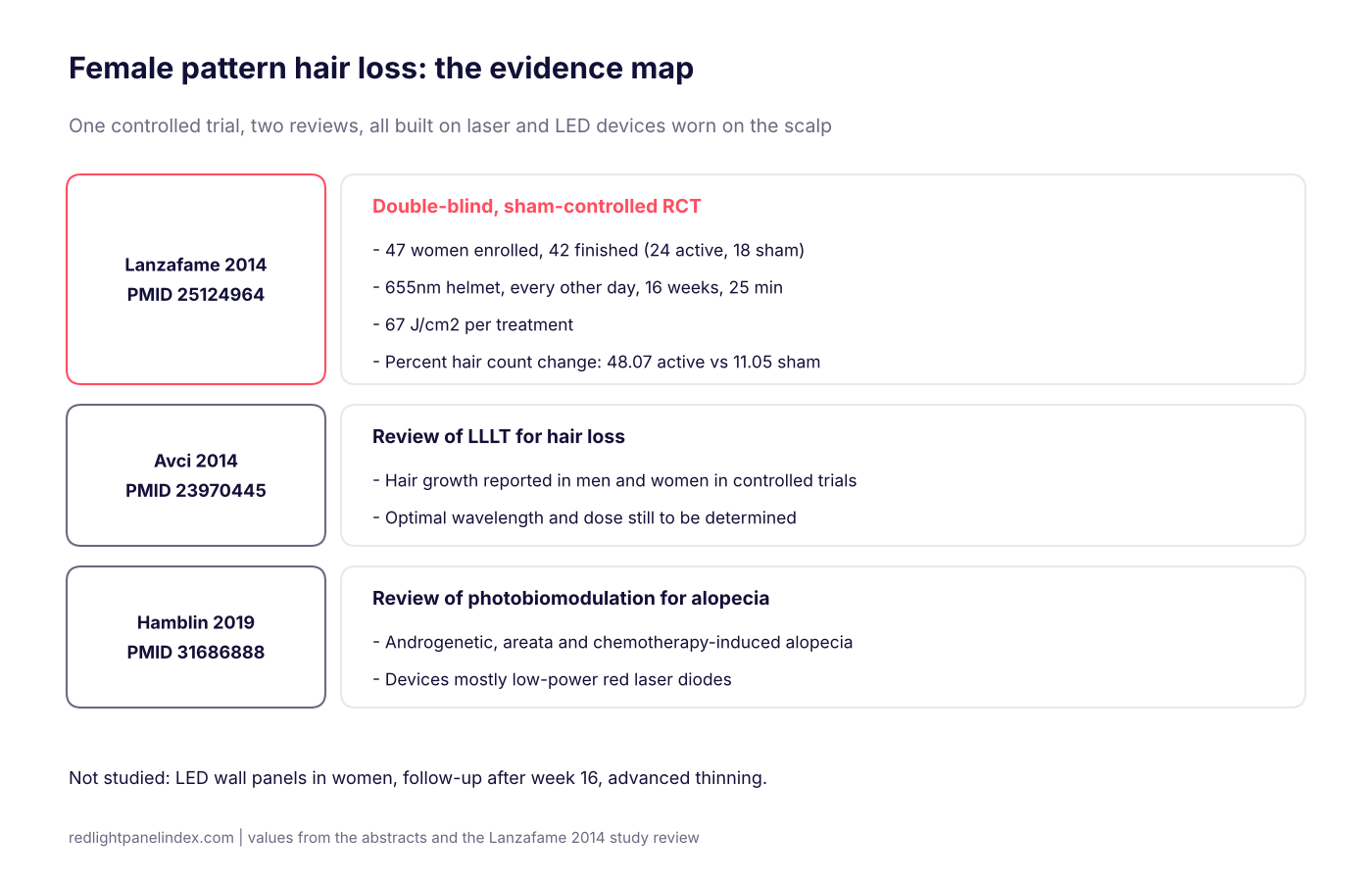
The evidence grade for red light and female pattern hair loss is Moderate: one double-blind, sham-controlled trial in women reported a significant gain in hair count, and two reviews describe a consistent picture, but the trial was small, used a 655nm helmet rather than a panel, and was measured only at 16 weeks (PMID 25124964). That is enough to take the question seriously and not enough to promise a result from a wall panel.
Choosing a panel? Our ranking of the best red light therapy panels is computed from published, method-labeled specs across 188 devices. For female hair loss, the spec that matters is how much 650 to 660nm light a panel delivers at scalp distance, since the trial devices sat in contact with the scalp.
Why the grade is Moderate
The site's grading scheme asks for controlled human data at doses a panel can match. For women there is a sham-controlled randomized trial with a clear primary outcome, which supports a grade above Limited. What holds it below Strong is that there is a single such trial in women, its device was a sealed helmet, and the follow-up ended with treatment. The general hair growth page covers men and women together; this page narrows to women.
The trial in women
The core study is the 2014 Lanzafame trial (PMID 25124964); the full design is in our study review of the female trial. In brief, as the abstract and paper describe it:
- Population. 47 women with androgenetic alopecia were enrolled and 42 finished, 24 in the active group and 18 in the sham group.
- Device. A helmet-style unit with laser diodes and LEDs at 655nm, against an identical-looking sham.
- Schedule. Treatment at home every other day for 16 weeks, about 25 minutes per session, delivering 67 J/cm2 per treatment as the paper states it. Our dose calculator shows how to turn a panel's irradiance and distance into a figure of that kind.
- Primary outcome. Percent change in hair count in a small marked area of scalp.
- Reported result. The active group's mean percent increase was 48.07 against 11.05 for sham, which the authors report as a 37% greater increase. No adverse events were reported.
The reviews
A 2014 review of low-level laser therapy for hair loss (PMID 23970445) reports that controlled clinical trials showed hair growth in both men and women, and describes the proposed mechanism as stimulation of epidermal stem cells in the follicle bulge, moving follicles into the growth phase. Its authors conclude the therapy appears safe and effective for both sexes while saying the optimal wavelength, coherence and dosimetry are still to be determined.
A 2019 review (PMID 31686888) covers androgenetic alopecia, alopecia areata and chemotherapy-induced alopecia, summarizing mechanisms, dosimetry, animal models, clinical trials and how patients might be selected. It notes that the devices in the literature are mostly low-power red laser diodes. Neither review adds a new trial in women; they place the one trial in context, which is worth something but is not independent confirmation.
Who the trial actually covers
The women enrolled were aged 18 to 60, Fitzpatrick skin types I through IV, with Ludwig-Savin patterns from I-2 to II-2, which means mild to moderate diffuse thinning. That is a narrow slice of the women who search for hair loss help. A woman with advanced thinning, darker skin than the range studied, or loss after pregnancy or illness is outside what the trial tested, and the reviews do not fill that gap with trial data of their own.
How the mechanism is described
The 2014 review proposes that light stimulates epidermal stem cells in the follicle bulge and nudges follicles from rest into the growth phase (PMID 23970445). The 2019 review frames photobiomodulation as a way to act on several types of hair loss through related pathways (PMID 31686888). The site's mitochondria and ATP page explains the general cell-level story. These are proposals that fit the trial result, not tests of it, and the trial itself did not measure follicle biology.
How to read the numbers
The headline figure is a difference between two percent changes, not a count of extra hairs per woman. In the marked patch, the active group's mean count rose from 209.6 to 309.9 and the sham group's from 228.2 to 252.1, but the raw post-treatment counts did not differ significantly between groups; the significant result was the percent change from each person's own baseline. A reader comparing products should be wary of any page that quotes 37% without saying it came from a helmet, a 16-week course and a small marked patch of about 2.85 cm2.
What was not studied
- A wall-mounted or handheld LED panel at any distance, in women, with hair count as the outcome.
- Follow-up beyond the end of the 16-week course, so whether gains last is unknown.
- Whole-scalp coverage and hair thickness: the primary measure was a small marked patch.
- Women outside the studied range: the trial included ages 18 to 60 and mild to moderate thinning patterns, so advanced loss is not covered.
- Head-to-head comparison with standard medical options.
- Hair loss with other causes, such as postpartum or illness-related shedding, which the trial was not designed for.
Reading the trial's limits
The non-significant raw counts beside the significant percent change are a reason for caution, and the sham group's high variability is too. The female trial review discusses both. The results in women and in men were close (see the male trial review), which is consistent but comes from the same group on the same device.
A practical section for panel owners
The tested floor is every other day for at least 16 weeks, so this is a months-long commitment; see the guide to how often to use red light. A helmet holds the light at a fixed distance, hair can block light, and a panel's irradiance falls with distance, which is why the cap versus panel guide treats panel use as an extrapolation. Red wavelength matters here: the trial band sits near 650 to 660nm, discussed on the 660nm page and the wavelengths page. Panels that cover that band are compared in the best devices for hair growth ranking, and a model such as the Hooga HG300 can be checked in the database for its measured output before you rely on any figure.
Two questions are worth asking before buying anything for this purpose. First, can the device keep the scalp at a short, repeatable distance for the full session, or will you be moving around it? Second, does the maker publish a method-labeled irradiance figure, as explained on the irradiance page, so the dose can be estimated and not guessed? If neither answer is clear, the trial result does not carry over, and that is a fair reason to wait or to choose a cap-style device built for the scalp.
Cautions
Hair loss in women has many causes, some of them medical, and a sudden change or patchy loss deserves a clinician's evaluation before any device. Eye protection is sensible with bright red light near the face. Nothing here supports "cure" language, and results reported in a trial are group averages, not a forecast for one person.