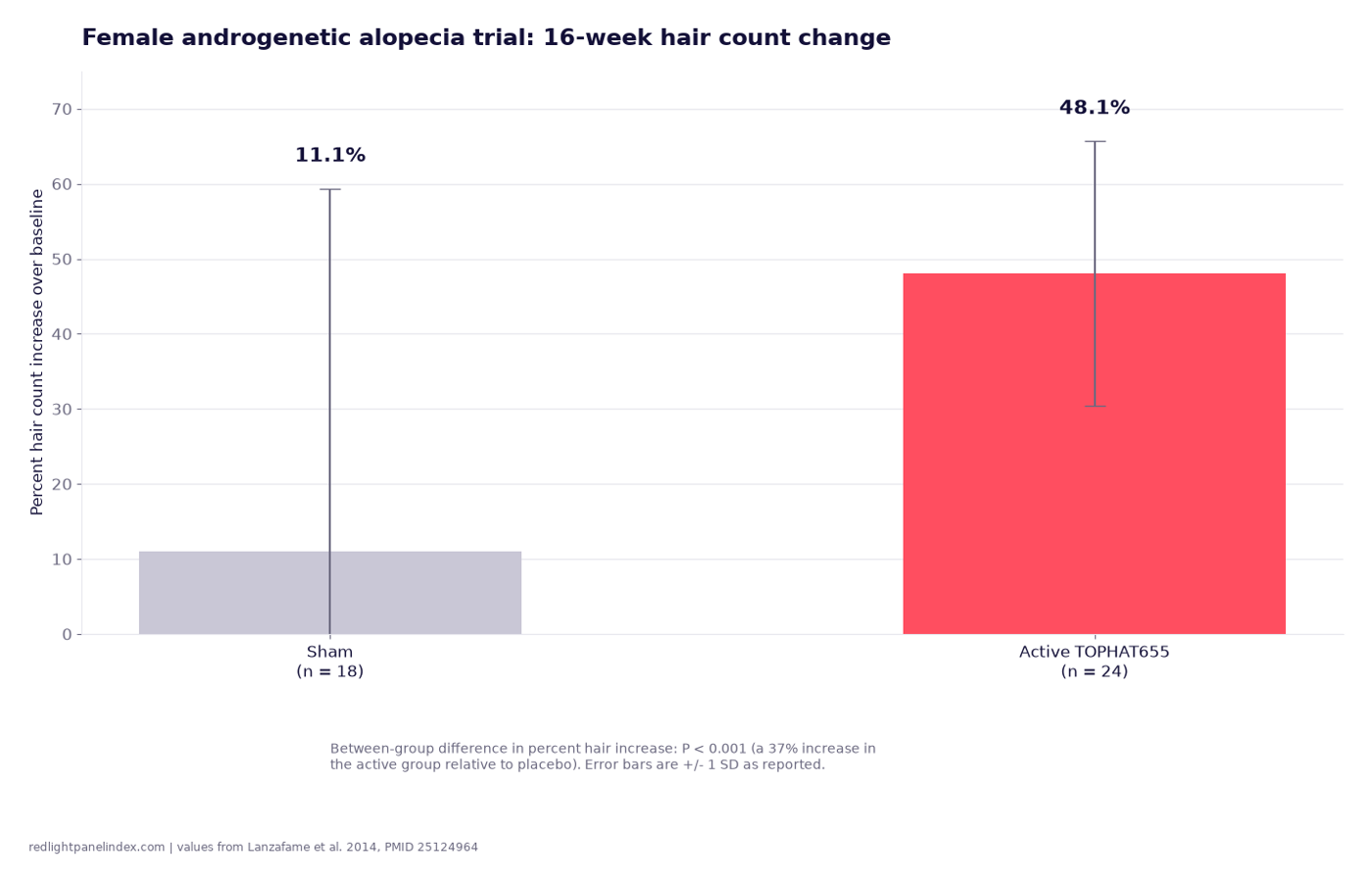
A double-blind, sham-controlled trial published in 2014 found that women with androgenetic alopecia who used the same 655nm LED and laser helmet as the earlier male trial, on the same every-other-day, 16-week schedule, grew 37% more scalp hair than women using an identical-looking sham unit, a statistically significant result (PMID 25124964). It is the direct companion to the 2013 male trial that most home hair-growth claims trace back to, run by the same authors on the same device.
Choosing a panel? Our ranking of the best red light therapy panels is computed from published, method-labeled specs across 188 devices. For hair growth specifically, the spec that matters is wavelength match at 655nm, not total irradiance.
What the study asked
Low-level laser and LED therapy had already been shown to promote hair growth in men using the TOPHAT655 device, but androgenetic alopecia in women differs from the male pattern in both its typical distribution and its usual baldness scale, so the male result did not automatically extend to women. Lanzafame and colleagues set out to define, in the paper's own terms, the safety and physiologic effects of the same LLLT device in women, using the same double-blind, sham-controlled design as the male trial: an identical-looking placebo unit, a fixed at-home schedule, and outcome counting by a blinded second investigator.
Who was studied
Forty-seven women aged 18 to 60 were recruited, all Fitzpatrick skin types I through IV, with Ludwig-Savin Baldness Scale patterns I-2, I-3, I-4, II-1, or II-2, a range of mild to moderate diffuse thinning rather than advanced baldness. A transition-zone scalp site was selected, trimmed to 3mm, tattooed for consistent relocation, and photographed before treatment began, the same protocol used in the male trial. Forty-two of the 47 completed the full study: 24 in the active group and 18 in the sham group, a less even split than the male trial's 22-19.
Device and parameters, as stated
The active unit was the same TOPHAT655 bicycle-helmet-style device used in the male trial: 21 diode lasers at 655±5nm (5mW each) and 30 LEDs at 655±20nm. The sham unit was visually identical but emitted only incandescent red light, no active laser or LED output. Both groups used their unit at home every other day for 16 weeks, 60 treatments in total, at 25 minutes per session, delivering 67 J/cm2 per treatment. A masked 2.85cm2 photographic area at the marked scalp site was evaluated by a second investigator blinded to group assignment, with percent increase in hair count from baseline as the primary endpoint, again matching the male trial's design exactly.
What was measured and what was found
Baseline hair counts did not differ between groups (sham 228.2 ± 133.4, active 209.6 ± 118.5; P = 0.642). After 16 weeks, raw post-treatment hair counts were 252.1 ± 143.3 in the sham group and 309.9 ± 166.6 in the active group, a difference that did not reach statistical significance on its own (P = 0.235). The change in hair count over baseline told a clearer story: 23.9 ± 30.1 in the sham group versus 100.3 ± 53.4 in the active group (P < 0.0001). Expressed as percent increase over baseline, the primary endpoint, the sham group gained 11.05% ± 48.30 while the active group gained 48.07% ± 17.61 (P < 0.001), which the authors state as a 37% increase in hair growth for the active group compared with placebo. No adverse events or side effects were reported in either group.
Limitations
The gap between the non-significant raw post-treatment counts (P = 0.235) and the significant percent-change result (P < 0.0001) is the first thing worth noticing: the sham group's percent-change figure carries a very wide standard deviation (48.30, nearly the size of the mean itself), which suggests high variability in how individual women's raw hair counts moved, not a clean separation between groups on every measure. The trial also measured a small marked patch rather than whole-scalp coverage or hair thickness, so the 37% figure describes count change in that patch, not a whole-scalp outcome a person would see in a mirror. The active-to-sham split, 24 to 18 among completers, was less even than the male trial's, which can affect how precisely the group comparison is estimated. As with the male trial, there is no reported follow-up past the 16-week endpoint, so durability of the gain, or what happens after stopping, is not addressed.
What differed from the male trial
The device, wavelength, dose, and 16-week every-other-day schedule were identical between the two trials, and the headline result was close: 37% for women here versus 39% for men in the 2013 trial. What differed was the population, women aged 18-60 with Ludwig-Savin pattern thinning here, versus men aged 18-48 with Hamilton-Norwood pattern loss in the companion trial, and the completer split, less balanced in this trial. The two trials were designed and reported together as a matched pair by the same author group, which is unusual rigor for this literature: most other home-device hair studies are one-off trials without a same-device companion in the opposite sex.
What this means for a home panel
The device-class gap that applies to the male trial applies here without change. The TOPHAT655 is a sealed helmet holding 655nm emitters in constant, close contact with the scalp for the full session, delivering 67 J/cm2 per session, a high and sustained dose compared with most panel protocols in the hair growth evidence register. A flat panel used a few inches from the scalp cannot reproduce that geometry: hair blocks some of the light before it reaches skin, distance and angle vary session to session, and few panels publish an exact 655nm peak. Run a panel's method-verified irradiance through the dose calculator to see how long a comparable per-session dose would actually take at a working distance, rather than assuming the trial's 25-minute session transfers directly.
Neither this trial nor its male companion tested a wall-mounted or handheld panel, so using one for hair growth is an extrapolation from a helmet-format trial, not a direct match to it. This site's ranking of the best red light devices for hair growth ranks the panels that come closest on wavelength and positioning, since the database tracks no dedicated caps or helmets to compare against the TOPHAT655 directly. Anyone trying a panel for this purpose should expect the how-often guide's every-other-day, at-least-16-week schedule as the tested floor, since both Lanzafame trials measured their only result at that checkpoint, and should not expect the 37% or 39% figures to transfer directly from a sealed helmet at 67 J/cm2 to a panel used at a working distance in open air.