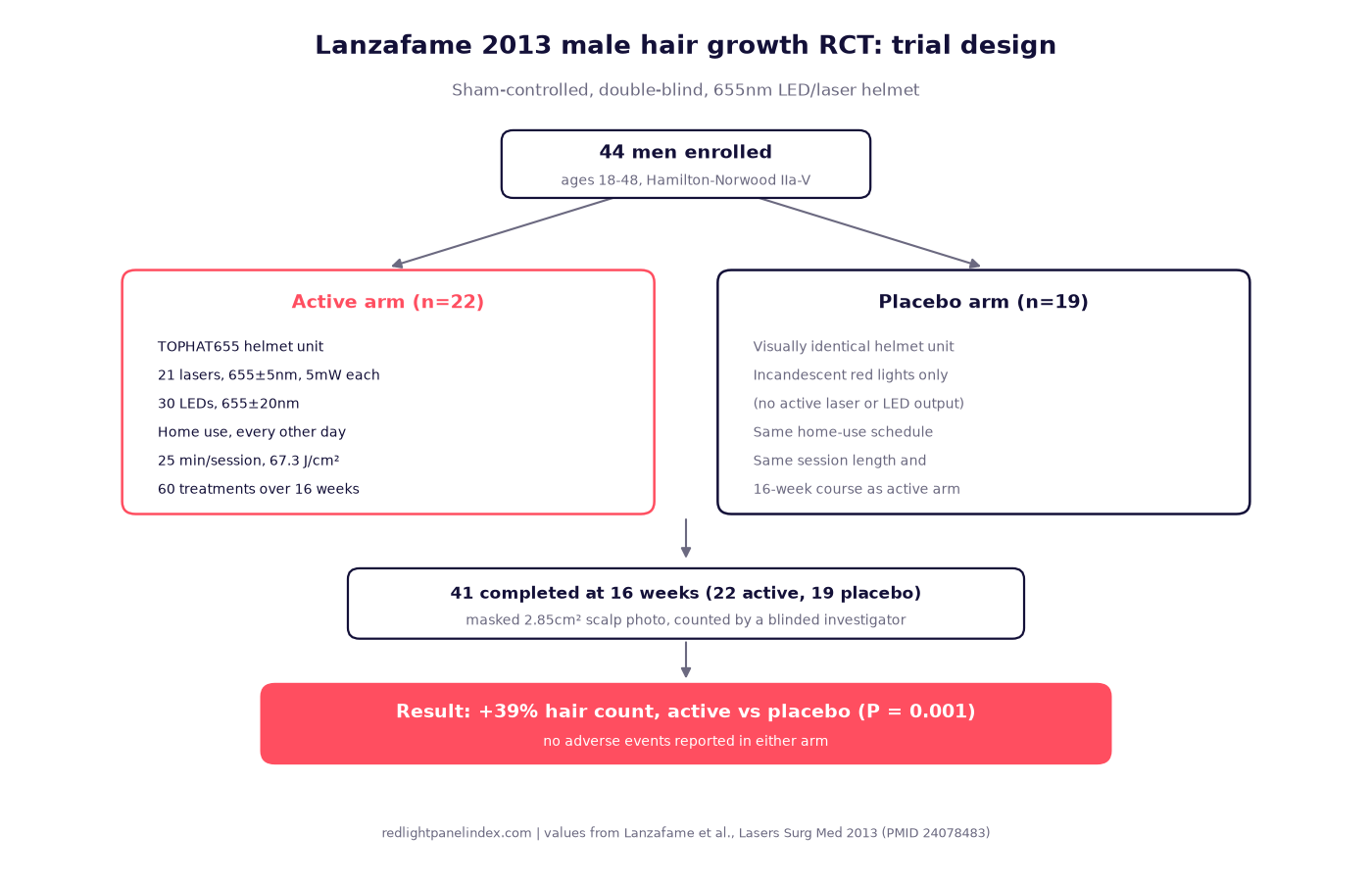
A double-blind, sham-controlled trial published in 2013 found that men with androgenetic alopecia who used a 655nm LED and laser helmet at home every other day for 16 weeks grew 39% more scalp hair than men using an identical-looking sham unit, a statistically significant result (PMID 24078483). It is the single trial most home hair-growth claims trace back to, so it is worth reading past the headline number.
Choosing a panel? Our ranking of the best red light therapy panels is computed from published, method-labeled specs across 188 devices. For hair growth specifically, the spec that matters is wavelength match at 655nm, not total irradiance.
What the study asked
Low-level laser and LED devices had been used informally for hair growth for years before this trial, building on the broader photobiomodulation mechanism proposed for red and near-infrared light generally, but the field needed a controlled test of a specific, purchasable device rather than a lab prototype. Lanzafame and colleagues set out to define, in their words, "the safety and physiologic effects" of a home-use LLLT device on androgenetic alopecia in men, using a design strict enough to separate a real light effect from expectation: a sham unit built to look and feel identical to the active one, worn on the same schedule, with the outcome counted by an investigator who did not know which unit any given man had used. That sham design, a device that still emits something rather than nothing, is the usual workaround for the fact that light is visible and a truly blank comparator would give itself away; the general problem and how other trials in this register solve it is covered in how to read a sham-controlled trial.
Who was studied
Forty-four men aged 18 to 48 were enrolled, all with Fitzpatrick skin types I through IV and Hamilton-Norwood pattern hair loss stages IIa through V, meaning mild to moderately advanced thinning rather than complete baldness. A transition-zone site on the scalp was marked, tattooed for consistent relocation, and photographed before treatment began. Forty-one of the 44 completed the full 16 weeks: 22 in the active group and 19 in the sham group. A companion trial in women using the same TOPHAT655 device and the same 16-week schedule was published the following year (PMID 25124964); this review covers only the men's results, since that is the trial this page cites and reads directly.
Device and parameters, as stated
The active device was a bicycle-helmet-style unit called the TOPHAT655, containing 21 laser diodes at 655±5nm (5mW each) and 30 LEDs at 655±20nm. The sham unit was built to be visually indistinguishable but emitted only incandescent red light with no active laser or LED output. Both groups used their unit at home every other day for 16 weeks, 60 treatments in total, at 25 minutes per session. The paper states a delivered irradiance of 67.3 J/cm² per session; run through the dose calculator, that works out to roughly 45 mW/cm² averaged over the 25-minute session, which is a meaningfully higher and more sustained exposure than most panel protocols aimed at skin or joints.
What was measured and what was found
The primary endpoint was the percent change in hair count from baseline, measured in a masked 2.85cm² photographic area of the marked scalp site and counted by a second investigator who did not know which treatment group the photo came from. At 16 weeks, the active group showed a 39% increase in hair count compared with the placebo group, a difference the authors reported as statistically significant (P = 0.001). No adverse events or side effects were reported in either arm over the full 16 weeks.
Limitations
The trial is well controlled for a home-device study, but a few gaps matter for reading the result. It measured hair count in a small marked patch, not overall scalp coverage or hair thickness, so the 39% figure describes count in that patch rather than a whole-scalp outcome a person would see in a mirror. Forty-one completers is a modest sample for a hair-growth trial, and the paper does not report longer-term follow-up after the 16-week endpoint, so how much of the gain persists with continued use, or fades after stopping, is not addressed by this trial. It also tested one specific device at one specific dose; it says nothing directly about a different wavelength, a different session length, or a different device shape. And the population was limited to men with mild-to-moderate thinning rather than advanced baldness, so the result does not speak to how much benefit, if any, a man with more extensive hair loss would see from the same protocol.
What this means for a home panel
The most important gap is device class. The TOPHAT655 is a sealed helmet that holds 655nm emitters in constant, close contact with the scalp for the full session, and it delivered a dose, 67.3 J/cm² per session, that is high compared with most panel protocols in the evidence register. A flat panel used a few inches from a scalp cannot reproduce that geometry: hair itself blocks some of the light before it reaches skin, distance and angle vary session to session, and few panels publish a wavelength at exactly 655nm. The Hooga HG300, for instance, publishes 660 and 850nm rather than 655nm, and its claimed 73 mW/cm² at 6 inches carries no stated measurement instrument, which this site's method-label rule treats as an unverified figure until proven otherwise. A panel at 660nm is close to the trial wavelength, not identical to it, and reaching a comparable dose through hair at a working distance takes a longer session than the calculator's plain irradiance number would suggest.
None of that means a panel cannot help; 655 and 660nm sit close enough in the red band that some crossover effect is plausible. It means the trial evidence directly supports a dedicated cap or helmet held close to the scalp at high, sustained dose, and using a panel for this specific goal is an extrapolation from that evidence rather than a direct match to it. Since this site's database tracks no dedicated hair caps or helmets, our ranking of the best red light devices for hair growth covers how the available panels compare on 660nm share and scalp-distance fit instead. Anyone treating hair loss with a panel should expect the how-often guide's schedule, every other day for at minimum 16 weeks, as the tested floor, and should not expect the 39% figure to transfer directly from a sealed helmet to a wall-mounted panel used at a few inches' distance. That 16-week wait to the trial's only measured checkpoint is typical, not unusual; this site's results timeline guide shows the same 15-to-16-week pattern across the skin and hair trials in this register.