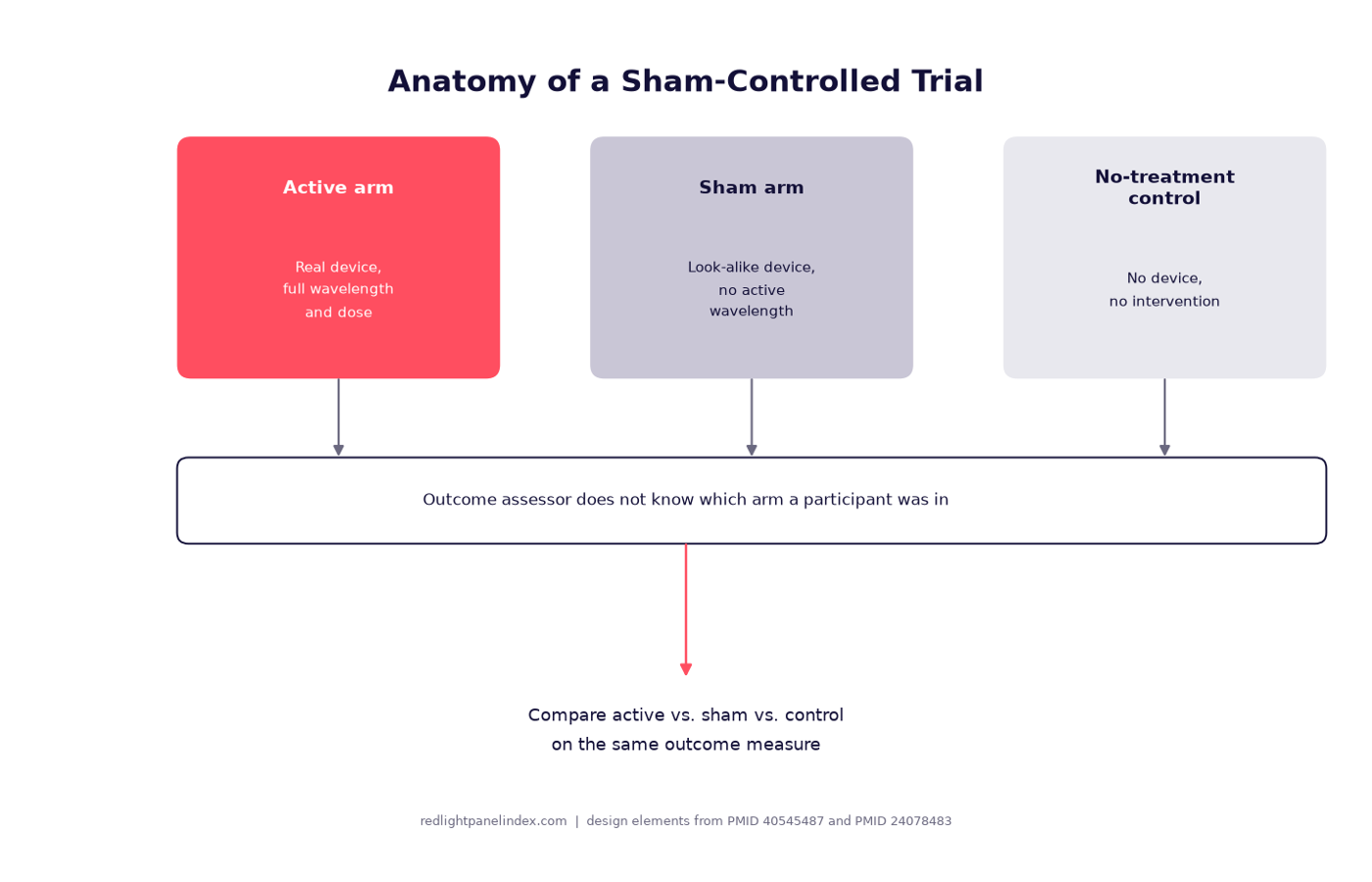
A sham-controlled trial compares an active light device against a fake device built to look and feel the same, so that any improvement from believing you were treated shows up in both arms and cancels out, leaving only the difference the light itself caused. It is the single design feature that separates a red light therapy claim you can trust from one that is just a testimonial with better lighting.
Choosing a panel? Our ranking of the best red light therapy panels is computed from published, method-labeled specs across 188 devices. For reading a study, the detail that matters is not the wavelength claimed but whether the sham arm was a real device or nothing at all.
What "sham-controlled" actually means
A sham is not the absence of treatment. It is a second device, built to be indistinguishable from the active one in appearance, weight, sound, warmth and handling, that a participant cannot tell apart from the real thing during the trial. The point of building one is narrow: it holds constant everything about the experience of being treated, so the only thing left to vary is whether the light dose reaching tissue does anything.
That is different from a no-treatment control, where a participant simply is not treated and knows it. A no-treatment arm tells you how a condition changes on its own, or with ordinary care, over the trial period. A sham arm tells you how much of the apparent effect is the ritual of treatment itself, rather than the light. Some trials run both at once, and that design is the strongest of the three, because it separates natural history from placebo response from a genuine light effect in a single comparison.
Why blinding is hard when the light is visible
Blinding is easy for a pill: an inactive pill looks exactly like the active one. It is harder for a light device, because a participant using the real thing sees, and sometimes feels, light and heat that a completely inert device would not produce. If the sham arm gets nothing, participants can often guess which group they are in, and that guess itself can change how they report pain or how carefully they use the device.
Several trials in this index's register work around the problem by building a sham that still emits something rather than nothing. The clearest example is the Lanzafame male hair growth trial (PMID 24078483), a trial behind the grade on this site's hair growth evidence page, where the sham helmet was visually indistinguishable from the active TOPHAT655 unit but emitted only incandescent red light with no laser or LED output. Participants in both arms saw red light and felt the same helmet on their scalp for the same 25 minutes every other day for 16 weeks; only the active group received the 655nm laser and LED wavelengths the trial was testing. That is what makes the 39 percent hair count increase over sham a result about the wavelength and dose, not about wearing a helmet and expecting hair to grow.
A weaker version of the same idea shows up in trials that dim or misalign a real laser rather than building a separate sham unit. Either way, the question worth asking about any red light trial is the same: does the sham arm produce a comparable sensory experience, or is "sham" doing less work than the name implies.
Placebo effects hit pain outcomes hardest
Not every outcome is equally vulnerable to a placebo response. A photograph of a wound closing, a spectrometer reading, or a blood test does not care what a participant believes. A pain rating on a visual analog scale, a symptom questionnaire, or a self-reported quality-of-life score does, because the participant is the instrument. Expectation, attention, and the simple experience of being cared for can move a subjective pain score meaningfully on their own, for weeks at a time, independent of any biological effect.
That is exactly why sham control matters most for the conditions this index covers most often: joint pain, muscle recovery, and skin appearance are all judged mainly on self-report. A trial that reports pain improved after treatment, without saying compared to what, has not ruled out the placebo response that pain outcomes are especially prone to. A trial that reports pain improved compared with a sham arm that had the same expectation of relief has ruled out a good deal of it.
Two worked examples from this index's register
The 790nm knee osteoarthritis trial (PMID 40545487), one of the trials behind the grade on this site's joint pain evidence page, shows the three-arm version of this design. Seventy-three participants with symptomatic knee osteoarthritis were randomized to an active photobiomodulation arm, a sham arm, or a no-intervention control, rather than just active versus sham. The active group's pain fell significantly compared with both comparators, while neither the sham nor the untreated control group changed. Running both comparators in the same trial is what let the authors say the sham group's lack of improvement was not a fluke of that particular sham design, since an independent no-treatment group told the same story.
The Lanzafame hair trial above shows the two-arm version, with the added detail of exactly how the sham was built to survive the fact that light is visible: not by hiding the light, but by substituting a different, inactive light source that produced a comparable-seeming experience. Both trials also masked the person measuring the outcome, so that whoever counted hairs or recorded a pain score did not know which group produced the number they were looking at, a detail each study review on this site reports separately when the abstract states it.
What to look for in an abstract
Most readers only ever see an abstract, so it helps to know what a well-designed trial states in one and what a weaker one leaves out.
- What was the comparator. Sham, no-treatment control, or nothing stated at all. "Improved after treatment" with no comparator named is not evidence of anything beyond passage of time.
- Was outcome assessment masked. If the person counting hairs, scoring a questionnaire, or reading a scan knew which group a participant was in, that knowledge can bias the result even with a good sham.
- Between-group or within-group. A statement that a group improved from before to after treatment is a within-group comparison and can happen with no active ingredient at all. The comparison that matters is against the sham or control group.
- Effect size or just a p-value. A p-value below 0.05 says a difference is unlikely to be chance. It says nothing about whether the difference is large enough to notice. An abstract that reports millimeters, percentages, or a confidence interval lets you judge size; one that reports only "p < 0.05" does not.
- Sample size and dropout. A trial that enrolled 44 and analyzed 41 is more trustworthy about that number than a trial that does not say how many withdrew.
None of this makes an abstract worthless on its own. It means reading past the headline sentence to see which of these the authors actually reported, which is the same habit this index's methodology page describes applying to every trial before a claim from it appears on this site.
The honest limit of any single trial
Even a well-blinded, sham-controlled, adequately powered trial describes one device at one dose in one population. It does not by itself establish that a different wavelength, a different device shape, or a home panel used at a working distance will produce the same result, which is why every study review on this site ends with a section on the gap between the trial device and a panel rather than a claim that the finding transfers automatically. Reading the design is the first step. Reading how far the design's device is from your own is the second, and it matters just as much.
A sham-controlled design is also what lets a trial count toward the grade a condition page carries; this site's evidence grading page explains how one or more trials like these add up to a Strong, Moderate, Limited or Insufficient label.