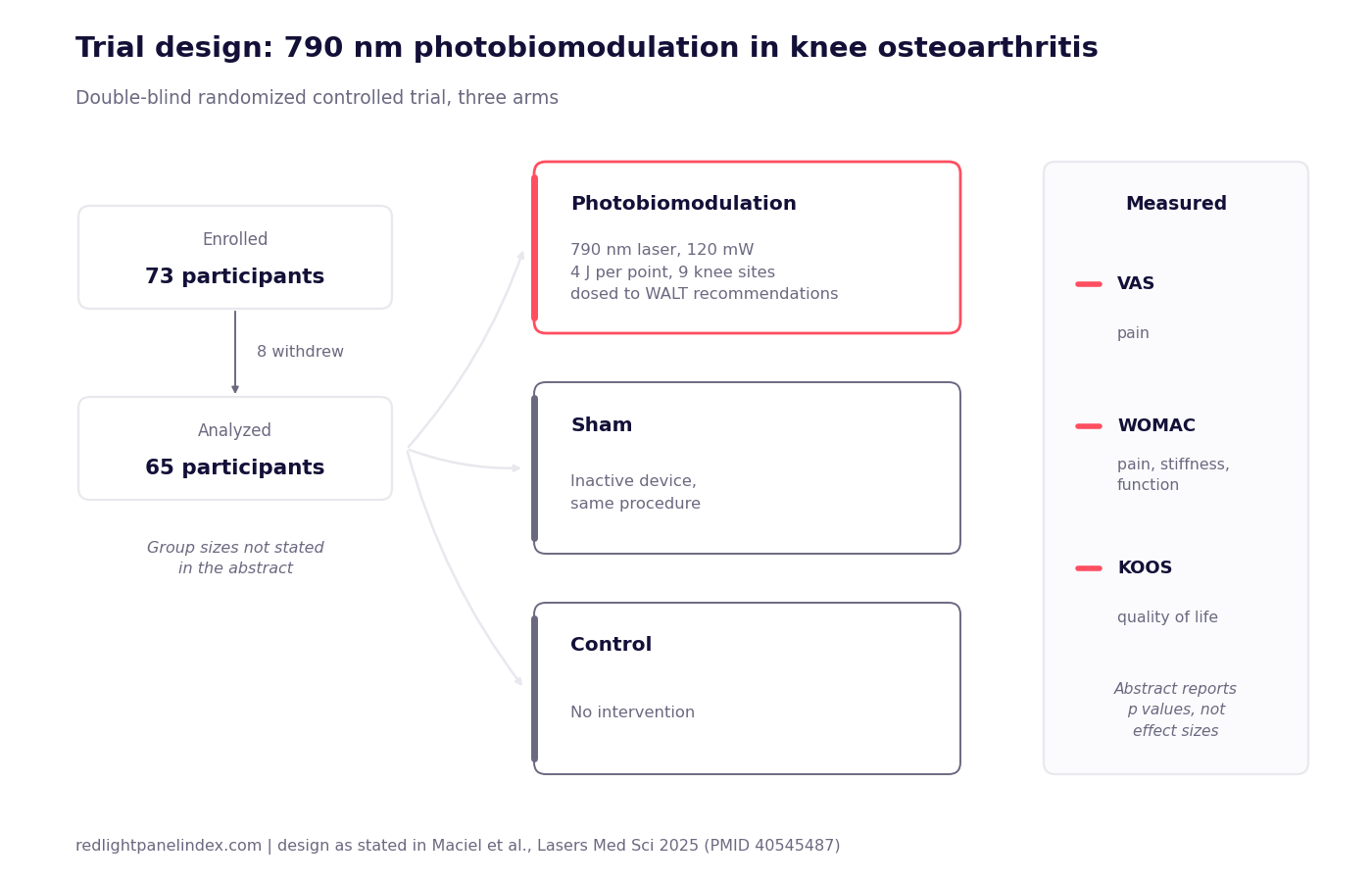
A 2025 double-blind randomized controlled trial in Lasers in Medical Science tested photobiomodulation at 790 nm, dosed to the World Association for Laser Therapy recommendations, against both a sham arm and a no-intervention arm in people with symptomatic knee osteoarthritis, and reported significantly larger pain reductions in the active group than in either comparator (PMID 40545487). It is the most recent knee trial in this index's joint pain register, and it is useful mainly because it pins a specific dose to a specific result.
Choosing a panel? Our ranking of the best red light therapy panels is computed from published, method-labeled specs across 188 devices. For a trial like this one, the spec that matters is near-infrared output density, not total wattage.
What the study asked
The stated aim was to evaluate the effects of photobiomodulation on patients with symptomatic knee osteoarthritis. The design question underneath it is narrower and more interesting: the active arm was dosed deliberately to the World Association for Laser Therapy recommendations rather than to whatever the device manufacturer suggested, which makes the trial a test of that dosing guidance as much as of light itself.
The authors report conducting the trial in accordance with the CONSORT guidelines for non-pharmacological interventions, and describe it as double-blind. What that label should and should not be taken to guarantee, and why running both a sham arm and a no-intervention control at once is stronger than either alone, is covered in how to read a sham-controlled trial.
Who was studied
The initial sample was 73 participants of both sexes with symptomatic knee osteoarthritis. Eight withdrew, leaving 65 in the final analysis.
Participants were randomized to one of three groups: photobiomodulation, sham, or a control group that received no intervention. The abstract gives the sex split per group rather than the group sizes: 83 percent female and 17 percent male in the active group, and 85 percent female and 15 percent male in the sham and control groups. It does not state how the 65 divided across the three arms, so this review does not either.
The third arm is the part worth noticing. Most trials in this literature compare light against sham alone. Running a no-intervention control alongside a sham lets the authors see the sham response separately from ordinary change over time, and both comparators are reported as unchanged.
Device and parameters as stated
- Wavelength: 790 nm
- Optical power: 120 mW
- Energy per point: 4 J
- Application sites: nine specific areas of the knee
- Dosing basis: the World Association for Laser Therapy recommendations
- Delivery: a laser, applied point by point
Two figures follow from those numbers by arithmetic rather than from the paper: nine points at 4 J each is 36 J of delivered energy per session, and at 120 mW a single 4 J point takes about 33 seconds, so about five minutes of emission per session in total.
The abstract does not state the number of sessions, the treatment frequency, the length of the course, the spot size, or the irradiance at the skin. Spot size matters, because without it there is no way to convert 4 J per point into J/cm2 as a measured irradiance figure would express it, and J/cm2 is the unit a panel dose is expressed in. That conversion is not available from the abstract and is not attempted here.
What was measured and what was found
Pain was measured on a visual analog scale, symptoms and function on the WOMAC index, and quality of life on the KOOS.
The authors report significant reductions in pain in the active group after treatment compared with both the placebo and the control groups (p < 0.05). On the WOMAC, they report significant within-group improvements in pain, stiffness, and functional limitations in the active group when comparing before and after treatment (p < 0.05), with no significant changes in the sham or control groups (p > 0.05).
The abstract reports significance levels rather than effect sizes. No mean differences, percentage changes, or confidence intervals appear in it, so none appear here. If you have seen this trial quoted with a percentage attached, that number did not come from the abstract.
Limitations
- No effect sizes in the abstract. A p value below 0.05 says a difference is unlikely to be chance. It says nothing about whether the difference is large enough for a person to notice, which is the only question a reader of this page actually has.
- Small, and smaller after attrition. Sixty-five participants split three ways leaves arms in the low twenties. Trials this size estimate effects imprecisely even when the direction is real.
- Heavily female sample. Above 80 percent female in every arm. That is common in knee osteoarthritis research and it still limits how far the result generalizes.
- The key WOMAC finding is within-group. The strongest-sounding sentence in the abstract compares the active group against itself before and after, not against the sham. The authors do report the between-group comparison for pain, which is the one that carries weight.
- Unreported protocol detail. Without session count, schedule, and spot size, the protocol cannot be reproduced from the abstract, by a researcher or by a reader.
- Duration unknown. The abstract describes outcomes after treatment. Whether anything held weeks later is not addressed, although the pooled knee osteoarthritis evidence suggests separation from placebo can keep growing for two to four weeks after a course ends.
What this means for a home panel
The gap here is larger than the usual one. This trial used a 120 mW laser pressed to nine points around a knee. A panel is a broad array of LEDs at a working distance, and it illuminates the whole joint at once rather than nine spots in sequence. The two devices deliver light to tissue in different geometries, and no published work converts one protocol into the other.
What does carry across is the wavelength band. At 790 nm this trial sits in the near-infrared, close to the 785 to 860 nm range that the Stausholm knee osteoarthritis meta-analysis named in its dose conclusion, the same 22-trial pooled analysis this index's knee osteoarthritis grade rests on. Panels publish their mixes as percentages, and for a knee the useful figure is how much sits in the 810 to 850 nm bands rather than the headline wattage or the total LED count.
What does not carry across is the number 4 J. Do not aim for 36 J on a panel because this trial delivered 36 J across nine laser points. If you want a number to work with, use your panel's method-verified irradiance in the dose calculator and aim inside the commonly studied range the tool displays, then hold that constant long enough to judge it. If your panel publishes an irradiance figure with no stated measurement method, halve it before you calculate, which is this index's standing working assumption for unlabeled figures.
And treat the third arm as the practical lesson rather than the dose. The no-intervention group did not improve, and neither did the sham group, over the same period. That is a reminder that the honest way to judge this on yourself is a consistent course over weeks at a steady session frequency, with one thing changing at a time.
The same pattern, positive trials clustering around guideline doses and the rest scattering, shows up outside the knee too: a meta-analysis of 25 tendinopathy trials found the same split between trials that followed dosing recommendations and trials that did not, in a completely different tissue. A separate knee osteoarthritis trial that paired a different device with a leg-strengthening exercise program found a similar-shaped split within one study: light reduced pain by itself, but the exercise did the work on walking distance and strength; see our review of that trial.