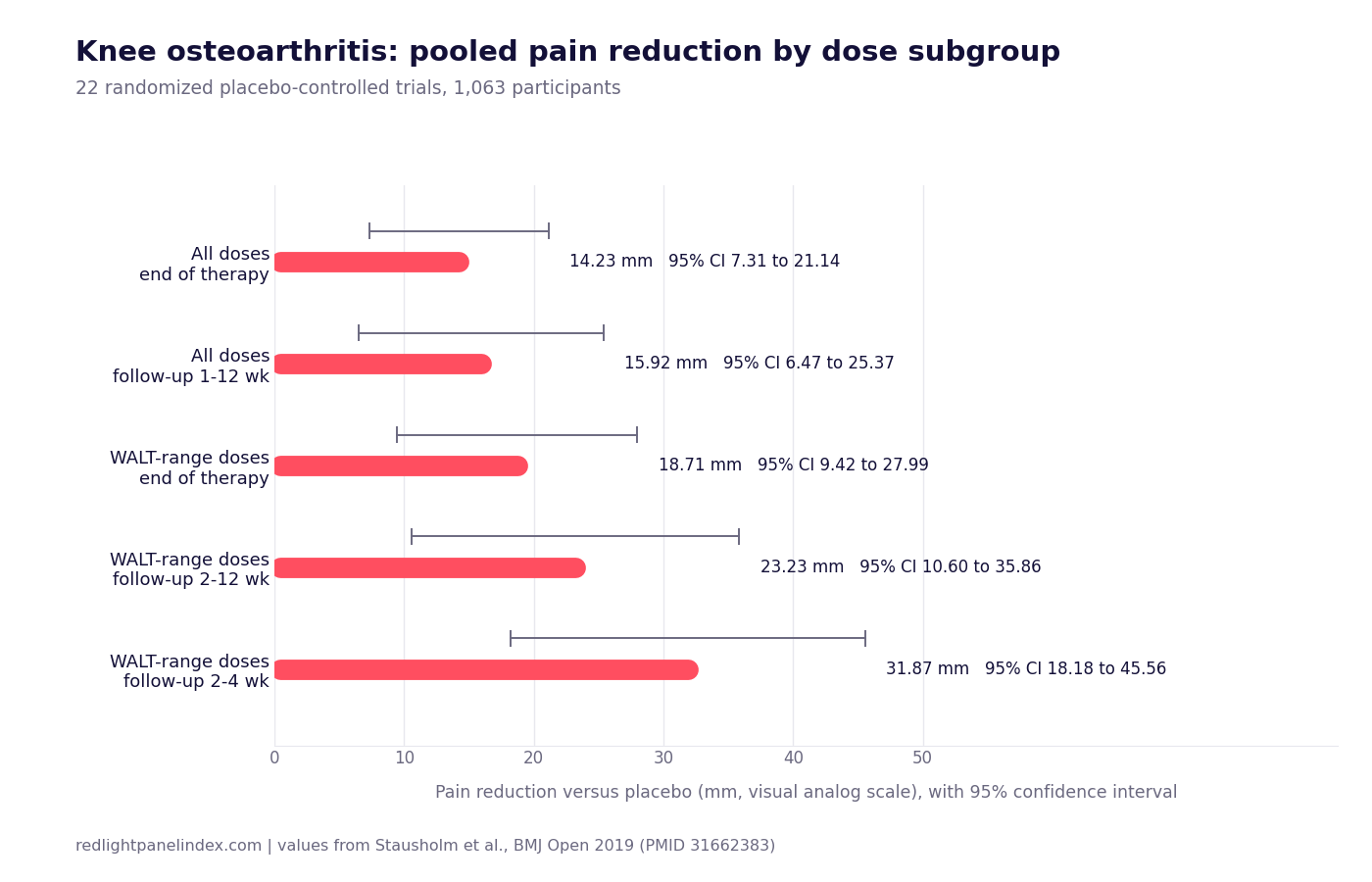
The evidence grade for knee osteoarthritis is Moderate. A meta-analysis of 22 randomized placebo-controlled trials reported significant reductions in pain and disability, and the effect was larger in the trials that used doses inside the World Association for Laser Therapy range, but nearly all of that evidence comes from clinic lasers applied point by point rather than from the LED panels sold for home use.
Choosing a panel? Our ranking of the best red light therapy panels is computed from published, method-labeled specs across 188 devices. For knee osteoarthritis, the spec that matters is how much of the output sits in the 810 to 850 nm band.
That gap between the trial device and the home device is the single reason this page is graded Moderate rather than Strong. The joint pain hub grades the wider joint literature, which includes conditions with different device profiles. Knee osteoarthritis on its own has the better trial base and the harder translation problem.
What the pooled evidence reports
Stausholm and colleagues searched five databases through February 2019 and meta-analyzed 22 randomized placebo-controlled trials in knee osteoarthritis, with 1,063 participants in total (PMID 31662383). Trials had to enroll participants meeting American College of Rheumatology or Kellgren and Lawrence criteria, and the authors recorded risk of bias as insignificant across the set.
Pooled across all doses, pain was reduced by 14.23 mm on a visual analog scale compared with placebo at the end of therapy (95% CI 7.31 to 21.14), and by 15.92 mm during follow-ups 1 to 12 weeks later (95% CI 6.47 to 25.37).
The more informative result is the dose subgroup. In the trials that used doses inside the World Association for Laser Therapy recommendations, pain was reduced by 18.71 mm at the end of therapy (95% CI 9.42 to 27.99) and by 23.23 mm during follow-ups 2 to 12 weeks afterward (95% CI 10.60 to 35.86). The largest separation from placebo appeared 2 to 4 weeks after the last session, at 31.87 mm (95% CI 18.18 to 45.56). Disability was also significantly reduced, and no adverse events were reported in the pooled set.
The authors' own conclusion names the doses: pain and disability were reduced at 4 to 8 J per treatment spot with 785 to 860 nm light, and at 1 to 3 J per spot with 904 nm light. Our full review of this meta-analysis walks through the search strategy and every pooled figure, including how the recommended-dose subgroup compared with the full set of 22 trials.
Two details are worth holding onto. The effect in this analysis grew for a few weeks after treatment stopped, which is not how an analgesic behaves and is one reason short trials may understate the outcome. And the same analysis found that trials outside the recommended dose window did not separate from placebo as clearly, which is consistent with the biphasic dose response described in the photobiomodulation literature (PMID 22461763): more energy is not reliably better. A meta-analysis of tendon trials reports the same dose-adherence pattern outside the knee joint.
The most recent trial in the register
The newest knee trial in this index is a double-blind randomized controlled trial by Maciel and colleagues, published in Lasers in Medical Science in 2025 (PMID 40545487). It enrolled 73 participants with symptomatic knee osteoarthritis, 8 of whom withdrew, leaving 65 in the final analysis, and it ran three arms rather than two: photobiomodulation, sham, and a no-intervention control.
The active arm followed the same World Association for Laser Therapy recommendations the meta-analysis used as its dose yardstick: a 790 nm laser at 120 mW delivering 4 J per point, applied to nine areas of the knee. The authors report significant reductions in pain in the active group compared with both the placebo and the control groups (p < 0.05), and significant within-group improvements on the WOMAC pain, stiffness, and functional limitation subscales, with no significant change in the sham or control arms. Quality of life was measured with the KOOS.
The abstract does not state the number of sessions or the treatment period, so this page does not either. A full-text read would be needed before anyone copies the schedule.
There is a third entry in the register, a randomized placebo-controlled trial that added photobiomodulation to a therapeutic exercise program for knee osteoarthritis (PMID 31144070). It is listed because it is the design most home users actually replicate: light alongside exercise rather than instead of it. Our full review of that trial covers its four-arm design and its mixed result: light reduced pain on its own, but added nothing measurable to what the exercise program already did for walking distance, mobility or strength.
What was not studied
- Panels. The trials above used point lasers held against or near the skin. No trial in this set used a wall-mounted LED panel at a working distance, which is the device almost every reader of this page owns or is considering.
- Dose in J/cm2. Laser trials report joules per treatment spot. A panel delivers irradiance in mW/cm2 across a broad area. The two numbers are not interchangeable, and no trial has established what panel dose corresponds to 4 J at a point.
- Structural change. The outcomes here are pain, stiffness, and self-reported function. Nothing in these abstracts speaks to cartilage, joint space, or radiographic progression.
- Long follow-up. The pooled follow-ups ran to 12 weeks. Whether anything persists at six months or a year is untested in this set.
- Home adherence. Every trial was supervised. Nothing here tells you what happens to the effect when a person does it themselves, three evenings a week, in a spare room.
Putting a panel dose together
If you are going to try this, the honest framing is that you are approximating a trial protocol with a different class of device. Two things carry over: the wavelength band and the idea that there is a dose window rather than a "more is better" rule.
On wavelength, the trials that worked clustered in the near-infrared. The 785 to 860 nm range named in the meta-analysis conclusion maps directly onto the 810 and 850 nm bands that panels publish, and the site's wavelength page describes 810 to 850 nm as the range that reaches muscle and joint tissue while 630 to 660 nm works at the skin. A panel that is mostly 660 nm is the wrong tool for a knee.
Published wavelength mixes vary widely. The MitoPRO 1500X publishes 17 percent each at 810, 830, and 850 nm; the RLT Home Total Spectrum MAX publishes 19 percent at 810 nm, 14 percent at 830 nm, 9 percent at 850 nm, and 14 percent at 1064 nm; the Hooga HG300 runs two bands only, 660 and 850 nm, and does not publish the split between them.
On dose, use the dose calculator with your panel's method-verified irradiance rather than its marketing number. Worked from the figures this index has verified: the Total Spectrum MAX is listed at 100.53 mW/cm2 at 6 inches on an independent spectrometer test, so roughly 100 seconds at that distance puts about 10 J/cm2 on the skin, and about five minutes puts about 30 J/cm2. The HG300 is listed at 73 mW/cm2 at 6 inches with the method not stated, and this index's standing advice for a method-unstated figure is to halve it as a working assumption, which turns the same 10 J/cm2 into roughly four and a half minutes rather than two.
That arithmetic tells you session length. It does not tell you that 10 J/cm2 at the skin equals 4 J at a laser point inside the joint, because nobody has shown that. Treat the calculator output as a way to be consistent and to avoid the extremes, not as a conversion of the trial protocol.
On frequency, the trials were courses of supervised sessions rather than daily use forever. The session frequency guide covers how the published protocols are usually structured.
Cautions
Knee osteoarthritis is a diagnosis, and pain in a knee has many other causes. Nothing on this page is a reason to skip an assessment, and nothing here should displace exercise therapy or weight management, which have a far larger evidence base and which the trial above deliberately ran alongside rather than against.
No adverse events were reported in the 22 pooled trials, which is reassuring but is not the same as a safety study; this index's safety and side effects page covers what that kind of reassurance does and does not establish across the broader trial register. If you take a photosensitizing medication, have an active skin condition over the knee, or have had a joint replacement or an injection recently, ask the clinician who did it before pointing a panel at the area.
Finally, judge it on your own timeline. The pooled data suggests the separation from placebo was still growing two to four weeks after a course ended, so a two-week trial of your own is likely to be too short to tell you anything either way.