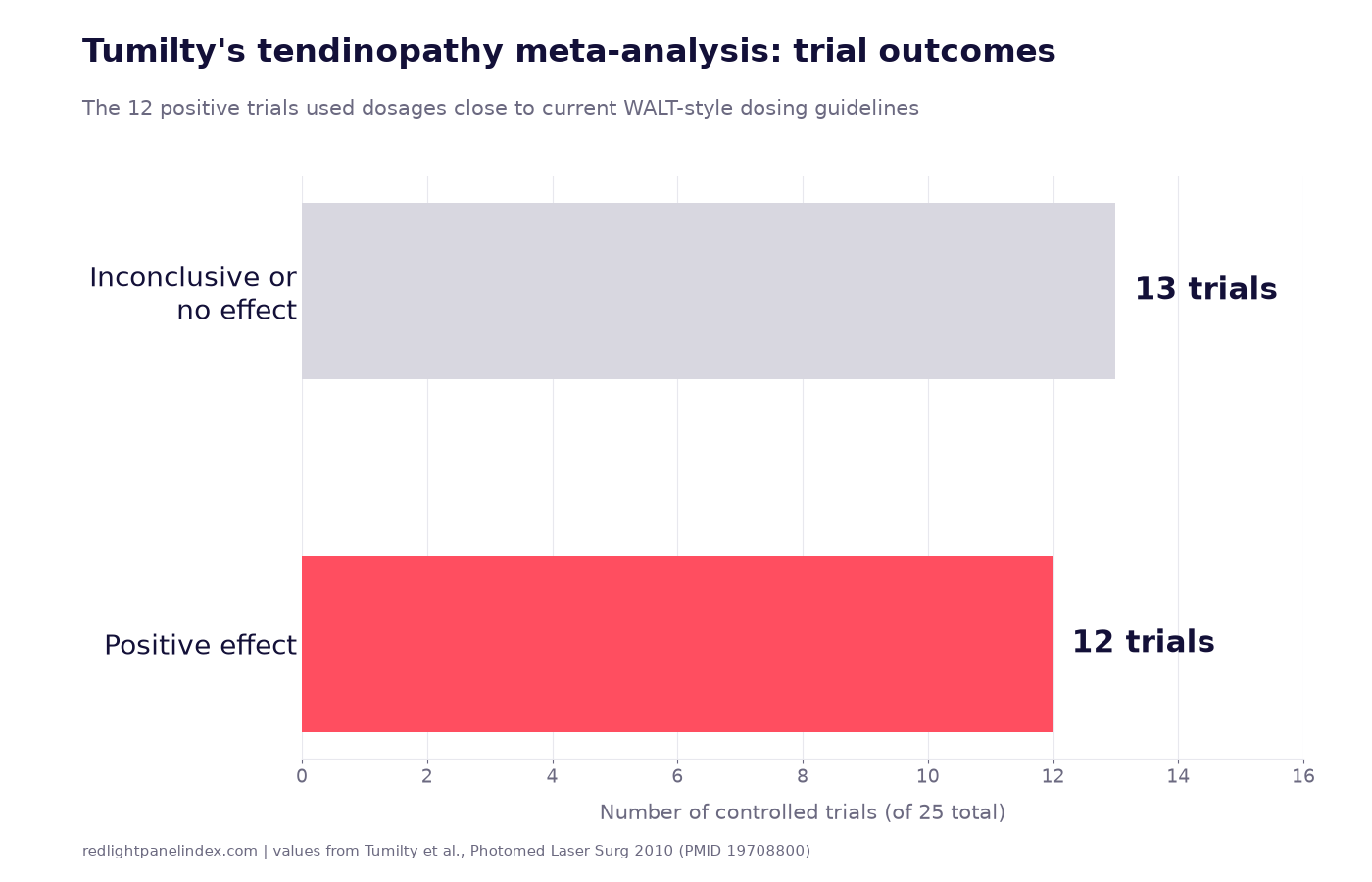
A 2010 systematic review pooled 25 controlled trials of low-level laser therapy for tendon injuries and found a clear split: 12 trials reported a positive effect, and 13 were inconclusive or showed no effect (PMID 19708800). The authors' central finding is not just that LLLT sometimes works for tendinopathy, but that the 12 positive trials shared something the other 13 did not: dosages close to established dosing guidelines.
Choosing a panel? Our ranking of the best red light therapy panels is computed from published, method-labeled specs across 188 devices. For a tendon injury, the spec that matters most is dose delivered at your treatment distance, not raw panel wattage.
What the study asked
The review, led by Steve Tumilty at the University of Otago, set out to answer two questions: does low-level laser therapy (LLLT) work for tendinopathy, and does it matter whether a trial's dosage matches the parameters recommended by dosing guidelines such as those from the World Association for Laser Therapy (WALT)? The authors also wanted to know whether treatment-parameter accuracy, not just LLLT versus placebo, explained why some trials succeeded and others did not.
This distinction matters because tendinopathy research had, by 2008, produced a confusing literature: some trials reported meaningful pain and function improvements, while others found no difference from sham treatment. Rather than treating that split as evidence that LLLT simply does not work, the authors asked whether the split tracked something more specific, namely whether each trial actually delivered a dose inside the range that dosing guidelines recommend for tendon tissue.
Who was studied
This was a meta-analysis of published trials, not a single patient cohort. The authors searched MEDLINE, PubMed, CINAHL, AMED, EMBASE, All EBM Reviews, PEDro and SCOPUS from inception through August 1, 2008, and included any controlled clinical trial that used LLLT as the primary intervention for a tendinopathy. Twenty-five controlled trials met the inclusion criteria, covering multiple tendon sites; the two conditions with poolable data were lateral epicondylitis (tennis elbow) and Achilles tendinopathy.
Device and parameters as stated
Because this is a meta-analysis, there is no single device or protocol. The authors instead graded each trial's methodological quality using the PEDro scale (high quality: 6 or more out of 10; low quality: under 6), then separately assessed whether each trial's irradiation parameters, wavelength, dose and treatment site, matched the dosage window supported by current recommendations. The paper's own framing is that the accuracy of dosage and parameter choice, not just the presence or absence of a laser, was the variable worth testing.
The included trials themselves used clinical laser devices, not consumer LED panels, delivered at specific point sites over the affected tendon rather than as a broad panel exposure. That is a real difference from how a home panel is typically used, and it is one reason the paper's figures should be read as evidence about dosing logic rather than as a direct prediction of what any particular home device will do.
What was measured and found
Twelve of the 25 trials showed a positive effect; 13 were inconclusive or showed no effect. The authors report that the dosages used in the 12 positive studies fell inside a dosage window that closely resembled current recommended guidelines, which they read as evidence for an effective dosing range rather than a simple positive-or-negative verdict on the modality itself.
Two conditions had enough comparable data to pool statistically. In high-quality trials (PEDro score of 6 or higher) of lateral epicondylitis, treated participants had grip strength 9.59 kg higher than control groups. In Achilles tendinopathy trials, treated participants reported 13.6 mm less pain on a 100 mm visual analogue scale than controls. Both figures come from pooled data across multiple trials, not one study.
Grip strength and a 100 mm pain scale are useful outcome measures precisely because they are objective or semi-objective and comparable across trials, but they are also narrow. The review does not report pooled results for every tendon site in the 25-trial set, only for the two conditions, lateral epicondylitis and Achilles tendinopathy, where enough trials used compatible outcome measures to combine statistically. For every other tendinopathy the 25 trials covered, the paper's conclusions rest on the broader 12-versus-13 split rather than a specific effect size.
Limitations
The authors' own conclusion is stated cautiously: LLLT "can potentially be effective" when recommended dosages are used, not that it reliably is effective. This is a meta-analysis of trials with mixed methodological quality, and pooling was only possible for two of the many tendon sites covered by the original 25 trials, so the grip-strength and pain-scale figures above do not generalize to every tendon condition. The review also predates a decade and a half of newer trials and updated dosing tables, and it cannot tell us whether a given home device's exact wavelength and irradiance sit inside or outside the effective window the authors describe, since it was built entirely from clinical trial devices, not consumer panels.
What this means for a home panel
The practical takeaway is not "more light is better," it's "the right dose, delivered consistently, is what separated the successful trials from the rest." A home panel used at an arbitrary distance for an arbitrary number of minutes has no particular reason to land inside that effective window. Use the dose calculator to work out how long a session needs to be, given your panel's irradiance at your actual treatment distance, to reach a dose in the range researchers have tested, rather than assuming a longer session is automatically a stronger one.
This is also a useful companion to the site's other WALT-dose study review, which looked at a single randomized trial using 790nm light dosed to WALT-style targets in knee osteoarthritis and found the same pattern: a trial that hit its target dose reported better outcomes than looser dosing (PMID 40545487). Tendon and joint tissue are not identical, but the dosing logic, matching irradiance and time to a validated dose window rather than guessing, is the same in both cases. For the broader evidence picture on joint and tendon pain, see the joint pain and arthritis evidence hub.