Red Light Therapy for Joint Pain and Arthritis: What the Evidence Shows
Evidence grade: Strong
How red light therapy acts on joint pain and arthritis
Joint pain in osteoarthritis and related conditions is driven substantially by low-grade inflammation in the synovium and periarticular soft tissue, not by structural damage alone. This matters because photobiomodulation (PBM) acts on exactly that inflammatory component. The mechanism is well characterized in Hamblin's review of PBM biology (PMC5523874): near-infrared photons are absorbed by cytochrome c oxidase, the terminal enzyme of the mitochondrial respiratory chain. Absorption briefly dissociates inhibitory nitric oxide from the enzyme, restores electron transport, and raises ATP output, while modulating reactive oxygen species that act as signaling molecules.
Downstream, that shift moves the local tissue environment away from the pro-inflammatory state that sustains arthritic pain. Controlled PBM work consistently reports reduced pro-inflammatory mediators (prostaglandin E2, COX-2, TNF-alpha, IL-1beta, IL-6) and increased anti-inflammatory signaling, alongside improved microcirculation. For a joint, the practical consequence is that light which actually reaches the synovium can dampen the inflammatory driver of pain rather than merely masking the sensation, which is also why the effect builds over weeks rather than minutes.
What the studies show
| Study | Design | Finding |
|---|---|---|
| PMID 31144070 | RCT, ~808nm + exercise, knee OA | Pain reduction and strength gains vs placebo |
| PMID 40545487 | RCT, 790nm, 4 J/point over 9 knee sites | Significant pain and function improvement vs sham and control |
| PMID 24801056 | Placebo-controlled RCT, LLLT in fibromyalgia | Significant pain and symptom-score reduction vs sham |
Knee osteoarthritis, PBM plus exercise (PMID 31144070, Lasers in Medical Science)
This randomized controlled trial paired roughly 808nm near-infrared light with a structured exercise program in knee osteoarthritis. The group receiving active light plus exercise showed greater pain reduction and larger strength gains than the group receiving exercise plus placebo light. The critical reading is that PBM was additive to exercise, not a substitute for it: the exercise did work, and the light made it work better.
Knee osteoarthritis, WALT-dosed 790nm (PMID 40545487, Lasers in Medical Science, 2025)
A more recent randomized controlled trial delivered 790nm light at doses consistent with World Association for photobiomoduLation Therapy (WALT) guidance, about 4 joules per point across nine points around the knee. Against both a sham-light arm and an untreated control, the active group achieved significant reductions in VAS pain scores and improvements in WOMAC and KOOS function measures. Because the dose and delivery are specified, this trial is useful for translating clinic protocols into a home routine.
Widespread musculoskeletal pain, fibromyalgia PBM (PMID 24801056, Lasers in Medical Science, 2014)
Fibromyalgia is a widespread-pain condition rather than a single joint, so it is included for what it demonstrates: light therapy acting on musculoskeletal pain in a placebo-controlled design. Twenty patients were randomized to a 670nm laser (4 J/cm² on 18 tender points, three sessions weekly for four weeks) or sham treatment; the active group improved significantly versus placebo on the Fibromyalgia Impact Questionnaire, McGill Pain Questionnaire, and VAS pain scores. A 2019 meta-analysis (PMID 31151332, Pain Physician) pooled the available trials and concluded low-level laser therapy is an effective and well-tolerated option for fibromyalgia. Note the device class: these are point-applied lasers, not panels, so read this as mechanism support rather than a panel protocol.
Which wavelengths do the work
Joints sit beneath skin, fat, and often muscle, so the only wavelengths that matter are the ones that survive the trip. Near-infrared at 810nm and 830nm penetrates into periarticular soft tissue, and 1064nm-class deep infrared reaches furthest of the consumer bands. Surface reds at 630 and 660nm are largely absorbed in the epidermis and dermis, so they are a skin protocol, not a joint protocol. When you evaluate a panel marketed for joints, read the per-wavelength density table rather than the wavelength list: a device that puts 80 percent of its output at 660nm and 850nm is not optimized for a knee or a hip, whatever the marketing says.
Dosing: distance, time, and frequency
The positive knee trials used WALT-style point dosing, a few joules delivered to each of several points around the joint. Translating that to a home panel: position the joint 6 to 12 inches from the panel, treat for 10 to 20 minutes, 3 to 5 sessions per week, and judge results over 8 or more weeks rather than after a session or two. The dose-response is biphasic, meaning there is a window: too little does nothing and too much can blunt the benefit, so longer is not automatically better. Run your panel's stated irradiance and your distance through the dose calculator to land inside a sensible joules-per-square-centimeter range.
How it compares with conventional options
In every trial where PBM helped, it was added to exercise and standard care, not used in place of them. Compared with the common alternatives, PBM has a favorable safety profile: unlike NSAIDs it carries no gastrointestinal, cardiovascular, or renal burden, and unlike an intra-articular corticosteroid injection it is non-invasive and repeatable. The trade-off is that it is slower and more modest, working over weeks, and it does not deliver the immediate relief a cortisone shot can. The reasonable framing is PBM as a low-risk adjunct that may reduce reliance on medication over time, discussed with your clinician, not a replacement for a management plan.
Which panel features matter for joint pain and arthritis
Joints need light that survives the trip through skin and soft tissue: 810nm, 830nm, and 1064nm-class bands at meaningful density. Check the density table on any panel marketed for joints; a panel with 80% of its output at 660/850nm is not optimized for this use.
Device picks from the database
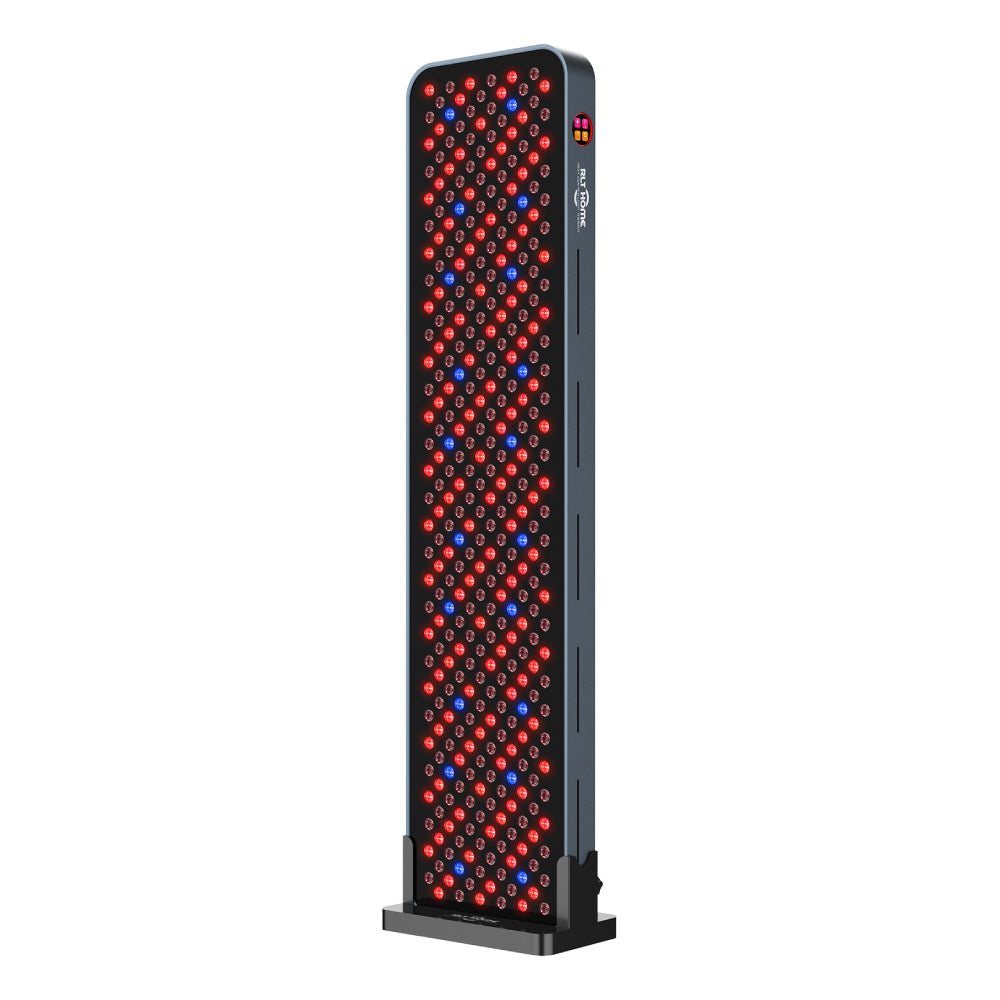
RLT Home Total Spectrum MAX
Deep-band density where it matters: 19% 810nm, 14% 830nm, 14% 1064nm.
Full specs
What the evidence does not support
The strong evidence is specifically for knee osteoarthritis with PBM added to exercise. Extrapolating that to every joint, every arthritis subtype, and every device class goes beyond what the trials show. Home panels are also not the exact devices, wavelengths, or dosing used in the clinical studies, so home results can differ. Most importantly, PBM does not regrow cartilage, reverse structural joint damage, or cure osteoarthritis; the honest claim is that it may reduce pain and improve function for some people, as an addition to the things already known to help.
Safety and contraindications
PBM is generally well tolerated, with mild transient warmth the most common report. Standard cautions apply: avoid treating over active or suspected malignancy, use care with photosensitizing medications, avoid the abdomen during pregnancy, and use eye protection with high-output panels. Anyone with a diagnosed joint condition should fold light therapy into a plan agreed with their clinician rather than replacing prescribed treatment.
Frequently asked questions
Does it replace physio or medication?
No. In the positive trials it was an addition to exercise and standard care, not a substitute.
Which wavelength is best for knee or hip arthritis?
Prioritize near-infrared that penetrates to the joint: 810nm and 830nm, and ideally some 1064nm. Treat surface reds (630/660nm) as a bonus for skin, not the working band for a deep joint.
Can red light therapy cure arthritis?
No. In the supportive trials it reduced pain and improved function as an addition to exercise; it does not reverse joint damage or cure the underlying disease.
How long before I would notice anything?
The positive knee trials ran for weeks of consistent sessions. Judge it over 8 or more weeks, not after a handful of uses.
Is a home panel as good as a clinic laser?
The trials often used clinic-grade devices at controlled doses. A well-specified panel with real near-infrared density is a reasonable home extrapolation, but match the dose sensibly and keep expectations proportional.
Tendon injuries follow the same dosing logic as the knee osteoarthritis trials above: a meta-analysis of 25 tendinopathy trials found that the trials reporting a positive effect were the ones using dosages close to established recommendations, while the rest were inconclusive.
A more recent, more tightly controlled fibromyalgia trial moved past the point-applied laser design above: a triple-blinded RCT of a whole-body LED bed reported a large, still-present-at-two-weeks reduction in pain, though the delivery device is a clinic bed rather than a panel. The site's dedicated fibromyalgia evidence page puts that bed trial next to a point-laser RCT and a 2019 meta-analysis and grades the combined literature Moderate; a full study review of that RCT and meta-analysis covers the same per-point dosing gap discussed above.
Chronic low back pain gets its own page rather than living on this hub: a 2016 meta-analysis of 15 laser trials found a similar dose-dependent pattern, benefit only above a per-point joule threshold, in a population defined by localized spinal pain rather than the joint or whole-body pain covered above.
Even at this page's Strong grade, the trials describe reduced pain and improved function as an addition to exercise and standard care, not a cure; this site's myths-checked guide checks the claim that red light therapy "cures the condition outright" against language exactly like this.
For picking a home panel against this literature, near-infrared share in the 810 to 850nm band, and 1064nm where a model offers it, matters more than total wattage; this site's ranking of panels for joint pain scores four models on that wavelength share alongside named-instrument irradiance and whether the panel's size actually fits over a single knee or shoulder.
For neck pain specifically, the evidence is one pooled paper: a 2009 Lancet meta-analysis of 16 laser trials that reported reduced pain compared with placebo, graded Moderate, with the same laser-to-panel gap described above.
Neck pain has its own page built on one pooled laser paper: see the study review of the Lancet neck pain meta-analysis for its 16 trials, the numbers the abstract reports, and why none of it was tested on a home panel.
For a small placebo-controlled trial that measured an inflammatory marker in the Achilles tendon after laser, see the study review of the 2006 Bjordal trial.
For the tendon side of this evidence, the tendinopathy evidence page grades the Tumilty, Bjordal and Naterstad sources together, and the 2022 meta-analysis of plantar fasciitis and lower-limb tendon trials is reviewed in full.
For the elbow specifically, the tennis elbow evidence page sets the pooled grip strength result beside the individual placebo-controlled laser trials and grades it Limited.
Methodology: rankings weigh measured or method-stated irradiance, wavelength coverage and published density, buyer terms (trial, restocking, stand, warranty), and value per LED. No brand pays for a position. Full methodology.