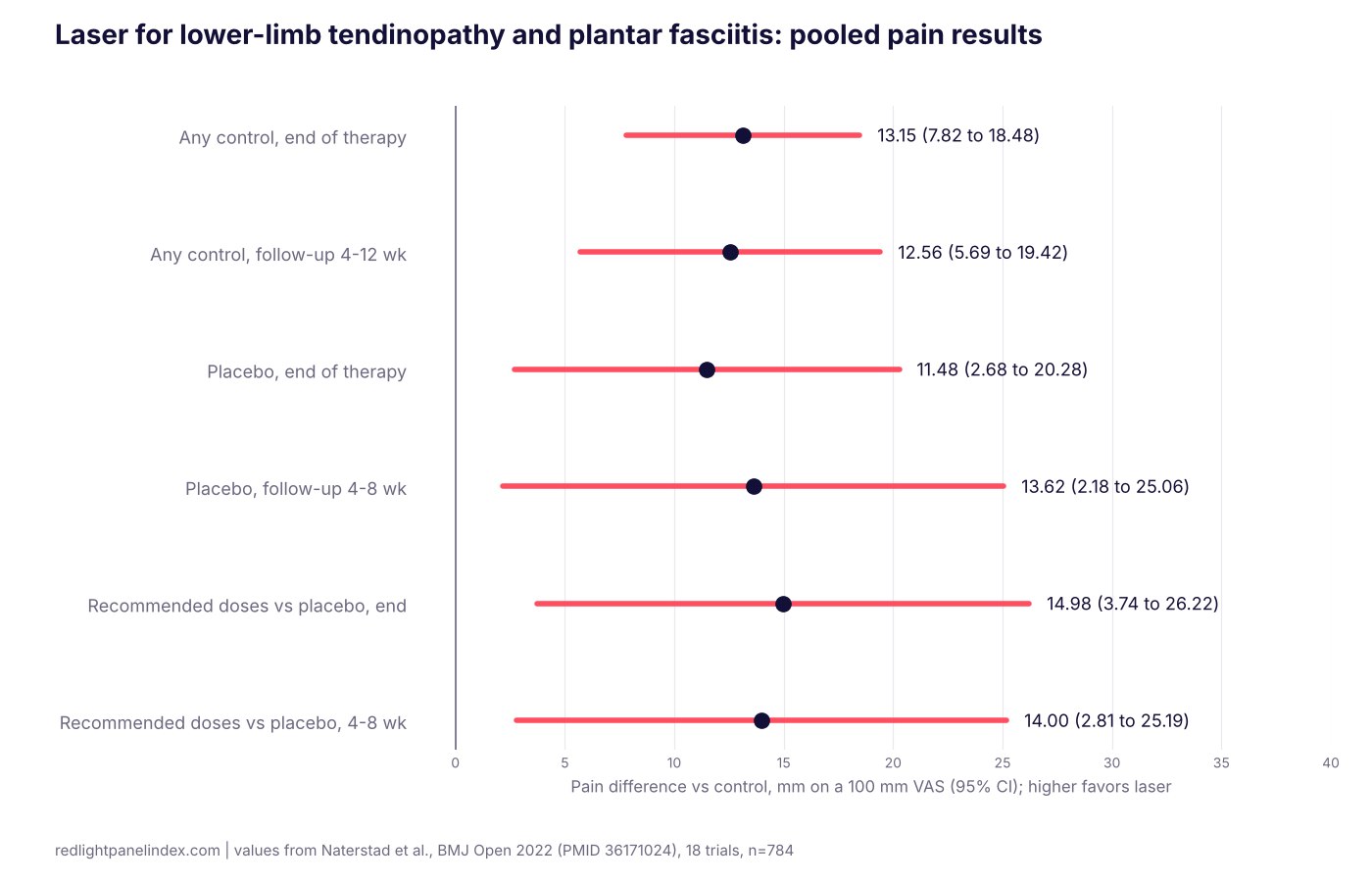
A 2022 systematic review and meta-analysis in BMJ Open pooled 18 randomized trial reports (784 participants) of low-level laser therapy for lower-limb tendinopathy and plantar fasciitis and reported that pain was lower after laser than after control, by about 13 mm on a 100 mm scale, with small improvements in disability (PMID 36171024). The finding most relevant to anyone choosing a light device is that the benefit appeared mainly in trials that used doses within World Association for Laser Therapy (WALT) recommendations, while the one trial with a non-recommended dose showed no benefit.
Choosing a panel? Our ranking of the best red light therapy panels is computed from published, method-labeled specs across 188 devices. For foot and lower-leg tendon questions, the spec that matters is method-labeled irradiance at the skin, because the trials turned on delivered dose.
What the study asked
The review asked whether low-level laser therapy (LLLT) reduces pain and disability in people with tendinopathy of the lower limb or with plantar fasciitis, and whether the answer depends on the dose delivered. The authors compared results by whether each trial's dose matched WALT recommendations, which are written as joules per treatment point. This builds on earlier work, including the Tumilty tendinopathy meta-analysis from 2010, which first linked positive trials to guideline-range dosing.
Who was studied
According to the paper, searches covered PubMed, Embase and PEDro up to 20 August 2020, with no language or date restrictions, and the review was registered in advance (PROSPERO CRD42017077511). Abstracts-only reports were excluded. Eighteen trial reports met the criteria, with 784 participants and a mean age of 43.6 years.
By condition, the included trials covered:
- Plantar fasciitis: 11 trials
- Achilles tendinopathy: 5 trials
- Patellar tendinopathy: 2 trials
Ten trials compared laser with placebo, five with other interventions, and three tested laser as an add-on to another treatment. The text I read does not give separate participant totals for tendinopathy and plantar fasciitis, so none are stated here.
Device and parameters as stated
The trials used clinical lasers, not LED panels. The paper reports these ranges across the included trials:
- Wavelength: 635 nm to 904 nm, including 810, 820, 830 and 904 nm.
- Mean output power: 7 to 200 mW.
- Time per spot: 30 to 600 seconds.
- Energy per spot: 0.21 to 8.4 J, where reported.
- Sessions: 6 to 24.
Six trials (35 percent) described their dose parameters inadequately. That matters because the review's dose comparison depends on being able to classify each trial. For background on how point doses are written and why they do not convert directly into panel minutes, see our explainer on WALT dosing recommendations, and for the bands themselves see the wavelengths overview.
What was measured and found
Pain was measured on a 100 mm visual analogue scale (VAS), and disability by standardized mean difference (SMD). The pooled results reported in the paper:
| Comparison | Time point | Pain difference, mm (95% CI) |
|---|---|---|
| Laser vs any control | End of therapy | 13.15 (7.82 to 18.48) |
| Laser vs any control | 4 to 12 weeks | 12.56 (5.69 to 19.42) |
| Laser vs placebo | End of therapy | 11.48 (2.68 to 20.28) |
| Laser vs placebo | 4 to 8 weeks | 13.62 (2.18 to 25.06) |
| Recommended doses vs placebo | End of therapy | 14.98 (3.74 to 26.22) |
| Recommended doses vs placebo | 4 to 8 weeks | 14.00 (2.81 to 25.19) |
Disability improved against any control by an SMD of 0.39 (95% CI 0.09 to 0.70) at the end of therapy and 0.32 (95% CI 0.05 to 0.59) at 4 to 9 weeks. Those are small effects by the usual conventions.
The dose subgroup
The dose analysis is the part that bears on home use. Against placebo, trials that used WALT-recommended doses reported a pain difference of 14.98 mm at the end of therapy. The single trial with a non-recommended dose reported -3.0 mm (95% CI -11.17 to 5.17), which is not a significant difference, and trials with unknown dose reported 10.83 mm. The paper gives a subgroup difference of p = 0.02. For laser used as an add-on to exercise at recommended doses, the end-of-therapy difference was 18.15 mm (95% CI 10.55 to 25.76).
One caution on the numbers: the text I read describes a figure of 15.90 mm in two slightly different ways, once in the abstract and once in the results section, so this review does not rely on it.
What the authors concluded
The authors concluded that LLLT significantly reduces pain and disability in lower-limb tendinopathy and plantar fasciitis, that long-term data were not available, and that some uncertainty about effect size remains because of wide confidence intervals and a lack of large trials. They suggested following WALT dose recommendations until further trials are available.
Limitations
- Wide intervals. Several confidence intervals run from a few millimeters to more than 20, so the true effect could be small or moderate.
- Dose reporting. Six trials did not describe dose adequately, and only one trial fell in the non-recommended group, so the dose contrast rests on a thin comparison.
- Blinding. Allocation concealment was reported in 61 percent of trials, therapist blinding in 28 percent and assessor blinding in 39 percent. A post hoc analysis found no significant link between lack of blinding and effect size.
- No long-term data. Follow-up in the pooled analyses ran 4 to 12 weeks.
- Review process. One reviewer extracted data with a second checking, one unpublished trial was included, and two trials (11 percent) were not in English.
- Mixed conditions. Plantar fasciitis made up most of the trials, so conclusions about the Achilles or the patellar tendon rest on fewer studies.
The authors rated trial quality with the PEDro scale: scores ranged from 5 to 10 with a mean of 7.1, with ten trials rated high quality and eight moderate. They found no evidence of small-study bias.
What this means for a home panel
The trials used lasers on small spots over the painful site, delivering joules per point. A home panel spreads light over a large area at a lower irradiance, so a trial's point dose cannot be copied straight onto a panel session. The honest gap is that no trial in this review tested a multi-wavelength LED panel, so the pooled results show that guideline-range laser dosing was associated with less pain in these conditions, not that a given panel will do the same.
Practical points for a reader weighing a panel for heel or lower-leg tendon pain:
- Work from method-labeled irradiance at the distance you will actually use, and turn it into a dose with the dose calculator rather than assuming a longer session is a stronger one.
- The trial wavelengths sat in the near-infrared range, mostly 810 to 904 nm. Check which of those bands a panel carries before relying on this evidence; our irradiance explainer shows how to read the spec method.
- The Achilles and the plantar fascia are fairly superficial, so depth is a smaller concern than for a hip, while coverage and positioning still matter.
- For a small crossover trial that measured an inflammatory marker in the Achilles, see our review of the 2006 Bjordal trial; for the wider joint and tendon picture, see the joint pain evidence hub.
- Heel pain has several causes. A sudden injury, a swollen or very painful tendon, or pain that is not improving should be assessed by a clinician, and anyone on photosensitizing medication should ask before starting.
For how we weigh studies like this one, see how rankings work.