WALT dose recommendations are the World Association for Laser Therapy's published tables of how many joules a class 3B laser should deliver to a single treatment point at a given wavelength, not a session dose in joules per square centimeter the way panel makers report it. A trial that follows WALT dosing applies a fixed energy, in joules, to each of several marked points on the body, one point at a time, which is a different unit of measurement than the J/cm2 figure this site's dose calculator works with for LED panels.
Choosing a panel? Our ranking of the best red light therapy panels is computed from published, method-labeled specs across 188 devices. For dosing, the spec that matters is whether a figure is reported as energy per point (laser convention) or as irradiance over an area (panel convention), because the two cannot be substituted for each other without knowing the treated spot size.
What the WALT tables actually list
WALT publishes minimum recommended doses in joules, not joules per square centimeter, for class 3B lasers at specific wavelength bands, most commonly 780-860nm and 904nm. The tables are organized by diagnosis and body region, and each entry gives a point dose, typically in the range of 1 to 18 joules depending on tissue depth and whether the laser is superpulsed or continuous wave, along with guidance on how many points to treat and how often. The tables also carry a stated dose window, roughly plus or minus 50 percent of the listed value, and general treatment-course guidance, such as daily sessions for two weeks or every-other-day sessions for three to four weeks, with instructions to reduce the dose once inflammation is under control. None of this is stated as a J/cm2 figure, because the tables assume a laser probe applied to one small, known spot rather than a beam spread over an open panel area.
How one knee osteoarthritis trial applied it
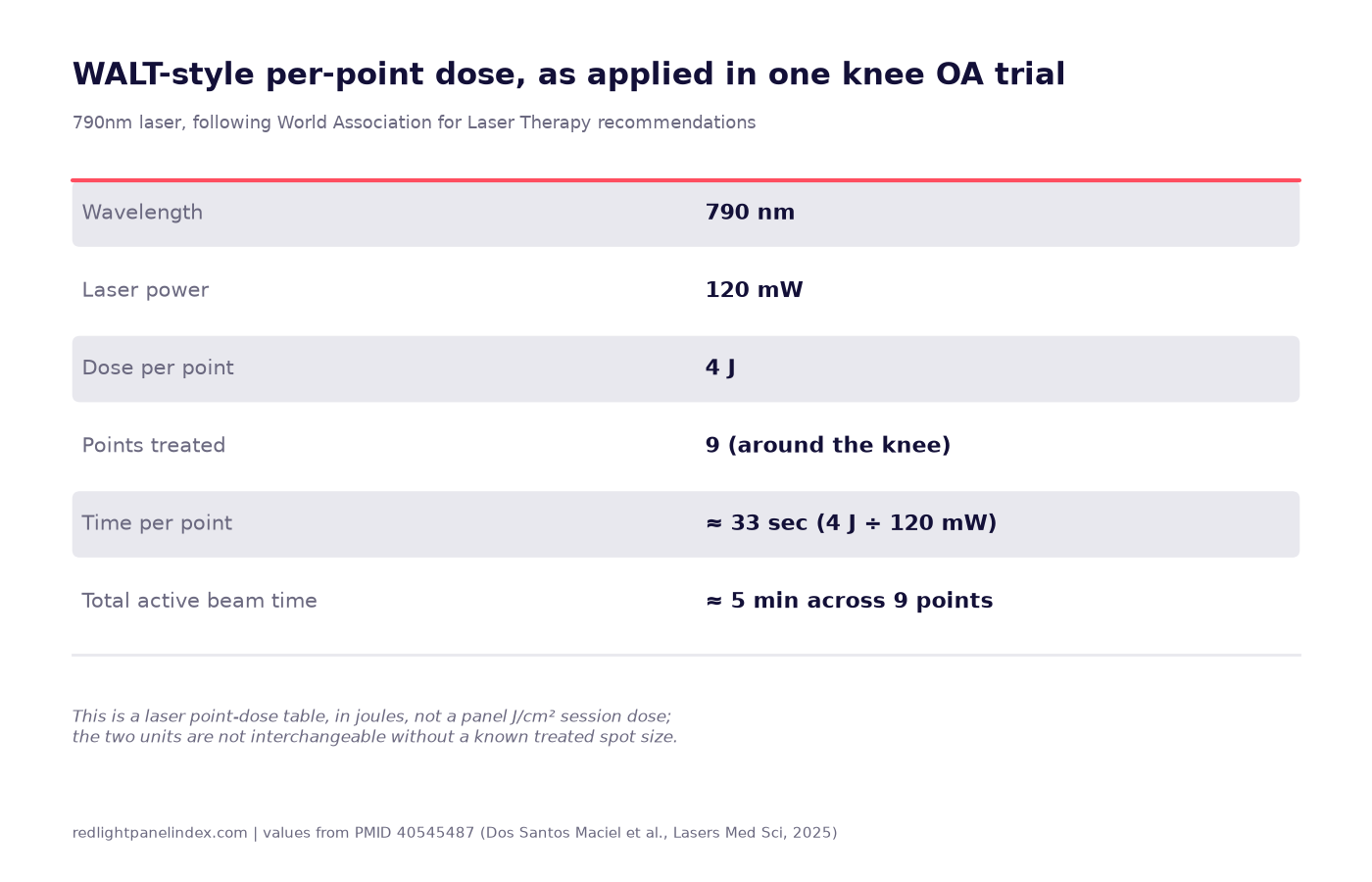
A 2025 randomized controlled trial on symptomatic knee osteoarthritis shows what a WALT-based protocol looks like in practice. The trial randomized 73 participants, with 65 completing the study, into photobiomodulation, sham, and no-intervention control groups. The active treatment used a 790nm laser at 120mW of power, delivering 4 joules to each of nine specific points around the knee, following WALT's recommendations for that wavelength and region. Pain fell significantly in the treated group compared to both sham and control, and WOMAC scores for pain, stiffness and functional limitation all improved significantly within the treatment group before to after treatment, while the sham and control groups showed no significant change (PMID 40545487). This is the shape of a WALT-dosed protocol: a stated wavelength, a stated power in milliwatts, a fixed joule figure per point, and a fixed number of points, none of which is expressed as irradiance over an area the way a home panel's spec sheet is.
At 120mW of laser power and 4 joules per point, simple division shows the laser spent about 33 seconds on each of the nine points, for roughly five minutes of active beam time across the whole knee, before accounting for repositioning the probe between points. That number is only meaningful for a point-by-point laser; it says nothing about how long someone would need to sit in front of an LED panel to reach a comparable effect, because a panel is not depositing 4 joules into one small spot, it is spreading its output across the full illuminated area at once.
Why the joule figure will not transfer to a panel timer
Converting a WALT-style per-point dose into a panel session dose requires knowing the exact area the laser probe covered, and trial papers using this convention typically do not report a spot size in square centimeters. Without that number, there is no way to back-calculate the trial's dose into J/cm2 and then plug it into a panel's irradiance figure to get a session time; any such conversion would be a guess dressed up as a calculation. LED panels and lasers also differ in how their light behaves at a distance: a laser stays collimated in a narrow, roughly parallel beam, while an LED panel's light cone widens as you move away, which is part of why the LED versus laser comparison on this site treats the two as separate dosing systems rather than interchangeable delivery methods for the same joule figure. The practical result is that a home panel user cannot take a WALT table's 4 joules per point and translate it directly into minutes under a panel without inventing a spot-size assumption the original trial never provided.
What a panel user can do instead
Rather than trying to reverse-engineer a laser trial's point dose, the more reliable approach is to work from the panel-dosing literature and this site's own dosing guide, which puts most studied home-panel protocols in the 10 to 60 J/cm2 range per treated area, with typical figures closer to 9 J/cm2 for skin-level work and 20 to 25 J/cm2 for deeper joint and whole-body sessions. The dose calculator converts a panel's measured irradiance in mW/cm2 and a chosen session length directly into that J/cm2 figure, using the standard formula of irradiance multiplied by seconds and divided by 1000. For example, the RLT Home Total Spectrum COMPACT, independently measured at 99.0 mW/cm2 at six inches, would need roughly 200 seconds, a little over three minutes, to reach a 20 J/cm2 dose at that distance, a figure worked out from the panel's own method-stated irradiance rather than from any laser trial's point dose.
This does not mean WALT-dosed trials are irrelevant to panel users. The wavelength band, the general dose magnitude relative to tissue depth, and the direction of the clinical result are all still useful context, and the knee trial above is one of the stronger single studies behind this site's knee osteoarthritis evidence grade. What does not carry over is the specific joule-per-point number, which belongs to a different measurement convention than the one printed on a panel's spec sheet.
The dose-response ceiling still applies
Whether the source is a WALT table or a panel's own dosing guide, more light is not automatically better. The biphasic dose response documented across photobiomodulation research shows therapeutic effect rising with dose only up to a point, after which additional light stops helping and can start working against the tissue. WALT's built-in instruction to reduce dose once inflammation subsides reflects the same underlying pattern that panel dosing guides apply when they recommend staying within a studied range rather than assuming a longer session is always stronger. For a panel user, that means treating the 10 to 60 J/cm2 range from the panel literature, not any laser trial's per-point figure, as the ceiling to plan around.
Practical takeaway
A WALT dose table tells you what a clinic laser delivered to one point on the body, in joules, at a stated wavelength and power; it does not tell you how long to sit in front of a home LED panel. Use the wavelength and the direction of the clinical outcome from a WALT-dosed trial as context, but get your actual session length from a panel's own method-stated irradiance figure run through the dose calculator, targeting the 10 to 60 J/cm2 range documented in the panel-dosing literature rather than trying to convert a per-point joule figure that was never reported with the spot size needed to convert it.