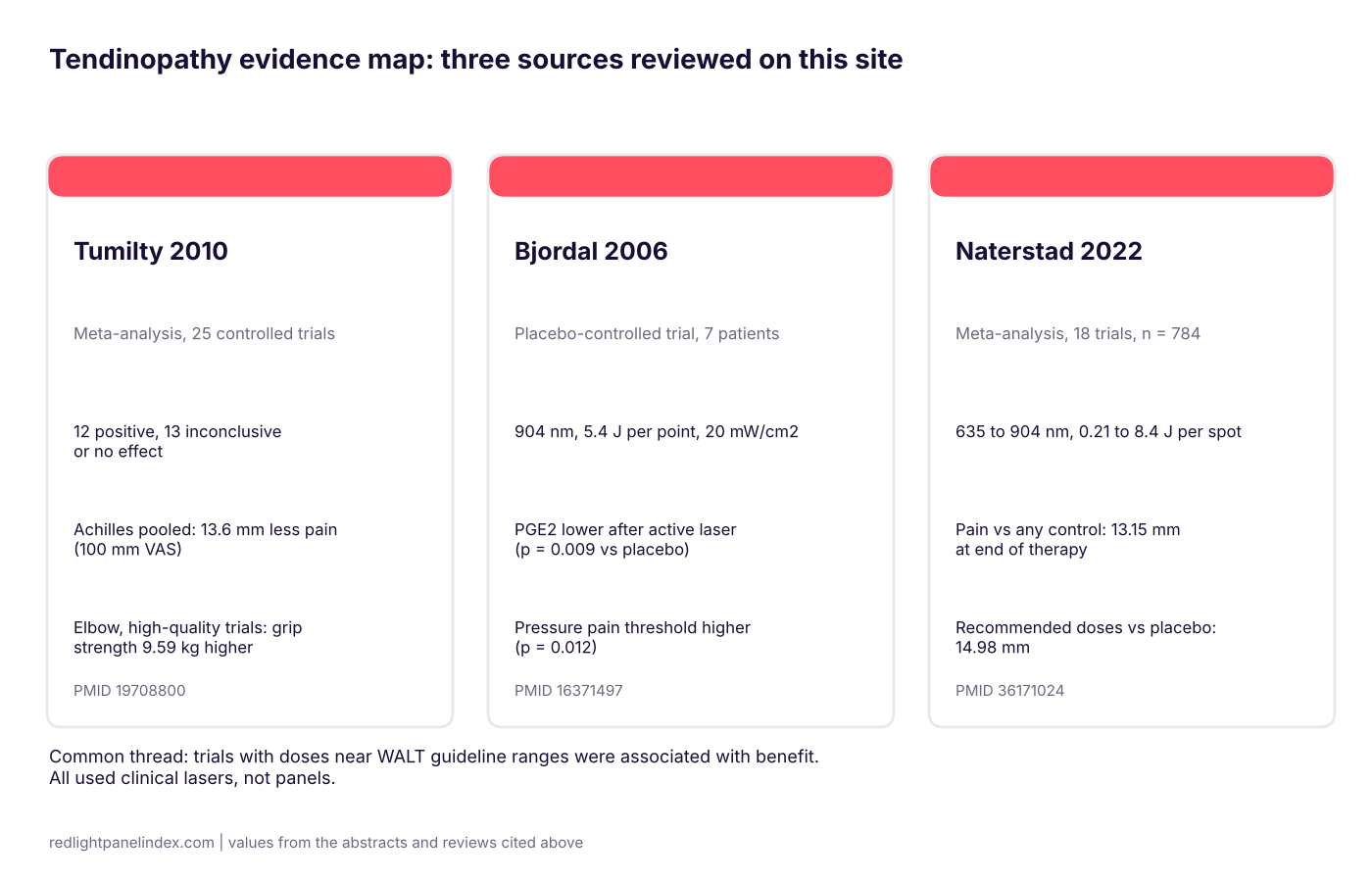
The evidence grade for red and near-infrared light in tendinopathy is Moderate: two meta-analyses of controlled trials (25 trials in 2010, 18 trial reports in 2022) reported less pain than control, but nearly all of that work used clinical lasers at guideline doses, the effects were modest, and no long-term data exist (PMID 19708800, PMID 36171024). The consistent thread is dose. Trials that delivered doses near published guideline ranges were the ones associated with benefit, which is the main thing a panel owner can act on.
Choosing a panel? Our ranking of the best red light therapy panels is computed from published, method-labeled specs across 188 devices. For tendon pain, the spec that matters is method-labeled irradiance in the near-infrared band, because the trials turned on delivered dose.
How this page grades the evidence
Moderate means more than one controlled body of evidence points the same way, but the quality, device match or size of effect keeps it short of Strong. The grades are explained in how this site grades evidence. Here the grade is held at Moderate, not higher, for three reasons: the trials used lasers, not panels; confidence intervals are wide; and follow-up stops at 12 weeks.
The studies
Tumilty meta-analysis (2010)
A systematic review pooled 25 controlled trials of low-level laser therapy for tendinopathy. Twelve trials reported a positive effect and 13 were inconclusive or showed no effect (PMID 19708800). The authors reported that the dosages in the positive trials were close to recommended guideline ranges. Two conditions had enough comparable data to pool. In high-quality lateral epicondylitis (tennis elbow) trials, treated groups had grip strength 9.59 kg higher than controls. In Achilles tendinopathy trials, treated groups reported 13.6 mm less pain on a 100 mm visual analogue scale. Full detail is in our review of the Tumilty meta-analysis.
Bjordal Achilles trial (2006)
A placebo-controlled trial in seven people with bilateral, activated Achilles tendinitis used 904nm laser at 5.4 J per point and 20 mW/cm2 on one tendon and a placebo on the other (PMID 16371497). Peritendinous prostaglandin E2 was significantly lower after active laser than before treatment (p = 0.026) and than after placebo (p = 0.009), and pressure pain threshold was higher after active treatment (p = 0.012). It is a very small trial of a biochemical marker over about two hours, so it supports a plausible mechanism, not a clinical outcome. See the review of the Bjordal trial.
Naterstad meta-analysis (2022)
A BMJ Open meta-analysis pooled 18 trial reports (784 participants) covering plantar fasciitis (11 trials), Achilles tendinopathy (5) and patellar tendinopathy (2) (PMID 36171024). Against any control, pain was 13.15 mm lower at the end of therapy (95% CI 7.82 to 18.48) and 12.56 mm lower at 4 to 12 weeks (95% CI 5.69 to 19.42). Trials using WALT-recommended doses against placebo reported 14.98 mm at the end of therapy (95% CI 3.74 to 26.22), while the one trial with a non-recommended dose reported -3.0 mm, not a significant difference. Disability effects were small. The authors noted wide confidence intervals, a lack of large trials and no long-term data. See the Naterstad review.
What the three sources agree on
- A small to moderate pain difference was reported in controlled trials, on the order of 13 to 15 mm on a 100 mm scale in the pooled Achilles and lower-limb results.
- Dose appeared to separate the trials that reported benefit from those that did not, in both the 2010 and 2022 reviews.
- A mechanism consistent with the clinical signal has been measured in tissue, a lower inflammatory mediator after active laser, though only in a tiny sample.
Reading the size of the effect
A pain difference of 13 to 15 mm on a 100 mm scale is a modest change. Clinical trials often treat a difference of around 10 mm as the point where a patient might notice, but that threshold varies by condition, and the confidence intervals here are wide: the 2022 placebo comparison at 4 to 8 weeks ran from 2.18 to 25.06 mm. The honest reading is that the average effect was probably real but small to moderate, and that individual results will vary.
It is also worth knowing how the sources were built. Meta-analyses combine trials that differ in wavelength, power, spot time and number of sessions. The 2022 review reported 6 to 24 sessions across trials, and six trials described their dose inadequately. A pooled number therefore blends several protocols, and it cannot tell you which single protocol is best. That is why this page grades the evidence on direction and consistency of the dose pattern, not on any single figure.
What was not studied
- Home LED panels. None of the three sources tested a multi-wavelength LED panel on a tendon. The trial devices were lasers delivering joules per point.
- Long-term outcomes. Follow-up in the 2022 pooled analyses ran 4 to 12 weeks. Whether benefits last, or whether tendons recover faster, is not established here.
- Most tendon sites. The 2010 pooled analyses covered only lateral epicondylitis and Achilles tendinopathy. Shoulder, hip and other tendons rest on the broader trial count without a pooled estimate in these sources. The elbow has its own page, which grades the evidence for tennis elbow and lists the individual laser trials.
- Panel doses. No source defines a dose for a panel placed at a distance, which spreads light over a large area at lower irradiance.
- Direct comparison with exercise. The 2022 review did report laser as an add-on to exercise, but this page does not draw conclusions about laser against loading programs.
A practical section for panel owners
Because dose, not just light, appeared to matter, the useful step is to compute it. Take the method-labeled irradiance at the distance you will use, multiply by minutes and use the dose calculator to check the result against the ranges the research describes. Keep in mind that guideline tables are written per point of a laser probe; our page on WALT dosing recommendations explains why they do not translate directly into panel minutes.
Wavelength matters too. The 2022 review's lasers ranged from 635 to 904 nm, including 810, 820, 830 and 904 nm. Near-infrared bands such as 810nm penetrate further than red, as covered on our 810nm page and in the wavelengths overview, and the tendons most often studied, the Achilles and the plantar fascia, lie close to the skin. Check what share of a panel's output is in the near-infrared band, and how irradiance was measured, using the irradiance explainer, before you rely on any trial wavelength. For the wider joint and tendon evidence, see the joint pain hub, and for how we rank devices, see how rankings work.
Cautions
- A tendon that is suddenly worse, swollen, hot or painful after an injury, or that cannot bear weight, needs assessment, not a light session.
- Light was studied as an add-on or alone in controlled trials; it was not shown to replace rehabilitation or medical care.
- People who are pregnant, have a history of skin cancer over the site, or take photosensitizing medication should speak with a clinician first.
- Eye protection matters with bright near-infrared sources, even though the band is invisible.
- Pain scores are self-reported, so a few millimeters of change on a 100 mm scale should be read as modest.