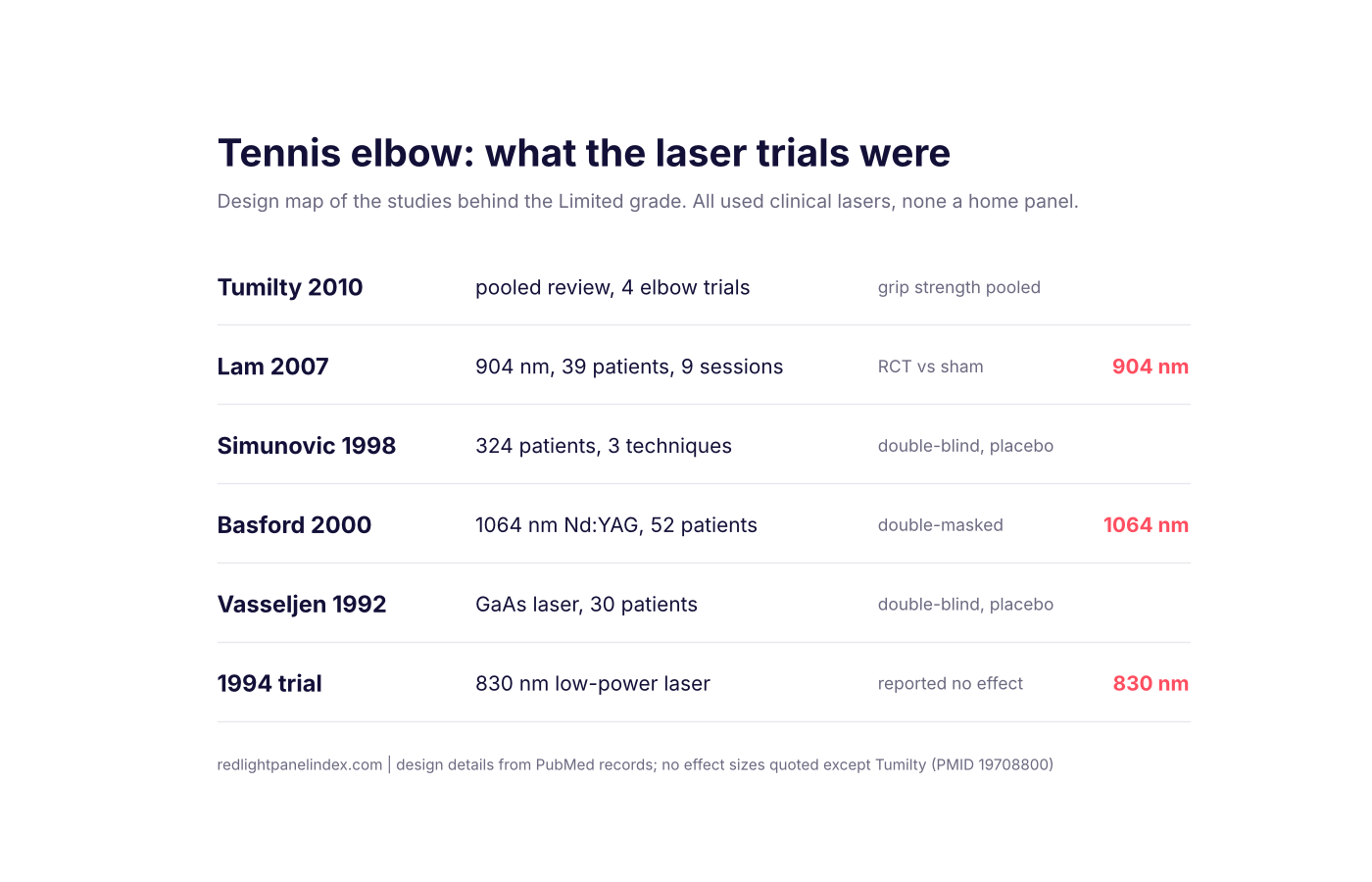
The evidence for red and near-infrared light on tennis elbow (lateral epicondylitis) is graded Limited. One meta-analysis pooled four higher-quality laser trials and found grip strength was higher in treated groups, but individual trials disagree, they are small, and every one used a clinical laser applied to a point on the tendon, not a home panel.
Choosing a panel? Our ranking of the best red light therapy panels is computed from published, method-labeled specs across 188 devices. For tennis elbow, the spec that matters is method-labeled near-infrared irradiance at the distance you would actually use.
How the grade was reached
The site's evidence grades run from Strong to Insufficient. Tennis elbow lands at Limited for four reasons:
- The one pooled result is a grip strength figure from a 2010 review, built on a small number of trials.
- The individual placebo-controlled trials point in different directions. Some report an advantage for active laser, and at least one found no effect.
- The trials differ in wavelength, energy per point, session count and follow-up, so they cannot be stacked into one protocol.
- No trial tested a home LED panel. Dose tables written for a laser probe do not translate directly into panel minutes.
For comparison, the broader tendinopathy page is graded Moderate because it adds larger pooled pain results for Achilles and plantar fascia. Elbow does not have that depth.
The pooled result: Tumilty 2010
The review by Tumilty and colleagues (PMID 19708800) searched databases through August 2008 and included controlled trials of low-level laser therapy for tendinopathy. Of 25 trials, 12 reported a positive effect and 13 were inconclusive or showed no effect. The authors linked the positive trials to doses close to the guidelines from the World Association for Laser Therapy (see the site's page on WALT dosing recommendations).
For lateral epicondylitis, the review pooled four higher-quality trials and reported grip strength 9.59 kg higher in treated groups than in controls. That is the headline number, and it is the only pooled elbow figure on this page. The authors concluded laser therapy can potentially be effective when recommended doses are used, which is weaker than saying it reliably is. Our study review of Tumilty goes through the design in more detail.
The individual trials
The studies below were identified on PubMed. The descriptions give design and direction only, taken from the record titles and the summaries returned in search, because the abstracts were not all readable in full in this run. No effect sizes are quoted from them.
- Lam and Cheing, 2007 (PMID 17508839). A randomized controlled trial of 904 nm laser in 39 patients, given at tender points over nine sessions against sham irradiation. The energy was 0.275 J per point, which is low.
- Basford and colleagues, 2000 (PMID 11083356). A double-masked, placebo-controlled randomized trial in 52 participants using a 1.06 micron (1064 nm) Nd:YAG laser against an inactive probe.
- Vasseljen and colleagues, 1992 (PMID 1604260). A double-blind comparison of a gallium-arsenide laser with placebo laser in 30 patients, split evenly between the two arms.
- Simunovic and colleagues, 1998 (PMID 9743652). A multicenter, double-blind, placebo-controlled study in 324 patients with medial or lateral epicondylitis, comparing trigger-point, scanner and combined laser techniques.
- A double-blind trial of an 830 nm low-power laser (PMID 7973480). Its title reports no effect of low-power laser in lateral epicondylitis.
Read together, these show the problem the pooled figure hides: the same condition, similar wavelengths and different outcomes. The 830 nm trial and the 904 nm trial sit in the same near-infrared band yet reached different conclusions, which is one reason to avoid treating any single wavelength as a guarantee.
Wavelengths the trials used
The trials above span roughly 830 nm to 1064 nm, with 904 nm among the most common in the elbow literature. That is the near-infrared range, and it matches how the tendon sits: the common extensor origin lies close to the skin on the outside of the elbow, so reach matters less than it does for a hip or a deep knee structure. Our 810 nm page explains the band most home panels use, and the wavelengths overview covers how it compares with red and with 850 nm. None of the cited trials tested 810 nm directly in the elbow, so a panel at 810 or 850 nm is an extrapolation from the laser data, not a match to it.
What was not studied
- Home LED panels on the elbow. All trial devices were lasers delivering a set number of joules to a point.
- Dose at distance. A panel spreads light over a large area at lower irradiance. Whether that delivers anything comparable to a probe pressed on a tendon is untested.
- Long-term outcomes. The reviews do not give a reliable picture beyond the follow-up windows of the trials.
- Comparison with exercise. Loading programs are a standard part of tendon care, and trials rarely isolate what light adds to them.
- Chronic versus recent cases. The trials mix presentations, so no one can say who responds.
A practical section for home use
If you decide to try a panel on the outside of the elbow, treat it as an experiment with a stop date and a pain diary, not a protocol with proven parameters.
- Check the irradiance. Look for a figure with a stated method. The irradiance explainer shows why a number with no measurement distance or instrument cannot be compared across devices.
- Do the dose arithmetic. Dose is irradiance multiplied by time. Enter the irradiance at your distance into the dose calculator and compare the result with the ranges in the research. Laser tables are written per point, so treat the comparison as rough.
- Keep the area small and close. The elbow is a small target. A panel held at a distance puts most of its output on skin that is not the tendon.
- Stay consistent for several weeks, then reassess. The trials ran multiple sessions over weeks. If pain and grip are no different after a fair trial, the evidence gives no reason to continue.
- Do not drop loading and activity changes. Light has not been shown to replace rehabilitation.
Related pages: the Bjordal Achilles study shows a tendon-level mechanism marker with a laser, and the Naterstad meta-analysis shows what a larger pooled analysis of tendon trials looks like. The joint pain hub lists the neighboring conditions, and how rankings work explains how the panel ranking is built.
Cautions
- Pain that begins after a fall or direct blow, a swollen or hot elbow, numbness or tingling in the hand, or weakness that is getting worse should be assessed by a clinician before anything else.
- Do not use light over a site with a history of skin cancer, or while taking photosensitizing medication, without medical advice. People who are pregnant should consult a clinician.
- Near-infrared sources can be bright to the eye even when the light is barely visible. Use protection as described in the eye protection guide.
- Pain scores and grip strength are partly effort-dependent, and placebo response in tendon trials is substantial.
Bottom line
One pooled analysis supports a grip strength benefit from laser at guideline doses in tennis elbow, and several small trials disagree about it. The grade is Limited. A panel is a reasonable thing to test for someone who understands that it is outside the studied range, and a poor reason to skip assessment or loading exercises.