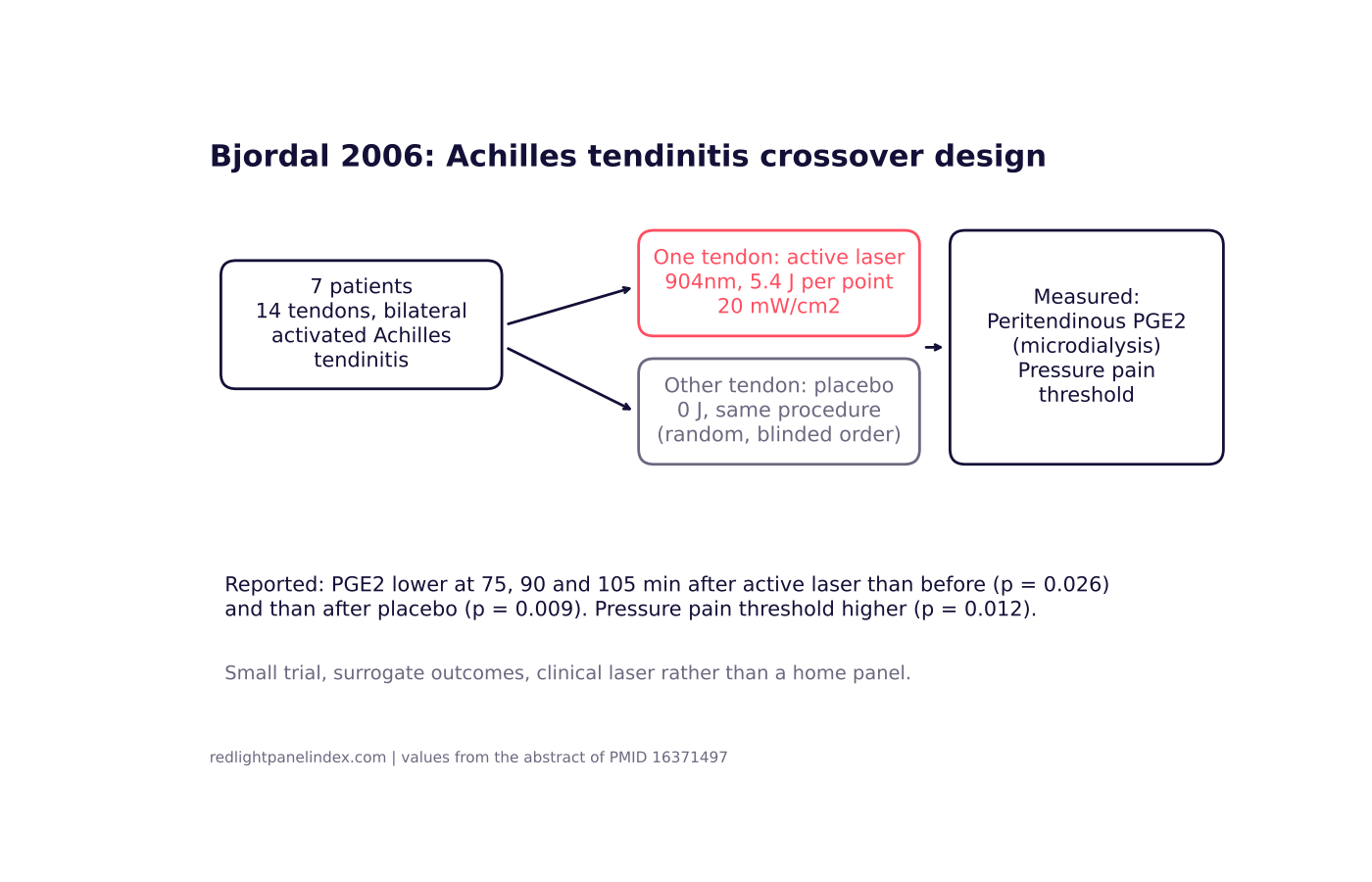
A 2006 randomized, placebo-controlled trial of 904nm low-level laser in seven people with activated Achilles tendinitis found that peritendinous prostaglandin E2 was significantly lower after active treatment than before it and than after placebo, and that pressure pain threshold rose after active treatment (PMID 16371497). It is a very small, single-session study of a biochemical marker, which makes it useful for asking why light might act on a tendon but weak evidence for what a home panel will do.
Choosing a panel? Our ranking of the best red light therapy panels is computed from published, method-labeled specs across 188 devices. For tendon questions, the spec that matters is method-labeled irradiance at the wavelength the trials used, since a dose depends on it.
What the study asked
The question was whether a defined dose of low-level laser changes inflammation inside an irritated Achilles tendon, and whether it does so measurably rather than only through a patient's report of pain. Most tendon trials rely on pain scores. This one added a direct chemical readout: the concentration of prostaglandin E2 (PGE2), an inflammatory mediator, sampled from the tissue around the tendon by microdialysis, a technique that draws fluid through a fine probe placed beside the tendon.
That design choice is the reason the trial is worth reading. Pain is subjective and responds strongly to expectation. A mediator measured in tissue fluid, in a placebo-controlled comparison, is harder to explain away as a placebo effect, although it is still only a surrogate for recovery.
Who was studied
According to the abstract, the trial enrolled seven patients with bilateral Achilles tendinitis, meaning 14 tendons, whose symptoms had been aggravated by pain-inducing activity immediately before the study. At baseline, Doppler ultrasound showed minor inflammation, in the form of increased blood flow inside the tendon, in all 14 tendons.
Each patient served as their own control. Both tendons were treated, one with active laser and one with placebo, with the order randomized and blinded. A crossover-style design like this removes differences between people, which matters when the group is this small, but it also means the finding rests on seven individuals.
Device and parameters as stated
- Wavelength: 904nm, an infrared laser.
- Dose: 5.4 J per point, applied over the tendon.
- Power density: 20 mW/cm2.
- Placebo: the same procedure at 0 J.
- Treatment: one active and one placebo application per patient, with PGE2 sampled before and at intervals afterward.
The abstract does not state the spot size, the number of points, or the total treatment time, so those cannot be reconstructed here. The dose is per point, which is the convention in clinical laser work and differs from how panels are specified. For the arithmetic of turning an irradiance and a time into a dose on skin, use the dose calculator.
What was measured and what was found
Three results are in the abstract:
- Inflammation at baseline. All 14 tendons showed increased intratendinous blood flow on Doppler ultrasound, confirming the tendons were inflamed.
- Prostaglandin E2. PGE2 concentrations were significantly reduced 75, 90 and 105 minutes after active laser compared with concentrations before treatment (p = 0.026) and compared with after placebo (p = 0.009).
- Pain sensitivity. Pressure pain threshold increased significantly after active laser compared with placebo (p = 0.012).
The authors concluded that laser at 5.4 J per point can reduce inflammation and pain in activated Achilles tendinitis. This site does not add effect sizes or percentages beyond what the abstract reports, and the abstract's results are expressed as p values rather than as sizes of change.
Why measuring PGE2 matters
Prostaglandin E2 is produced when cells in an irritated tissue convert fatty acids through the cyclooxygenase pathway, and it contributes to swelling and to the sensitization of pain nerves. It is also the pathway targeted by common anti-inflammatory drugs. A drop in PGE2 after light therefore fits a mechanism, an effect on inflammation in the tissue itself, rather than only a change in how pain is reported.
For the wider mechanistic background on how light is thought to act on cells, see the review of photobiomodulation dosimetry and mechanisms by Chung and colleagues (PMID 22045511), and our page on the optical window for why red and near-infrared reach tissue at all. Note that a lower PGE2 in 7 people at roughly two hours is a short-term finding. It does not show that the tendon healed faster or that symptoms stayed better.
Limitations
- Seven patients. Small trials can overstate effects, and a p value from seven people is fragile.
- A short window. The reported PGE2 comparisons run to 105 minutes after treatment. Nothing in the abstract addresses days, weeks or return to activity.
- Surrogate outcomes. PGE2 and pressure pain threshold are indicators, not function, walking tolerance or time back to sport.
- A laser, not a panel. A 904nm clinical laser applied to points on the tendon is a different device from a multi-wavelength LED panel, with different beam, spot size and delivery.
- Acute flare-up. The tendons were aggravated by activity just before the study. Results may not apply to chronic, stable tendon pain.
How it fits with the rest of the tendon evidence
A larger body of work asks the clinical question. Our review of the Tumilty tendinopathy meta-analysis covers 25 controlled trials, 12 of which reported a positive effect, and links positive results to doses near guideline ranges. For Achilles tendinopathy specifically, that review reported pain 13.6 mm lower on a 100 mm visual analogue scale in pooled trials. Read together, the two reviews point the same way: there is a plausible biological effect and some clinical signal, with dose as the open variable. The wider joint and tendon picture is on the joint pain evidence page, and the dose-window idea is shown in the WALT-dose knee trial review.
What this means for a home panel
This trial used 904nm, a wavelength most home panels do not carry; the wavelengths overview shows the bands panels actually offer, such as 810nm, 830nm and 850nm. Nothing in this study tests those bands on a tendon, so it cannot be used to claim that a panel will lower tendon inflammation.
If you are weighing a panel for a sore Achilles, the useful takeaways are practical:
- Look for method-labeled irradiance at the skin and compute dose from it with the dose calculator rather than relying on a number in an advertisement.
- Remember the Achilles lies just under the skin, so depth is a smaller concern here than for a hip or a deep joint, while coverage and distance still matter.
- Treat this trial as mechanistic support, not as proof of benefit, and do not use light in place of an assessment of a tendon that is swollen, suddenly worse or following an injury.
- People with medical conditions or on photosensitizing medication should talk with a clinician first.
For how this trial fits with the larger meta-analyses, see the tendinopathy evidence page. For how we weigh studies like this one, see how rankings work and the evidence hub.