810nm is a near-infrared wavelength, invisible to the eye, that sits just past the red-to-infrared boundary and is the band most transcranial research devices were built around. It appears on 98 of the 188 panels in this site's database, 52 percent, which makes it the second most common near-infrared band after 850nm.
Choosing a panel? Our ranking of the best red light therapy panels is computed from published, method-labeled specs across 188 devices. For 810nm, the spec that matters is the published share of output at that band, because panels that list it can put anywhere from a few percent to a quarter of their output there.
What 810nm is
Light therapy panels use wavelengths measured in nanometers. Visible red runs from roughly 600 to 700, and near-infrared starts somewhere between 700 and 750, a boundary the red versus near-infrared page explains. 810nm sits in that near-infrared range alongside 830nm and 850nm. Like the red bands, it is absorbed by a mitochondrial enzyme, the first step in the process the photobiomodulation page describes. Because near-infrared is absorbed less strongly by skin than red light is, it is the family associated with reaching below the surface.
The wider wavelength guide places 810nm among the deep bands, and calls it one of the most-studied of them, used in transcranial research.
Why transcranial research used it
Transcranial photobiomodulation means light applied to the head. Researchers working on brain questions needed light that could cross scalp and skull, and near-infrared is the family they turned to. A 2014 open-protocol study is a representative example: 11 people with chronic mild traumatic brain injury, ages 26 to 62, were treated with red and near-infrared LEDs applied to the scalp for 18 outpatient sessions over six weeks, beginning 10 months to 8 years after the injury (PMID 24568233). Because it was open-protocol, with no sham group, it describes a small group's course and cannot isolate an effect from the light itself.
A 2018 pilot trial, ELATED-2, studied transcranial photobiomodulation in major depressive disorder (PMID 30346890). It is a pilot, and this page does not report its outcomes, because the point here is the wavelength, not the result. The trial's design, dose and three effect sizes are reviewed in the ELATED-2 study review. The brain and mood evidence this site grades is covered on the brain and mood page, which rates it Insufficient. The two depression studies, including the one above, are set out on the transcranial light and depression page.
How much of it reaches the brain
The key measurement comes from a 2015 review of near-infrared penetration. Its tissue studies found that low-level near-infrared energy did not penetrate 2 millimeters of skin or 3 centimeters of skull and brain, and that at 10 to 15 watts, 0.45 to 2.90 percent of 810nm light penetrated 3 centimeters of tissue (PMID 26346298). Those power levels belong to research lasers. A home panel delivers far less, so the practical lesson is that 810nm being the transcranial band does not mean a panel delivers a transcranial dose; the longer 1064nm band raises the same gap, with a laser trial's dose set against panel output. The penetration depth page lays out the wider depth evidence and why modeled figures are ceilings.
How much 810nm the database panels carry
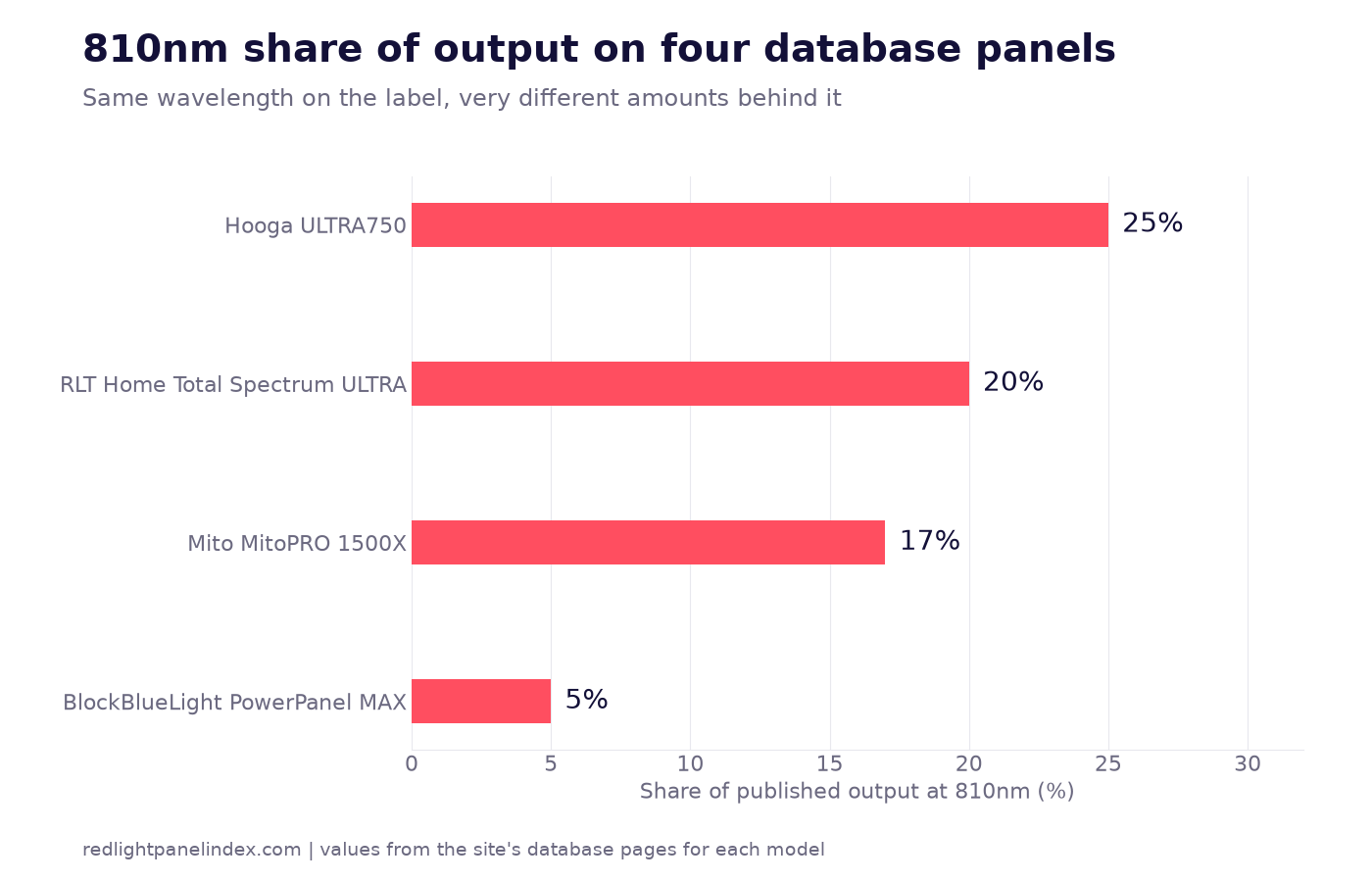
A wavelength on a spec sheet is a yes or no. A share of output is a number. The panels below publish both, and they differ a lot:
| Model | 810nm share | Other bands |
|---|---|---|
| Hooga ULTRA750 | 25% | 630, 660, 850nm at 25% each |
| RLT Home Total Spectrum ULTRA | 20% | Seven bands including 850nm at 8% |
| Mito Red Light MitoPRO 1500X | 17% | Six bands; 830 and 850nm also 17% |
| BlockBlueLight PowerPanel MAX | 5% | 660 and 850nm 40% each |
The same 810nm entry on a spec sheet means a quarter of the output on the ULTRA750 and one twentieth on the PowerPanel MAX. A buyer who wants a meaningful 810nm component should read the share, not the list. Many panels put most of their output in 660 and 850nm and list the other bands as supporting wavelengths; the 850nm page covers that dominant near-infrared band.
Prices on these pages carry their own verification dates: $799 for the ULTRA750 (verified September 12, 2026), $2,895 for the Total Spectrum ULTRA (verified 2026-09-12), $1,299 for the MitoPRO 1500X (verified August 13, 2026) and $1,100 for the PowerPanel MAX (verified September 12, 2026). Treat them as snapshots.
Worked example: reading an irradiance figure
Take the ULTRA750. The page lists a manufacturer claim of 161 mW/cm² at 6 inches with no disclosed method, and notes independent testing on a similar model found roughly half. Using the page's own guidance of working from roughly half, about 80 mW/cm² total, and the 25 percent share at 810nm, the 810nm portion would be about 20 mW/cm². That is an estimate built from a share and a discounted claim, not a measurement of 810nm irradiance, and the irradiance explainer shows why the method label matters. To turn any such figure into a session, use the dose calculator, which converts irradiance and minutes into energy per square centimeter.
810nm next to its neighbor at 830nm
810nm rarely appears alone in the near-infrared range, and the 830nm page covers its neighbor in the same detail. The same database pages show 830nm carried at 17 percent on the MitoPRO 1500X, 13 percent on the Total Spectrum ULTRA and 5 percent on the PowerPanel MAX, while the Hooga ULTRA750 skips 830nm entirely and spends that output on 810nm and 850nm instead. Because 810, 830 and 850nm are all near-infrared, a panel that omits one of them is not missing a category of light so much as choosing how to spread its output across neighbors. The wavelength guide groups 810 to 830nm as the band most transcranial work uses, so a panel that carries both is covering that range, while one carrying only 850nm is covering the common near-infrared default.
How to compare two panels on 810nm
- Check that the page publishes a percentage for 810nm, not just the wavelength. If it does not, you can only say the band is present.
- Check the irradiance method label. A spectrometer or dual-disclosed figure is a measurement; a bare manufacturer claim is not.
- Multiply cautiously. A share applied to a total figure gives an estimate, and the estimate inherits any uncertainty in the total.
- Decide what you need from the band. If the goal is a transcranial protocol, remember that no panel in the database is evaluated here as a validated substitute for a research device.
- Use the dose calculator with the distance you will actually sit, then keep sessions at the lengths the protocol you are following actually used.
810nm versus 850nm
The two neighbors are only 40 nanometers apart. 810nm versus 850nm compares them directly: 810nm has the longer transcranial trial history, 850nm is on 93 percent of panels, and nothing in the evidence tracked here shows one outperforming the other.
What to take from this
- 810nm is a real, well-used research wavelength, and 52 percent of database panels include it.
- Its association with the brain comes from research devices, not from anything a panel at normal distance has been shown to do.
- Shares range widely, so compare published numbers.
- A panel with 810nm is not a transcranial device, and the brain and mood evidence is graded Insufficient.
Filter the panel database by wavelength to see which models include 810nm and how much of their output it gets.