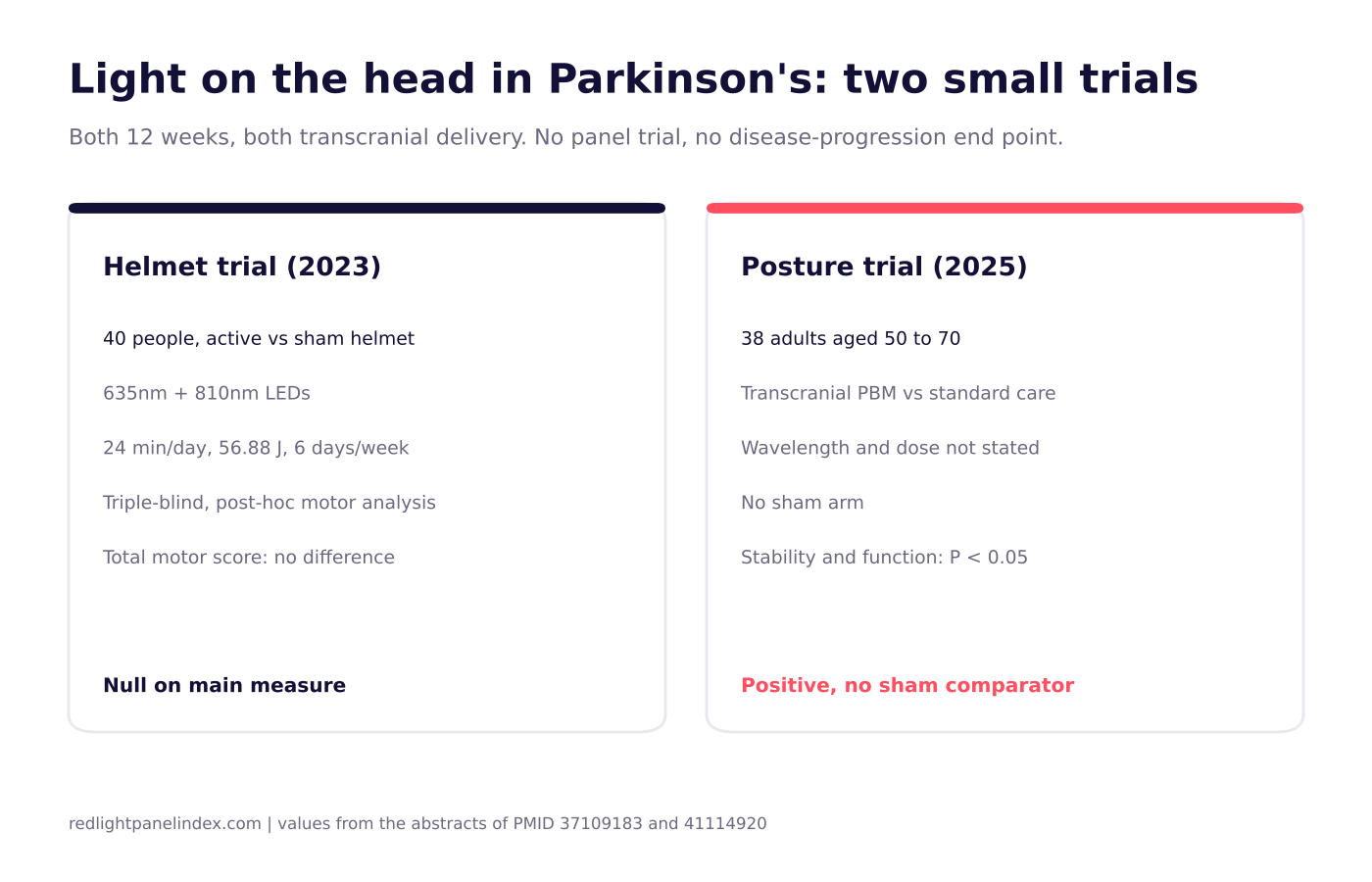
The evidence grade for red and near-infrared light in Parkinson's disease is Insufficient, bordering Limited: there are two small randomized trials, both of light delivered to the head rather than from a panel, and neither produced a replicated efficacy result. The sham-controlled helmet trial found no difference from sham on its total motor score (PMID 37109183), and the second trial compared light against standard treatment without a sham (PMID 41114920). No trial has tested a home panel in Parkinson's, and no trial has looked at whether light changes how the disease progresses.
Choosing a panel? Our ranking of the best red light therapy panels is computed from published, method-labeled specs across 188 devices. For Parkinson's, the spec people ask about is the published share of output at 810nm, but no panel has been tested for this condition, and a helmet on the head is a different intervention.
Why the grade sits where it does
On this site's scale, set out in the evidence grades explainer, Insufficient means no credible controlled trial at doses a consumer device can deliver, and Limited means pilot data or a single trial at parameters a panel cannot match. Parkinson's sits on the line between them. There are two randomized trials, which is more than many conditions on this site have. But the one with a sham found no difference on its main measure, the one that reported a between-group difference had no sham, both were small, and both used head-mounted or transcranial delivery that a panel does not reproduce.
If you are reading this for a parent, a partner or yourself, the plain version is this: researchers are taking the idea seriously enough to run trials, and the trials so far are too small and too mixed to say light helps.
The studies
The triple-blind helmet trial (2023)
- Population: 40 people with idiopathic Parkinson's disease, randomized to active or sham treatment. The abstract does not give the split between arms, ages or disease stage.
- Device and wavelengths as stated: a transcranial photobiomodulation helmet with 635nm and 810nm LEDs.
- Dose as stated: 24 minutes per day, 56.88 J per session, six days a week for 12 weeks. That is total energy in joules, not energy per square centimeter, and the abstract gives no irradiance or treated area.
- Comparator and blinding: a sham helmet on the same schedule, triple-blind.
- Primary measures: safety and the motor section of the MDS-UPDRS (part III), a 37-item clinician-scored movement assessment, at baseline and 12 weeks.
- Main result: no significant difference in total motor score between active and sham. The authors attributed this to a likely placebo effect.
- Secondary findings: facial and lower-limb sub-scores improved significantly with active treatment; gait and lower-limb sub-scores improved significantly with sham. About 70 percent of participants responded to active treatment, defined as a drop of 5 or more points on the motor score.
- Safety: no safety concerns beyond occasional, temporary and minor dizziness (PMID 37109183).
The paper's own title calls the motor results a post-hoc analysis, meaning the sub-score and responder analyses were shaped after the data were in. The triple-blind sham is a real strength, and it is exactly why the null total score carries weight: the sham group improved too. The Parkinson's light helmet study review goes through the design and its limits in detail.
The posture and function trial (2025)
- Population: 38 adults aged 50 to 70 with Parkinson's disease, postural instability and reduced functional activity, randomized into two groups. The abstract does not give the number per group.
- Device and wavelengths as stated: transcranial photobiomodulation. The abstract does not state the wavelength, power, dose, session length or sessions per week.
- Comparator: standard treatment. There was no sham arm, and the abstract does not describe what standard treatment included.
- Duration: a 12-week program, with assessment before and after.
- Measures: limit of stability and functional level. The keywords name the Biodex Balance System and the Modified Parkinson Activity Scale.
- Result: the light group showed statistically significant improvement in limit of stability and functional level after three months (P < 0.05). The authors conclude that transcranial photobiomodulation may improve posture stability and functional activity in Parkinson's (PMID 41114920).
- Safety: the abstract does not report adverse events.
This trial reports a positive between-group result, which the helmet trial did not. But without a sham, the light group knew it was receiving something extra, and the helmet trial has just shown how much a sham group can improve in this condition. Balance and activity scales also depend on effort and confidence on the day of testing. The result is a reason for a sham-controlled repeat, not a settled finding. The guide to sham-controlled trials explains why that difference in design matters so much.
What was not studied
This is the most important section on the page.
- No panel trials. Both trials used light delivered to the head, one with a helmet worn on the scalp. No study in this index's sources tested a red light panel, at any distance, in Parkinson's.
- No disease-progression end points. Neither trial measured whether light slows, stops or changes the course of the disease. Both measured symptoms over 12 weeks. Any claim that light protects the brain in Parkinson's is not supported by these trials.
- No long-term outcomes. Follow-up ended at about three months in both trials. Whether any change lasts, fades or needs continued treatment is unknown.
- No medication interactions. Neither abstract describes how light interacts with levodopa or other Parkinson's medicines, or with the timing of doses.
- No replication. The sub-score and responder findings of the helmet trial have not been tested again with the comparison fixed in advance, and the posture trial has not been repeated with a sham.
- No dose comparison. One trial gives energy in joules without irradiance or area, the other gives no parameters, so there is no dose a home device could be checked against.
Related brain questions, such as memory, mood and head injury, have their own small literatures and their own pages: cognition and dementia, transcranial light and depression and the wider brain and mood evidence page. None of them changes the picture for Parkinson's.
Practical notes for a home panel
There is no tested home protocol to give, so this section is about what the trial parameters do and do not tell you.
- The wavelengths do not make it the same treatment. The helmet used 635nm and 810nm. A panel can list both bands, but the 810nm explainer sets out the verified finding that only a small fraction of near-infrared light from 10 to 15 watt research lasers penetrated 3 centimeters of tissue, and a panel delivers far less power than that. The 630nm explainer covers why visible red is absorbed mostly near the surface. The wavelengths overview and the penetration depth page put those numbers in context.
- Delivery differs. A helmet sits against the scalp on all sides for a fixed time. A panel is aimed from a distance, usually at one side, and its output drops as you move back, as the irradiance explainer shows.
- The calculator cannot match a trial that gave no irradiance. The dose calculator turns irradiance and minutes into energy per square centimeter. Because neither Parkinson's abstract gives an irradiance and area, there is no trial dose to reproduce.
If you already own a panel and use it for skin or joints, nothing here suggests Parkinson's itself rules that out. Nothing here suggests the panel will help Parkinson's symptoms either.
Cautions
- Keep Parkinson's care with the neurologist. Nothing in either trial supports changing, reducing or retiming medication, or replacing physical therapy and exercise programs, which have their own evidence. Raise any add-on with the clinician who knows the history.
- Dizziness was the one reported effect. The helmet trial reported occasional, temporary, minor dizziness. In a condition where balance and falls are already a concern, that is worth knowing; sit down for any session and get up slowly.
- Protect the eyes. Bright light close to the face needs eye protection; the eye protection guide covers what to use, and the safety and side effects page covers light-sensitizing medicines and other general cautions.
- Be careful with claims and costs. Devices are sometimes marketed to families with hope as the main selling point. Two small trials with mixed results are not a basis for an expensive purchase.
The honest summary: two small randomized trials have tested light on the head in Parkinson's. The one with a sham found no difference on its main motor score, and the one that reported a benefit had no sham. That justifies a larger, properly controlled trial. It does not justify expecting a home panel to change Parkinson's symptoms or its course.