The evidence grade for transcranial red and near-infrared light in depression is Limited: there is one small open pilot and one small sham-controlled trial, both from dedicated forehead devices at stated doses, and both authors' groups call for replication. Neither study tested a wall panel, and nothing here is a substitute for evidence-based care of a mood disorder.
Choosing a panel? Our ranking of the best red light therapy panels is computed from published, method-labeled specs across 188 devices. For head-applied light, the spec that matters is how much near-infrared output a device concentrates at one spot, because the studies delivered it that way.
Why the grade is Limited
The site's wider brain and mood evidence page rates the whole area Insufficient. This page looks at the narrower question of depression, where two human studies exist, so the grade here is one step higher: Limited. That is a statement about how much evidence there is, not about whether light works. Two small studies, one without a control group after the first session and one with 21 people in its main analysis, cannot settle the question. A grade of Limited means the signal is worth following and not yet worth relying on.
What was studied
The 2009 pilot (PMID 19995444)
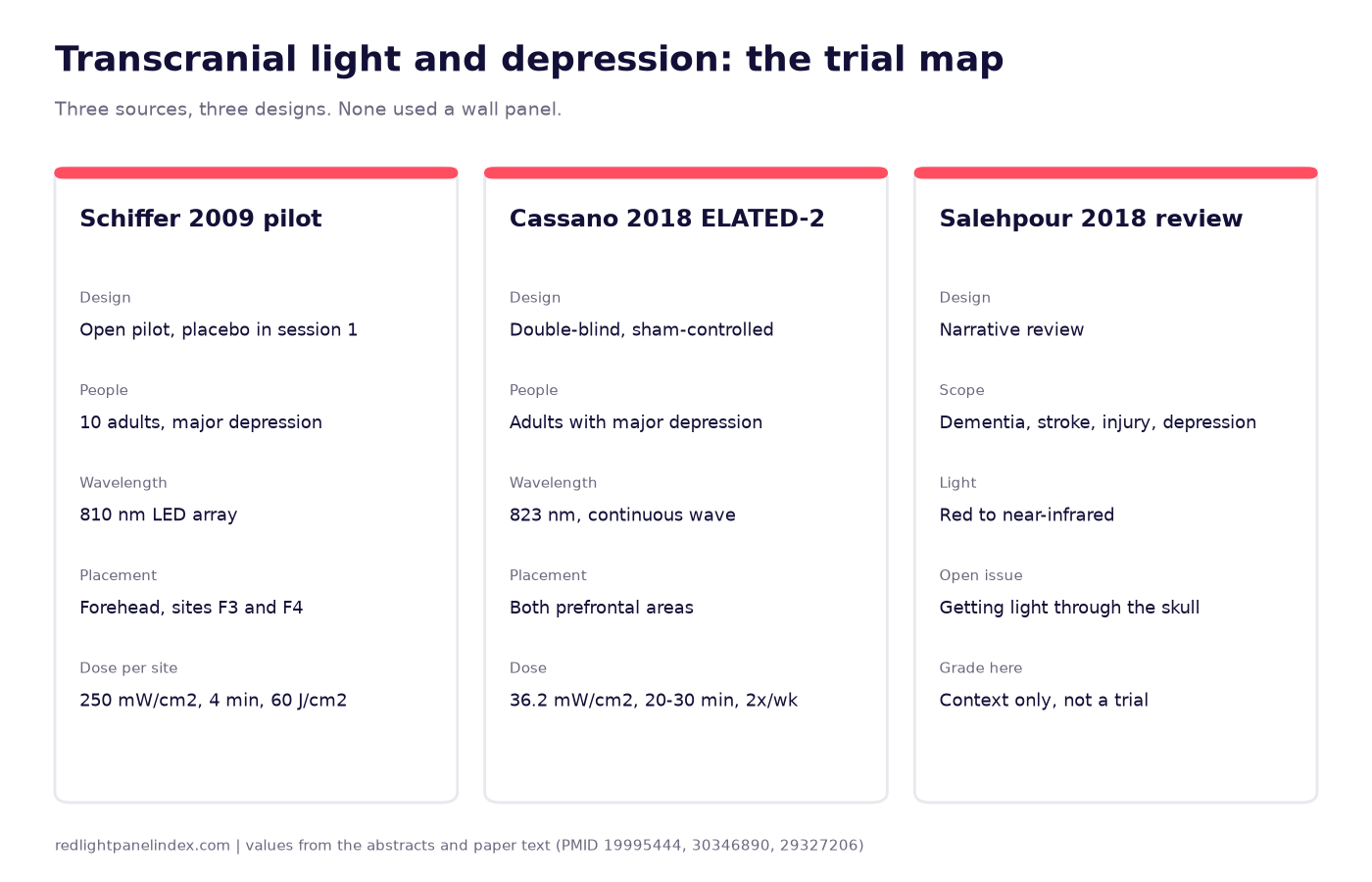
A pilot study of 10 patients with major depression applied 810nm near-infrared light from an LED array to the forehead. According to the paper, the placement was the left and right forehead sites known as F3 and F4, each treated for 4 minutes at 250 mW/cm2, a dose of 60 J/cm2 per site. The abstract reports that at 2 weeks after treatment, 6 of 10 patients met a remission cutoff (a score of 10 or lower) on the Hamilton depression scale (HAM-D), and 7 of 10 did so on the Hamilton anxiety scale (HAM-A). The full write-up is on the study review page.
The limits are plain. There were 10 people, the 2 and 4 week outcomes had no placebo comparison and were unblinded, and the measured increase in blood flow did not reach statistical significance. The authors state that the mechanism is not understood and call for double blind, randomized, placebo-controlled trials. This is a reason for the pilot to exist, not a reason to treat its numbers as an expected result.
The 2018 ELATED-2 pilot trial (PMID 30346890)
ELATED-2 was a double-blind, sham-controlled study of adjunct transcranial photobiomodulation in adults with major depressive disorder. Per the abstract, the light was 823 nm, continuous wave, delivered over 28.7 x 2 cm2 at 36.2 mW/cm2, up to 65.2 J/cm2, for 20 to 30 minutes per session. It went to the dorsolateral prefrontal cortex on both sides at once, twice a week for 8 weeks. The primary measure was the change in HAM-D 17 total score at end-point.
The abstract reports effect sizes for the antidepressant effect of 0.90 (baseline observation carried forward, 21 people), 0.75 (last observation carried forward, 19 people) and 1.5 (completers, 13 people), described as medium to large. It also reports that the treatment was fairly well tolerated, with no serious adverse events. The authors conclude that replication is warranted, especially given the small sample size. The trial's design and its three effect sizes are reviewed in the ELATED-2 study review.
Note how the effect size depends on who is counted. The completers figure is the largest and rests on the fewest people. When 13 of 21 people finish, the completers number tells you about those who stayed, which is why the abstract reports three analyses. Treat the smaller figures as the more cautious reading.
The 2018 narrative review (PMID 29327206)
A narrative review of brain photobiomodulation covers red to near-infrared light across dementia, Parkinson's disease, stroke, brain trauma and depression. It describes the proposed mechanism, light absorbed by an enzyme in the mitochondrial respiratory chain, and names the central difficulty: getting enough light through the skull. It is useful background, but it is a review and not a trial, so it adds context and not an additional test of depression.
What the three sources share
All three describe devices applied directly to the head, at close range, with defined wavelengths, irradiance, area and minutes. The two trials used wavelengths of 810 and 823 nm, both near-infrared, which matches what the 810nm explainer describes as the transcranial research band. They differ a lot in dose: the pilot delivered 250 mW/cm2 for 4 minutes per site, while ELATED-2 used 36.2 mW/cm2 for 20 to 30 minutes. Neither can be taken as the one right dose, and the two do not agree on a dose a panel should aim for.
What was not studied
- Wall or stand panels. Neither trial used a consumer panel at a distance.
- Long-term outcomes. The pilot followed people for 4 weeks; the ELATED-2 abstract reports end-point change after 8 weeks of sessions.
- Large samples. The main ELATED-2 analyses involved 13 to 21 people.
- Head-to-head dose comparisons. No study here compared one dose against another.
- People using light instead of standard care. ELATED-2 tested light as an adjunct, so it says nothing about replacing anything.
- Home use over months. No source here follows home users.
How much light reaches the brain
The depth question matters because the target is cortex, not skin. The site's penetration depth page reports modeled figures for 810nm through skull and brain tissue: roughly 2.9 percent of surface power density at 3 cm, from a source of 10 to 15 watts. Those are research-grade outputs concentrated at one spot, and the page treats modeled numbers as ceilings. A forehead device delivering 250 mW/cm2 at close range is a different thing from a panel spread across a body-sized area.
A practical section for panel owners
If you own a panel, three points follow from the studies, none of which is a recommendation to use it for mood.
- Check the irradiance, with its method. The trial doses came from stated irradiance at a stated distance. A panel claim with no method behind it cannot be compared with them. The irradiance explainer shows how to read the label.
- Do the arithmetic. The dose calculator converts irradiance and minutes into energy per square centimeter, so you can see how far a panel session is from, say, 60 J/cm2 at the forehead.
- Check the wavelength mix. Both trials were near-infrared at 810 or 823 nm. The wavelength guide shows where those bands sit, and the 810nm versus 850nm page compares the two common near-infrared choices. A panel that lists 810nm on a spec sheet may devote only a small share of output to it.
Even with all three checked, a panel is not a validated substitute for the devices in these studies. It spreads its output over a large area, at a distance, and the forehead is only a small part of it.
Cautions
- Depression is a medical condition. If you have symptoms, talk to a clinician; light is experimental here and should not replace evidence-based care, therapy, medication, exercise or sleep.
- Near-infrared light is invisible, so it gives no warning that it is bright. The eye protection guide covers why the eyes need care, especially for anything aimed at the forehead.
- Skin warmth and general safety points are on the safety and side effects page.
- Studies this small can point in either direction when repeated. Read a result here as a reason for a larger trial, not as a result you should expect.
Bottom line
Two small studies reported improvements in depression scores after forehead near-infrared light, one open and one sham-controlled. That earns a grade of Limited. It does not show that a home panel does the same, and the dose gap between the trial devices and a panel is the first thing to check, using the numbers above.