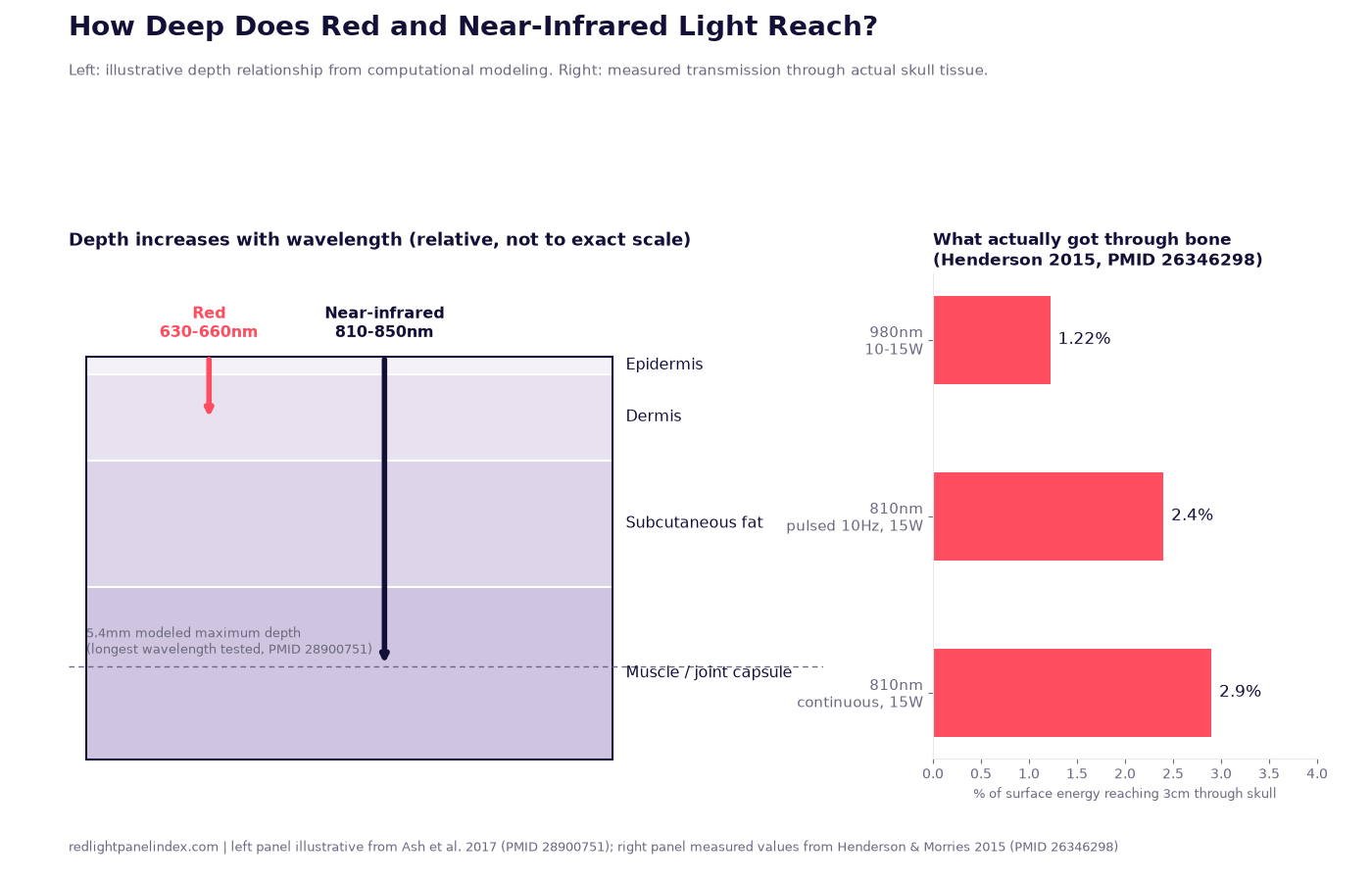
Red and near-infrared light do not penetrate tissue to a fixed depth measured in inches; they attenuate gradually as they pass through skin, fat and muscle, losing intensity the whole way, so "how deep" only has an answer once you specify how much of the original light has to still be there for it to matter. Computational modeling puts the outer range of that attenuation at a few millimeters for the longest wavelengths panels commonly use, and direct tissue measurement through the skull shows that even at that range, only a small single-digit percentage of the light that started at the surface is still present.
Choosing a panel? Our ranking of the best red light therapy panels is computed from published, method-labeled specs across 188 devices. For penetration depth, the spec that matters is which wavelength band a panel actually publishes density for, not a depth number on the marketing page.
What is absorbing the light on the way in
Light entering skin does not travel in a straight line to a fixed stopping point; it is continuously absorbed and scattered by whatever it passes through, and how much of each happens depends on wavelength. This is why "depth" for a wavelength is really a curve of remaining intensity versus distance, not a single number, and why two sources describing "penetration depth" for the same wavelength can report different figures if they are using different thresholds for how much light has to remain before they call it "reached."
The site's red versus near-infrared page covers the same absorption pattern that underlies this: red and near-infrared sit in a range where visible-light absorption by blood and skin pigment has mostly dropped off, which is part of why this band, rather than blue or green light, is the one that reaches anywhere below the surface layers of skin at all.
What the computational modeling found
A 2017 study modeled light transport through a multi-layered skin model using Monte Carlo simulation, a standard stochastic method for this kind of tissue-optics problem, testing ultraviolet, visible and infrared wavelengths against different beam widths and skin tones (PMID 28900751). The clearest finding was directional rather than a single fixed number: calculated penetration depth increases with increasing wavelength, and the deepest wavelength tested in that model reached a maximum calculated penetration depth of 5,378 micrometers, about 5.4 millimeters.
That figure is a modeled ceiling for one specific scenario in that paper, not a guarantee that any given near-infrared wavelength on a consumer panel reaches 5.4 millimeters into a particular person's tissue; skin thickness, fat layer, tissue hydration and the specific wavelength and beam geometry used all shift the real number. What the modeling supports with more confidence than any single depth figure is the direction of the relationship: longer wavelengths, within the red-to-near-infrared range panels use, calculate out to greater depth than shorter ones, and beam width matters much less than wavelength does. Our 660nm vs 850nm comparison applies that same modeling directly to the two most common wavelengths on a panel spec sheet. The same study found that a 10-millimeter beam produced 73 to 88 percent of the fluence, depending on depth, that an infinitely wide beam of equal intensity would produce at 1 to 3 millimeters (PMID 28900751), meaning a wider panel face does not meaningfully add penetration once the beam is already a reasonable size.
What happens when the target is behind bone: the skull case
The clearest published numbers on how much light is lost passing through a specific real barrier come from research on whether near-infrared light can reach brain tissue through the skull, a use case some panels and marketing pages describe as "transcranial" photobiomodulation. A 2015 review of that question reports tissue studies finding no measurable penetration of low-power near-infrared light through 2 millimeters of skin or 3 centimeters of skull and brain tissue combined (PMID 26346298). At much higher power, 10 to 15 watts, the same research found that 0.45 to 2.90 percent of 810 nanometer light reached 3 centimeters of depth, with a 15 watt continuous source delivering about 2.9 percent of its surface power density at that depth; pulsing the same source at 10 hertz cut the dose delivered at the surface by half but still got 2.4 percent of the surface energy to 3 centimeters. A 980 nanometer source at the same power range delivered about 1.22 percent of its surface energy to the same depth (PMID 26346298). For comparison, the review notes that at low power generally, less than half of one percent of surface energy reaches even 1 centimeter of depth.
Read plainly, that is a conditional finding, not a blanket one: meaningful energy reaching 3 centimeters through skull in that research required 10 to 15 watts of near-infrared output concentrated at the treatment site, a power level well above what most home panels deliver at any single point, and even then the fraction of light actually arriving was in the low single digits of what left the source. It is direct evidence that near-infrared light is not blocked entirely by bone, but it is not evidence that a home panel held near the head is delivering a comparable dose at 3 centimeters of depth, since the review's own transmission figures depend heavily on the specific power, wavelength and pulsing pattern used.
Why published depth numbers do not agree with each other
Anyone comparing depth claims across different sources will notice the numbers do not line up, and the reason is usually methodology rather than a contradiction in the underlying physics. The 2017 modeling study reports a calculated depth from a computational model of a generic multi-layered skin structure, not a measurement on a living person. The 2015 skull-transmission research reports a directly measured percentage of surface energy remaining at a fixed depth through an actual bone barrier, at power levels far above a typical home panel. A third source describing "penetration depth" as the point where intensity drops to a specific fraction of its surface value, a common convention in tissue optics, will produce yet another number for the identical wavelength, because it picked a different cutoff. None of these approaches is wrong; they are answering slightly different questions, which is exactly why a bare depth figure without its method attached is not something to compare directly against a different bare depth figure from another source.
Why "penetrates two inches" does not hold up
Two inches is roughly 51 millimeters, about ten times the maximum depth calculated in the 2017 modeling study for its longest tested wavelength, and the skull-transmission research above is describing single-digit percentages of surface energy at 3 centimeters, not full-strength light. Neither of the two most directly relevant studies covered here supports a claim of multi-inch penetration for red or near-infrared light at power levels a home panel produces. Marketing language that quotes a specific number of inches, without naming the wavelength, power, and the percentage of surface intensity that number refers to, is stating something well beyond what the modeling and measurement literature in this area currently supports. This site's myths-checked guide checks that exact "penetrates inches" claim against these same two studies.
What this means for using a panel
Depth claims aside, the practical takeaway is the same one the red versus near-infrared comparison reaches from the other direction: pick the band suited to how deep your target actually sits, red for skin-level work, near-infrared for anything below it, rather than assuming a bigger number on a spec sheet buys proportionally more depth. Confirm which bands a panel publishes real density for using its wavelength and FWHM figures, since a wavelength listed on the box without a density figure behind it is not something you can verify is reaching the target at all, however deep the modeling literature says that wavelength could in principle travel. The total spectrum guide comparing a 1064nm-equipped panel against one that stops at 850nm walks through exactly this kind of published-density comparison for a specific deep near-infrared band. None of this changes the underlying mechanism the site's photobiomodulation page describes; it only sets realistic expectations for how far into the body that mechanism's light is actually likely to reach. That reach is also what separates a panel from an infrared sauna, whose far-infrared heaters are chosen specifically because they are absorbed at the skin surface rather than reaching tissue the way a panel's near-infrared band does; the site's panel versus infrared sauna comparison covers that band difference directly.