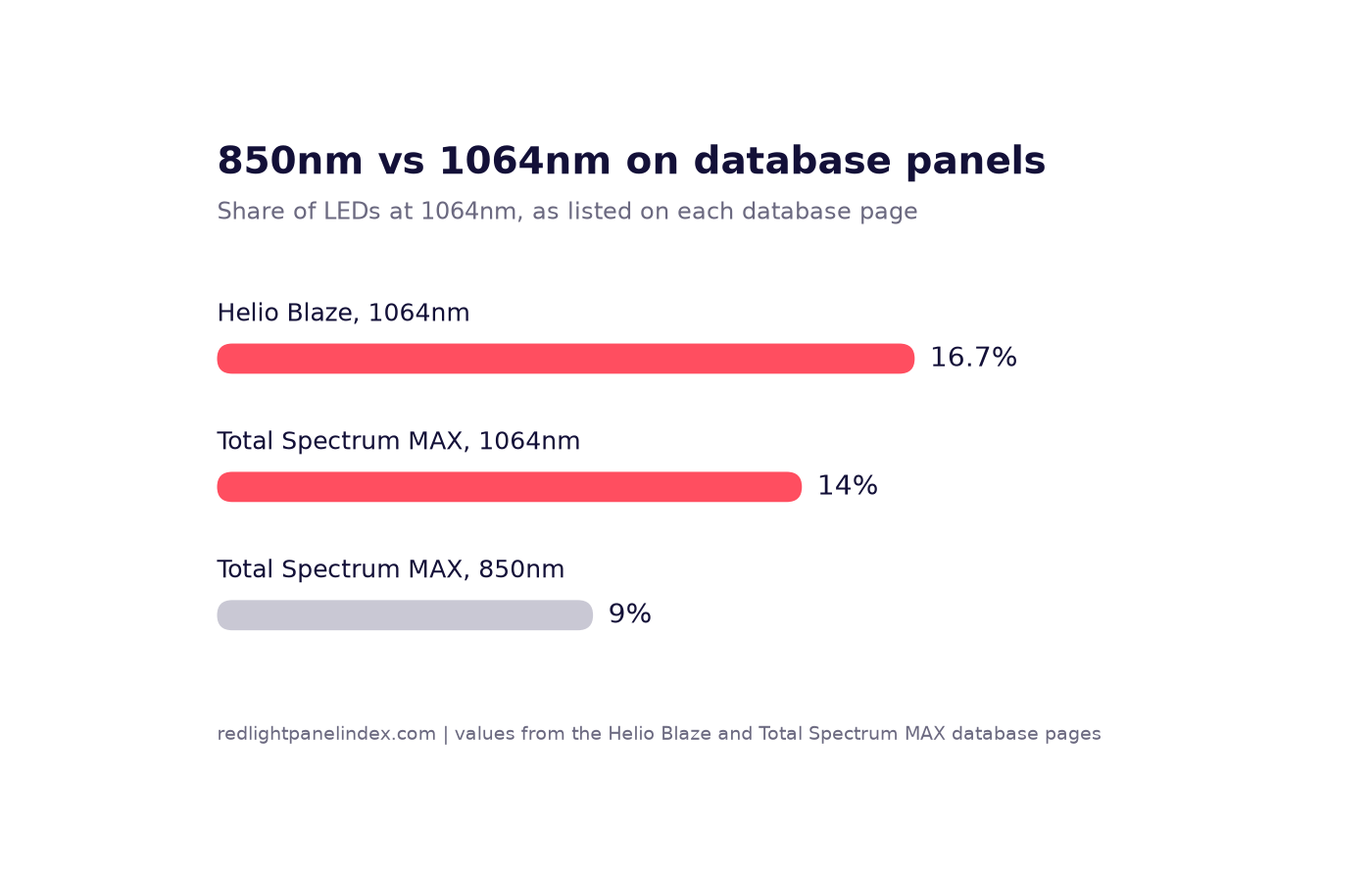
850nm is the standard near-infrared band on home panels and has the larger share of everyday use; 1064nm is a deeper infrared band that only a small number of panels include, usually as a minority of their output. Whether the deeper band is worth paying for depends on whether you want the research it is tied to, which is narrower than the marketing around it suggests.
Choosing a panel? Our ranking of the best red light therapy panels is computed from published, method-labeled specs across 188 devices. For this comparison, the spec that matters is the share of output assigned to 1064nm, because a band that gets a small share delivers little energy however deep it is said to reach.
What each band is
Both bands sit in the near-infrared range, beyond the visible red of 630nm and 660nm. The site's 850nm explainer describes the band most panels use for deeper-tissue claims, and the 810nm versus 850nm page compares it with the other common choice. 1064nm sits further out. It is the wavelength of a common type of laser, and it is the band the site's deep-tissue 1064nm ranking is built around.
The trade-off: reach against absorption
The pull toward longer wavelengths is the idea that they travel deeper. The pull away is water. Tissue is mostly water, and water absorbs infrared light more strongly as the wavelength moves further out, so a longer wavelength is not simply a deeper one (our optical window explainer shows where each band sits; see the chromophores explainer for how water, hemoglobin and melanin compare). This page does not put a number on the water effect, because the site does not publish one for these two bands and the sources used here do not support one. What the site does publish is a modeled-penetration discussion, where the penetration depth page reports that the deepest wavelength tested in one model reached a maximum calculated depth of about 5.4 millimeters, and that a 980 nanometer source delivered about 1.22 percent of its surface energy to 3 centimeters, compared with 0.45 to 2.90 percent for 810 nanometers at high power. The computational work behind that kind of figure (PMID 28900751) is about how wavelength and beam width change penetration in a model, and a model is not a measurement in a living person.
Two cautions follow. First, the site's penetration figures do not cover 850nm or 1064nm directly, so no depth number should be attached to either band from this page. Second, a laser beam with a narrow width and a wide LED panel are different things, which is why beam width appears in that title at all.
What the 1064nm research covers
The most cited human study of 1064nm light is a transcranial one. Researchers applied 1064 nm infrared laser stimulation to the prefrontal cortex of healthy adults and reported effects on memory, learning, attention and mood (PMID 23200785). It is a laser study on healthy volunteers, with the beam applied to the head, and the site has a full review of that trial and a 1064nm explainer that sets its laser dose against what a panel delivers. It does not test a wall panel, an LED array, or any condition that needs treating.
That leaves a gap worth stating plainly. The research tied to 1064nm is laser research with defined placement and dose. A panel that lists a 1064nm band shares a wavelength with it and little else. The same point applies to the 810nm explainer for the more common transcranial band.
What panels actually offer
Only two brands qualify on the site's criteria for a meaningful 1064nm share. From the ranking page:
| Model | 1064nm share | Irradiance (method) | Price |
|---|---|---|---|
| Helio Blaze | 16.7% of LEDs | 71 mW/cm2 at 6 in (catalog figure, from a LightLab test) | $2,799 |
| RLT Home Total Spectrum MAX | 14% of LEDs | 100.53 mW/cm2 at 6 in (measured, Electropossible spectrometer, commissioned by the brand) | $1,795, verified 2026-09-12 |
The method labels matter. One figure is a catalog value from a named test, the other a spectrometer measurement commissioned by the brand, and the two are not directly comparable. Both brands list a total irradiance, not the 1064nm portion alone. The Total Spectrum MAX page lists a mix of 480nm (6%), 630nm (19%), 660nm (19%), 810nm (19%), 830nm (14%), 850nm (9%) and 1064nm (14%). Notice that 1064nm gets a larger share than 850nm on that panel, which is unusual, but it is a share of LEDs and not a measurement of delivered 1064nm energy. The irradiance explainer shows why the method label decides how far a figure can be trusted. Other brands list a 1060nm band at densities too low to qualify.
Worked example
Take the Total Spectrum MAX. The page lists 100.53 mW/cm2 at 6 inches with a 14% share at 1064nm. If output were split in proportion to LED share, which is an assumption and not a measurement, the 1064nm portion would be about 14 mW/cm2. Ten minutes at that level is about 8.4 J/cm2 (14 mW/cm2 x 600 seconds = 8,400 mJ/cm2). The dose calculator does this arithmetic for any irradiance, minutes and distance. It will not tell you whether that is the right dose, only what the dose is.
How to read a spec sheet for either band
Three checks apply to any panel that lists a near-infrared band. First, look for a wavelength share, not just the word "includes": a band that is present but gets a few percent of the LEDs contributes little. Second, check the irradiance method and distance. A measured figure at 6 inches and a manufacturer claim with no stated method are different grades of evidence, and the how to read irradiance labels guide walks through the difference. Third, ask what the band is for. If the reason is a study, find out whether the study used a laser, a head-mounted device or a panel, because the answer decides whether the wavelength match means anything. Applied to 850nm, these checks are quickly satisfied, because the band is common and the panels that carry it list it widely. Applied to 1064nm, the first check does most of the work: very few panels pass it, which is why the ranking page names only two brands.
Verdict by use case
- You want one near-infrared band for general use. 850nm is the standard choice, and most panels include it. The wavelength comparison helps if you are weighing 810nm too.
- You are curious about the 1064nm literature. Only a few panels include the band, and the research behind it is laser research on healthy adults. A panel that carries it gives you the wavelength, not the protocol.
- You are choosing mainly on irradiance and price. Compare method-labeled figures first. A rare band at a small share is a poor reason to pay more.
- You want the deepest reach possible. The evidence does not support attaching a depth to either band here. A panel is not a laser, and distance and beam angle change what arrives.
Cautions
Near-infrared light is invisible, so it gives no warning when it is bright; the eye protection guide covers why that matters. Skin warmth is common with strong near-infrared, and anyone with a medical condition or on photosensitizing medication should check with a clinician first.
Bottom line
850nm is the practical default; 1064nm is a niche band with a narrow body of laser research behind it and a minority share on the few panels that carry it. It is worth wanting only if you have a specific reason, and the shares on the database pages show how much of a panel's output that reason actually gets.