940nm is a near-infrared wavelength that sits between the common 850nm band and the deeper 1060 to 1064nm band, and it appears on only a minority of home panels. It is a real option in the research literature, but it is not one of the bands most trials were built around, and few brands publish how much of a panel's output they put into it.
Choosing a panel? Our ranking of the best red light therapy panels is computed from published, method-labeled specs across 188 devices. For 940nm, the spec that matters is the published share of output in that band, because a listed wavelength with no stated share could be a major component or a token one.
Where 940nm sits
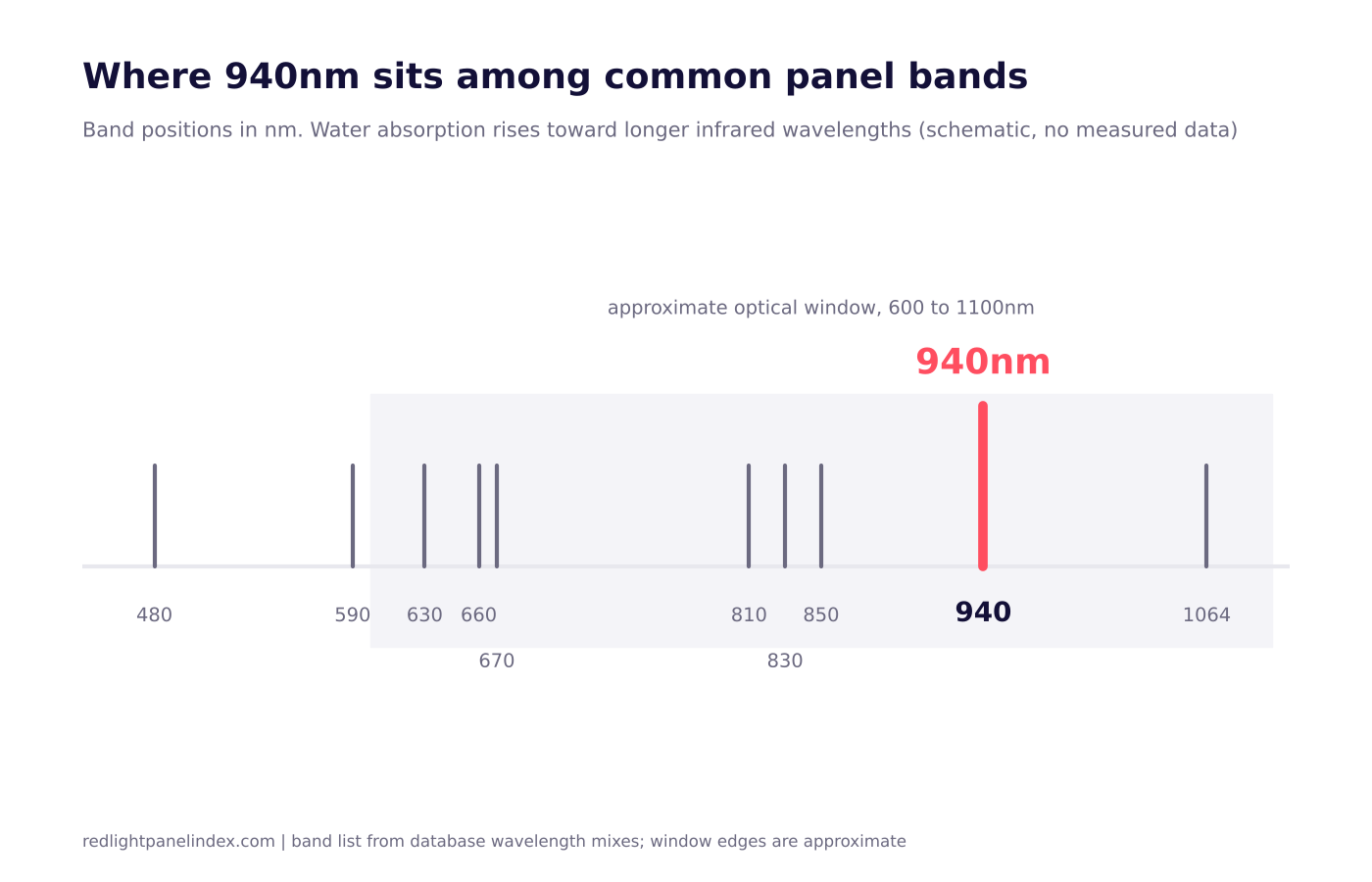
The diagram above places 940nm among the bands that show up in this site's database wavelength mixes: 480, 590, 630, 660, 670, 810, 830, 850, 940 and 1064nm. It falls inside the approximate 600 to 1100nm range described on our optical window page, the stretch where hemoglobin and melanin have mostly dropped off and water has not yet taken over. That range is a convention, not a hard cutoff, and 940nm sits in its upper half.
The shorter near-infrared bands are covered on their own pages: 810nm, 830nm and 850nm. The longer end is covered in 1064nm, and the trade-off between 850 and 1064 is laid out in 850nm vs 1064nm. The idea that connects them all is the one that matters most for 940nm: tissue is mostly water, and water absorbs infrared light more strongly as wavelength increases. Our chromophore page explains this, and it carries a caution that applies directly here: a longer wavelength is not simply a deeper one. This site gives no numeric water-absorption figure for 940nm, because neither the site nor its sources support one, so the honest summary is directional. Moving from 850nm toward 940nm and on to 1064nm, more of the light is expected to be taken up by water along the way.
What the research used 940nm for
There is no dedicated 940nm trial in this site's evidence base. The closest link is the 2025 Tsou meta-analysis on delayed onset muscle soreness (PMID 40700213). As summarized on our DOMS evidence page, it covered 14 controlled studies in which photomodulation was applied after soreness was induced, at wavelengths from 660 to 950nm, on one to six points of the affected muscle. Four studies had enough data to pool against placebo.
That wavelength range includes 940nm, but the pooled analysis does not break results out by wavelength in the figures this site reports, so it cannot tell you whether a 940nm source did better or worse than an 850nm one. What it supports is narrower: trials that used bands up to 950nm were eligible and were included. The overall evidence grade for soreness on this site is Limited, because the two meta-analyses on the question reached different conclusions and the pooled result rests on only four trials. Our before versus after a workout guide covers the timing question that sits alongside it.
So the fair reading is this: 940nm belongs to the range of near-infrared light that has been tested in recovery trials, but there is no study this site has found that tests it against 850nm and reports a difference.
Which database panels include 940nm
Several brands include the band, and the details differ a great deal:
| Brand or model | Wavelength mix (nm) | What is published about 940nm |
|---|---|---|
| MitoADAPT MIN 4.0 | 590, 630, 660, 670, 810, 830, 850, 940 | 12.5% each, a nominal split; $549 (verified 2026-08-13) |
| LightpathLED Diesel Mini | 670, 810, 940 | No per-band share; $374 (updated October 2026) |
| LightpathLED Titan | 670, 810, 940 | No per-band share; 1,056 LEDs, $5,994 (updated October 2026) |
| Bestqool Pro series | Adds 630 and 940 to 660 and 850 | No per-band share stated |
| iRestore | 590, 630, 660, 810, 830, 850, 940, 1060 | Share not stated |
| RedLife | 480, 590, 630, 660, 670, 810, 830, 850, 940, 1060 | Share not stated |
The pattern is clear. Among the panels listed here, the MitoADAPT line is the one that states a per-band split, and even that is described as nominal because dual-chip LEDs divide each diode's power between two wavelengths. The five LightpathLED panels all carry 940nm, but the database shows no per-wavelength share for any of them and no named method for the irradiance figure. The multi-wavelength panels ranking makes the same argument about band counts in general: a long list of wavelengths tells you less than the density behind each one.
A worked example with real database figures
The MitoADAPT MIN 4.0 lists 125 mW/cm2 at 6 inches, with an even 12.5 percent split across eight bands. The database calls the labeling internally inconsistent and suggests that a solar-meter or method-unstated figure be treated as roughly half. The claimed versus measured page explains why. Here is what the 940nm band would work out to under each reading, as an illustration and not a measurement:
- Face value: 125 x 0.125 = about 15.6 mW/cm2 at 940nm at 6 inches.
- Halved working value: 62.5 x 0.125 = about 7.8 mW/cm2 at 940nm.
For a 10-minute session (600 seconds), dose in J/cm2 is irradiance times seconds divided by 1,000. At 15.6 mW/cm2 that is about 9.4 J/cm2 from the 940nm band alone; at 7.8 mW/cm2 it is about 4.7 J/cm2. The dose calculator runs the same arithmetic for any figures you enter. These are surface doses from one band of one panel; they say nothing about how much reaches deeper tissue, and the split is nominal, not measured.
Cautions and what is not known
- No head-to-head trial of 940nm against 850nm or 1064nm is known to this site, so a claim that 940nm is better for any specific condition is unsupported here.
- A panel adding 940nm is not automatically stronger. If the band takes 12.5 percent of the output, it takes that share away from the others.
- Near-infrared is invisible, so use eye protection (see the eye protection guide) and keep sessions comfortable. Warmth that lingers or discomfort is a reason to shorten them.
The bottom line
940nm is a legitimate near-infrared band that sits inside the optical window, closer to the deeper end than 850nm, and the recovery literature includes sources up to 950nm. But the evidence does not single it out, and most brands that list it do not publish its share of output. When comparing panels, treat 940nm as a minor extra unless a brand gives you the number, and judge the panel on its published irradiance, method labels and the bands you actually have evidence for. The wavelength guide puts the full set of bands side by side.