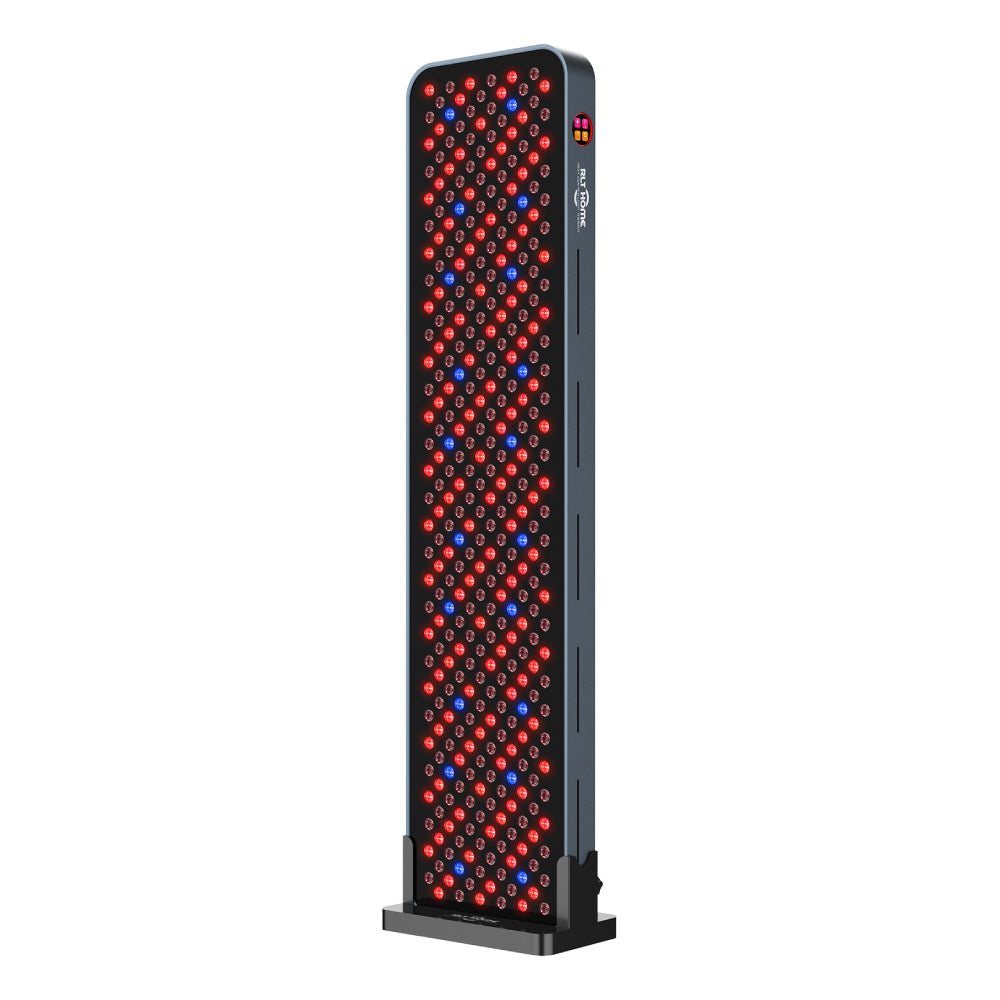
The best multi-wavelength panel, on the database fields this site ranks by, is the RLT Home Total Spectrum MAX at $1,795: it lists seven bands, publishes the share of output each one gets, and carries an independent spectrometer reading of 100.53 mW/cm2 at 6 inches. The ranking turns less on how many wavelengths a panel lists than on whether the brand tells you how much of its output each one receives, because a long list with an undisclosed split tells you almost nothing.
Choosing a panel? Our ranking of the best red light therapy panels is computed from published, method-labeled specs across 188 devices. For a multi-wavelength panel, the spec that matters is the published percentage of output given to each wavelength.
How this list was ranked
The method is the one described in how rankings work. RLT Home is one brand among 41 and is held to the same criteria and cautions as every other brand on this page. Only panels listing five or more wavelengths in the database are eligible, and this page covers the models whose database pages were checked for this update; the panels listing shows every five-plus-band model, including many not ranked here.
| Criterion | What counts |
|---|---|
| Published density | Whether the brand states the share of output (or of LEDs) for each wavelength |
| Irradiance | A figure at a stated distance with the instrument named; a spectrometer reading ranks above a solar meter reading or an unlabeled number |
| Price | Database price and the date it was verified |
| Warranty and trial | Warranty length, trial window, fees |
Models are sorted first by whether density is published, then by how well the irradiance figure is labeled, then by trial and warranty terms.
Why wavelength count is not the point
The site's wavelength science page makes the same argument: count matters less than density. A panel that lists seven bands may send most of its output to two of them. A band that receives a small share, such as the 6 percent given to 590 nm on the MitoPRO models, is a minor part of what comes out of the panel, and a band with no published share could be anything from a major component to a token one.
There is also a research reason for caution. A review of light parameters in photobiomodulation (PMID 30550048) describes how the wide range of settings, including wavelength, energy, power, irradiance and treatment duration, has in some cases led to contradictory results across studies. The authors report that cells and tissues with many mitochondria tended to respond to lower doses than those with fewer, and that ineffective studies in highly active cells more often looked like over-dosing than under-dosing. For a buyer, the lesson is that adding bands does not add benefit by itself; the dose delivered to the target matters, and you can work it out with the dose calculator.
The ranked picks
| Rank | Model | Price (verified) | Wavelengths (nm) | Published density | Irradiance as listed | Trial | Warranty |
|---|---|---|---|---|---|---|---|
| 1 | RLT Home Total Spectrum MAX | $1,795 (2026-09-12) | 480, 630, 660, 810, 830, 850, 1064 | Yes | 100.53 at 6 in, spectrometer, Electropossible Ltd | 60 days | 3 years |
| 2 | MitoADAPT MIN 4.0 | $549 (2026-08-13) | 590, 630, 660, 670, 810, 830, 850, 940 | Yes, 12.5% each | 125 at 6 in, solar meter and spectrometer disclosed | 60 days | 3 years |
| 3 | MitoPRO 300X | $449 (2026-08-13) | 590, 630, 660, 810, 830, 850 | Yes (percent of LEDs) | 130 at 6 in, solar meter and spectrometer disclosed | 60 days | 3 years |
| 4 | MitoPRO 1500X | $1,299 (2026-08-13) | 590, 630, 660, 810, 830, 850 | Yes | 160 at 6 in, solar meter and spectrometer disclosed | 60 days | 3 years |
| 5 | Helio Spark | $499 (2026-09-12) | 630, 660, 810, 830, 850, 1064 | Yes | 71 at 6 in, method not stated | 60 days | 3 years |
| 6 | Rouge Tabletop G4 | $516 (2026-08-12) | 630, 650, 660, 670, 810, 830, 850, 1060 | No | 164 at 6 in, solar meter; 90 spectrometer | 60 days | 3 years |
| 7 | Vital Pro 2.0 | $599 (2026-08-13) | 480, 590, 630, 660, 670, 810, 830, 850, 1060 | No | 150 claimed, distance not stated | 30 days | 3 years |
Published allocation tables
Where a brand publishes its split, the database records it. These are the figures as listed.
| Model | Allocation |
|---|---|
| Total Spectrum MAX | 480 nm 6%, 630 nm 19%, 660 nm 19%, 810 nm 19%, 830 nm 14%, 850 nm 9%, 1064 nm 14% |
| MitoADAPT MIN 4.0 | Even 12.5% each across eight circuits |
| MitoPRO 300X and 1500X | 590 nm 6%, 630 nm 22%, 660 nm 22%, 810 nm 17%, 830 nm 17%, 850 nm 17% (percent of LEDs) |
| Helio Spark | 630 nm 19.4%, 660 nm 19.4%, 810 nm 19.4%, 830 nm 13.9%, 850 nm 8.3%, 1064 nm 19.4% |
Why the order falls this way
Total Spectrum MAX. It ranks first because it combines a per-band split with an independent spectrometer reading and a 60-day trial with no restocking fee. It is also the most expensive model here, at 49.2 by 11.8 inches it is a stand-mounted, vertical-only panel, and it has no app by design. Its 1064 nm band is one that most competitors lack; the 1064 nm panel ranking compares the models that carry it.
MitoADAPT MIN 4.0. Eight bands in an even split and a dual-disclosed irradiance make it the best-labeled model under $600. The database notes that independent spectrometer measurements differed significantly from claimed figures, so read the 125 as the brand's figure. Return shipping is the buyer's cost unless the paid add-on was bought, and the stand is extra.
MitoPRO 300X and 1500X. Both publish the same split, and both disclose two instruments. On the 1500X page the database notes that the labeling is internally inconsistent, with an independent spectrometer reading far below the claimed figure,.
Helio Spark. It publishes its allocation, includes a tabletop stand and carries 1064 nm at $499, which makes it the lowest-priced model here with that band (the Total Spectrum MAX is the other). Its irradiance has no stated method, which is what holds it below the Mito models.
Rouge Tabletop G4 and Vital Pro 2.0. Both list the most bands and neither publishes a split. The Rouge page does name its measurement, giving 164 on a solar meter and 90 on a spectrometer at 6 inches. The Vital Pro 2.0 page lists a brand claim with no distance, a 30-day trial and no stated return terms, and it markets "FDA Cleared" without a 510(k) number the database could verify.
What you can and cannot conclude
- Density is a disclosure, not a quality score. A published split lets you see what you are buying; it does not show that the mix helps with your goal. For condition-specific questions, go to the evidence pages.
- Method labels still matter. Solar meter readings run roughly twice the spectrometer figure on LEDs. The claimed versus measured analysis and the irradiance explainer explain how to compare.
- Dual-chip designs split power. The Rouge page notes that each diode divides power between two wavelengths, so a listed band count is not the same as independent output per band.
- Check the instrument on each model page. The figure listed for each model names its own method; do not compare across methods.
Bottom line by use case
- You want the most transparent spec sheet: Total Spectrum MAX, if the price and vertical mounting suit you.
- You want published density at a lower price: MitoADAPT MIN 4.0 or MitoPRO 300X.
- You want a 1064 nm band on a small budget: Helio Spark, noting no stated irradiance method.
- You want many bands and accept no published split: Rouge Tabletop G4, which at least names its measurement method.
Confirm the current price, trial window and return terms on the seller's page before you buy.