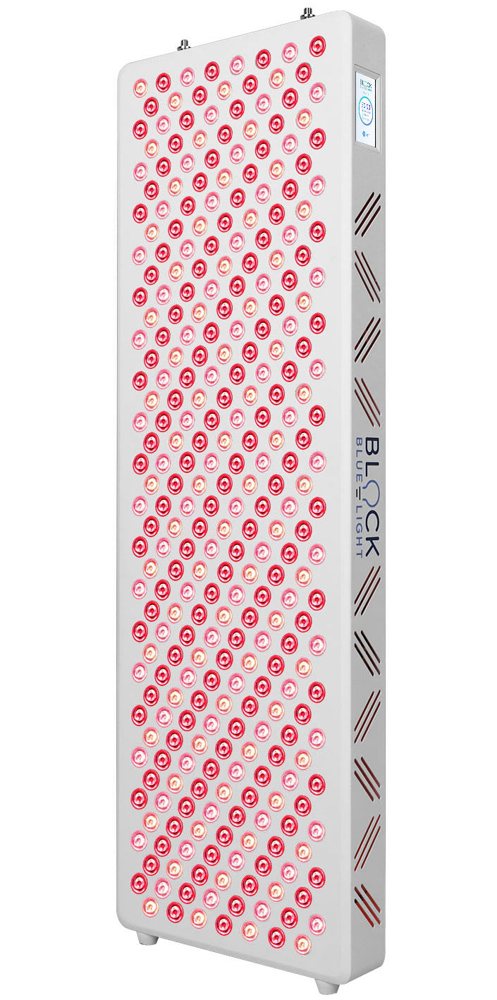
Among panels that publish a dual-chip LED type, the BlockBlueLight PowerPanel MEGA ranks first: Light Therapy Insiders measured it at 81 mW/cm2 on average and 105 peak at 6 inches, the strongest reviewer measurement of any dual-chip panel in the database. The MITO LIGHT Mitohacker 5.0 is effectively level with it at over 80 average. Dual-chip is a construction detail, not a performance grade: it is how most multi-wavelength panels get red and near infrared out of the same diode, and nothing about it raises irradiance by itself.
Choosing a panel? Our ranking of the best red light therapy panels is computed from published, method-labeled specs across 188 devices. For a dual-chip panel, the spec that matters is an irradiance figure that names its instrument, because the chip count says nothing about output.
What dual-chip means
A dual-chip LED puts two emitters behind one lens, usually one red and one near infrared. A panel built that way delivers both wavelengths from every diode position, so red and near infrared overlap evenly across the face instead of coming from separate banks of single-wavelength LEDs. The LED chips explainer sets out the trade: a single-chip LED gives its full rated power to one wavelength, while a dual-chip LED splits whatever it emits between two. Neither is a scam; they are different engineering choices.
What dual-chip does not do is make a panel brighter. A line such as "120 x 5W dual-chip" gives the diode count and each diode's electrical rating, and as the page on optical versus electrical power explains, the electrical rating is what the diode draws, not the light it emits. Two dual-chip panels with the same LED line can read very differently at 6 inches. The only comparable number is irradiance measured with a named instrument at a stated distance.
Dual-chip also tends to fix how output is shared between wavelengths. The Rouge brand notes say its two chips are equally placed in every LED, which forces an even split of roughly 12.5 percent per wavelength across its eight-band G4 panels. Whether an even split suits you depends on what you want from red versus near infrared; the multi-wavelength ranking covers panels that publish their per-wavelength density.
How many panels publish it
Recounted from the LED type field on the live model pages on 2026-11-14:
| LED type on the model page | Models |
|---|---|
| Dual-chip | 67 |
| Dual-chip, but the brand's own statements conflict | 3 |
| Single-chip | 22 |
| Quad-chip | 5 |
| Chip-on-board (COB) | 8 |
| Other (SMD, "multi-spectrum", single/dual both listed) | 6 |
| Not published | 77 |
The 77 "not published" models include panels that give a wattage per LED, such as "5W LED", without saying how many chips sit under each lens. Fifteen of the 41 brands in the database publish the chip configuration for none of their models. The three conflicting entries are LightpathLED Gen3 panels, which a brand comparison table calls "double chipped" while a site FAQ says "triple-chip".
Dual-chip panels come from 17 brands. Only 29 of the 67 also publish a 6-inch irradiance figure that names its instrument; the rest give no method, a figure at 3 inches or at no stated distance, or a solar meter figure alone.
How this ranking works
The general rules are on the page explaining how rankings work. For this list, a panel had to publish a dual-chip LED type without a conflicting statement and a 6-inch (or 15 cm) irradiance figure that names its instrument.
| Criterion | Rule used here |
|---|---|
| LED type | Dual-chip on the model page, no conflicting brand statement |
| Irradiance | A 6-inch figure naming its instrument; for dual-disclosed panels, the spectrometer figure, not the solar meter figure |
| Tier 1 | A reviewer measurement on file (Light Therapy Insiders), ordered by the measured average where one is given |
| Tier 2 | The brand's own spectrometer reading, ordered by that figure |
| Shown, not ranked | Price with verification date, wavelengths, beam angle, warranty and trial |
The ranking
| Rank | Panel | Irradiance at 6 in (method) | Wavelengths | Price (verified) |
|---|---|---|---|---|
| 1 | BlockBlueLight PowerPanel MEGA | LTI: 81 average, 105 peak; brand spectrometer over 89 | 5 | $1,500 (2026-09-12) |
| 2 | MITO LIGHT Mitohacker 5.0 | LTI: over 80 average, about 100 peak; brand spectrometer 90 | 6 | $2,148 (2026-08-13) |
| 3 | Rojo Refine 900 | LTI: 73 average, 85 peak; brand spectrometer 73 | 5 | $1,295 (2026-08-13) |
| 4 | Rojo Refine 3600 | LTI: 72; brand spectrometer 75 | 5 | $3,699 (2026-08-13) |
| 5 | Rouge Pro G4 | LTI (flagged affiliated): 59.2 average, 65 peak; brand spectrometer 90 | 8 | $1,196 (2026-08-12) |
| 6 | MitoADAPT MAX 4.0 | LTI: 58 average, 74 peak; brand spectrometer over 60 | 8 | $1,499 (2026-08-13) |
| 7 | MitoPRO MegaX | LTI: 56.5 average, 63 peak; brand spectrometer over 59 | 6 | $2,649 (2026-08-13) |
| 8 | MitoPRO 300X | LTI: 51.8 average, 60 peak; brand spectrometer over 56 | 6 | $449 (2026-08-13) |
| 9 | BlockBlueLight ULTIMATE XXL | Brand spectrometer: 90 | 7 | $4,500 (2026-09-13) |
| 10 | BlockBlueLight PowerPanel ELITE XL | Brand spectrometer: 90 | 5 | $3,500 (2026-09-12) |
| 11 | MITO LIGHT Master 5.0 | Brand spectrometer: 90 | 6 | $3,995 (2026-08-13) |
| 12 | Rouge Ultimate G4 | Brand spectrometer: 85 | 8 | $4,476 (2026-09-13) |
Irradiance is in mW/cm2. Seventeen more panels qualify in tier 2 with brand spectrometer figures from 56 to 83.1, including the BlockBlueLight PowerPanel MAX (over 82), the Rojo Refine 180 (75) and the Rouge Tabletop G4 (79). Prices were verified between August and September 2026; check the model page before buying.
The picks
Best dual-chip panel overall: BlockBlueLight PowerPanel MEGA
The PowerPanel MEGA has the highest reviewer-measured average of any dual-chip panel, 81 mW/cm2 at 6 inches, against a brand spectrometer figure of over 89 and a solar meter figure of 167. It uses five wavelengths through 60 degree lenses on a 92 by 30 cm face and carries a 5-year warranty, longer than the 3-year norm. Two cautions. The trial is 30 days, and returns cost you the shipping. And the brand's wavelength allocation (40 percent 660nm, 40 percent 850nm, the rest split across 630, 810 and 830nm) differs from what Light Therapy Insiders measured, roughly 25/25/17/17/17, so treat a dual-chip allocation claim as something to check, not assume.
Best large dual-chip panel: MITO LIGHT Mitohacker 5.0
The Mitohacker 5.0 measured over 80 average and about 100 peak, slightly above the brand's own spectrometer figure of 90, which is rare. Its six wavelengths run through 30 degree lenses on a 101.5 by 49.5 cm face, so it also appears on the narrow-beam ranking. The 30-day trial is the main drawback at $2,148.
Best match between claim and measurement: Rojo Refine 900
The Rojo Refine 900 publishes a spectrometer figure of 73 at 6 inches, and Light Therapy Insiders measured exactly 73 average and 85 peak. When a brand's number holds up that closely you can plan sessions from it with some confidence. It has five wavelengths, 60 degree lenses, a 3-year warranty and a 60-day trial at $1,295. The Rojo Refine 3600 uses the same chips across a 70.9 by 23.6 inch face, measured at 72, for full-body use at $3,699.
Best budget dual-chip panel: MitoPRO 300X
The MitoPRO 300X is the only dual-chip panel under $500 with a reviewer measurement: 51.8 average and 60 peak, close to the brand's over-56 spectrometer figure and well below its over-130 solar figure. Its six wavelengths are allocated by LED count (22 percent each at 630 and 660nm, 17 percent each at 810, 830 and 850nm, 6 percent at 590nm). At 9.5 by 14.5 inches it is a spot-treatment panel. The Rojo Refine 180 at $459 has a higher brand spectrometer figure of 75 but no reviewer measurement on file.
Most wavelengths: MitoADAPT MAX 4.0 and the Rouge G4 line
The MitoADAPT MAX 4.0 and the Rouge Pro G4 both list eight wavelengths in an even split. The MitoADAPT MAX was measured at 58 average, the Rouge Pro at 59.2 by a source the database flags as affiliated with the brand, both well below the brands' own figures. Eight bands on two chips per lens means each band gets a small share; check the peak wavelength and FWHM page before paying for wavelengths that sit 10nm apart.
Planning sessions on a dual-chip panel
Chip design drops out of the arithmetic once you have a measured figure. Use the reviewer measurement where one exists, otherwise the brand's spectrometer figure, never the solar meter figure, and put it into the dose calculator. If you want to know how much of that output is red and how much is near infrared, only a published allocation or a measured one tells you, and the BlockBlueLight example above shows the two can differ.
Cautions
- Dual-chip is a brand-stated construction detail, recorded as the brand describes it.
- Several brands publish a solar meter figure roughly double their spectrometer figure. The claimed versus measured table shows how large the gaps run.
- Panels without a published chip type are not worse for it; 77 models simply do not say. Rank them on measured output instead, using the panel database.