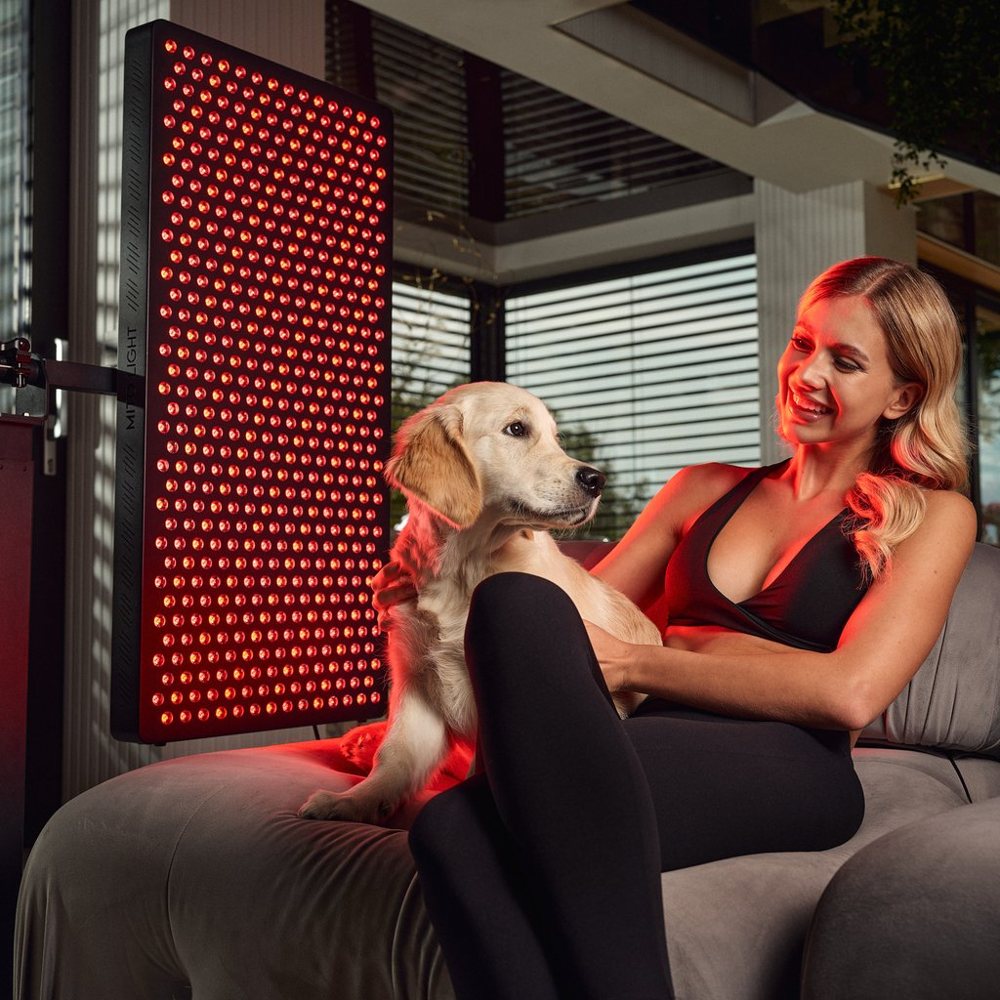
Among panels that publish a beam angle of 40 degrees or less, the MITO LIGHT Mitohacker 5.0 ranks first: it uses 30 degree lenses and is the narrow-beam panel with the strongest reviewer measurement on file, more than 80 mW/cm2 on average at 6 inches. The Red Light Rising Advantage 900 is close behind at a measured 75 average. A narrow beam is not better in general, though. It keeps more of a panel's light on target as you move back, and it pays for that with a smaller lit area at every distance, so it suits standing-back and targeted use rather than whole-body sessions.
Choosing a panel? Our ranking of the best red light therapy panels is computed from published, method-labeled specs across 188 devices. For treating at a distance, the spec that matters is the beam angle read together with an irradiance figure that names its instrument.
What a narrow beam does and does not buy you
The beam angle explainer covers the mechanism: total optical output is fixed by the LEDs and the driver, and the lens decides how widely that output spreads. The footprint of one LED's cone is twice the distance times the tangent of half the beam angle. Running that formula at the distances people actually use gives a clear picture of the trade.
| Beam angle | Cone width at 6 in | At 12 in | At 24 in |
|---|---|---|---|
| 19 degrees | 2.0 in | 4.0 in | 8.0 in |
| 30 degrees | 3.2 in | 6.4 in | 12.9 in |
| 60 degrees | 6.9 in | 13.9 in | 27.7 in |
| 90 degrees | 12.0 in | 24.0 in | 48.0 in |
These are geometric estimates for a single emitter, not measured footprints; a real panel is a grid of hundreds of LEDs, so its lit area also depends on its length and width. What the table shows is the direction of the trade. At 24 inches, each LED on a 30 degree panel still throws its light into a cone about 13 inches wide, roughly the width of a torso. On a 60 degree panel the same cone is over two feet wide, so more of the light lands beside you rather than on you. That is the sense in which a narrow beam "holds" irradiance at a distance: more of the output is still on target.
The cost is coverage. The treatment area and coverage page explains why light is weaker at a panel's edges and how many positions a session needs. A narrow-beam panel spills less past its own outline, so the area that gets a useful dose stays closer to the size of the panel face. If you want to light your whole front from a few feet away with one panel, a wider beam does more of that job.
Distance still costs you a lot of light whatever the lens. The inverse square law page explains why a flat panel fades more gently than the law predicts up close and more steeply once you are several panel-widths away, and the guide to sitting distance explains why a 6-inch figure cannot be stretched to 18 or 24 inches by arithmetic. A narrow beam slows the loss; it does not stop it.
Who this list is for
- People who cannot comfortably sit 6 inches from a panel, for example because of heat, mobility, or a mounting position on a wall or door.
- Targeted work on one joint or one area of skin from a standing or seated position a foot or more back.
- Anyone who has already settled on a working distance of 12 inches or more and wants less light wasted on the room.
If your goal is full-body coverage from close range, the highest-irradiance panels and the general panel ranking are the better starting points.
How this ranking works
The general rules are on the page explaining how rankings work. For this list, a panel had to publish a single beam angle of 40 degrees or less and a 6-inch (or 15 cm) irradiance figure that names its instrument. Panels were then ordered by who measured them, then by the figure itself.
| Criterion | Rule used here |
|---|---|
| Beam angle | One published angle of 40 degrees or less; panels listing mixed 30 and 60 degree lenses are excluded |
| Irradiance | A 6-inch figure naming its instrument; for dual-disclosed panels, the spectrometer figure is used, not the solar meter figure |
| Tier 1 | A reviewer measurement on file (Light Therapy Insiders) |
| Tier 2 | A lab report published by the brand (LightLab International, Electropossible) |
| Tier 3 | The brand's own in-house spectrometer reading |
| Shown, not ranked | Price with verification date, wavelengths, warranty and trial |
What the database shows
Recounted from the live model pages on 2026-11-14, 130 of the 188 models publish a beam angle and 58 do not. Of the 130, 59 publish a single angle of 40 degrees or less: 52 at 30 degrees, 4 at 19 degrees, 2 at 35 degrees and 1 at 40 degrees. Fifty-six publish 60 degrees, five publish 90 degrees (one of those from a reviewer's beam-angle test rather than the brand), nine list a mix of 30 and 60 degree lenses, and one, the Valo Blaze, lists 30 degrees in one spec table and 60 in another.
Only 22 of the 59 narrow-beam models also publish a 6-inch irradiance figure that names its instrument. The rest either give no method, quote a figure at 3 inches, at the panel surface or at no stated distance, or give no figure. A narrow beam with an unlabeled irradiance claim cannot be compared on this list, because the spectrometer versus solar meter page shows how far apart two instruments can read on the same panel.
The ranking
| Rank | Panel | Beam | Irradiance at 6 in (method) | Price (verified) |
|---|---|---|---|---|
| 1 | MITO LIGHT Mitohacker 5.0 | 30 | LTI: about 100 peak, over 80 average; brand spectrometer 90 | $2,148 (2026-08-13) |
| 2 | Red Light Rising Advantage 900 | 30 | LTI: 106 peak, 75 average; brand spectrometer 86.4 | £1,725 (2026-09-13) |
| 3 | Rouge Pro G4 | 30 | LTI (flagged affiliated): 65 peak, 59.2 average; brand spectrometer 90 | $1,196 (2026-08-12) |
| 4 | CytoLED Triplex | 30 | LTI: 54; brand spectrometer-corrected 38 | $1,079 (2026-08-13) |
| 5 | RLT Home Total Spectrum ELITE | 30 | Electropossible lab report: 121.62 | $4,595 (2026-09-12) |
| 6 | RLT Home Total Spectrum ULTRA | 30 | Electropossible lab report: 119.28 | $2,895 (2026-09-12) |
| 7 | RLT Home Total Spectrum MAX | 30 | Electropossible lab report: 100.53 | $1,795 (2026-09-12) |
| 8 | RLT Home Total Spectrum COMPACT | 30 | Electropossible lab report: 99.0 | $1,095 (2026-09-12) |
| 9 | RLT Home Total Spectrum MINI | 30 | Electropossible lab report: 98.7 | $595 (2026-09-12) |
| 10 | Helio Glow | 19 | LightLab report: 71.7 average | $1,199 (2026-09-12) |
| 11 | MITO LIGHT Master 5.0 | 30 | Brand spectrometer: 90 | $3,995 (2026-08-13) |
| 12 | Red Light Rising Advantage 450 | 30 | Brand spectrometer: 86.4 | $1,767 (2026-08-13) |
Irradiance is in mW/cm2. Ten more models qualify in tier 3 and sit below these: the Rouge Ultimate G4 (85), Max G4 (81) and Tabletop G4 (79), the MITO LIGHT Biohacker 5.0 (82), Expert 5.0 (80) and Starter 5.0 (74), the Red Light Rising Half Stack (57), and three CytoLED panels at 37 to 39. Prices were verified between August and September 2026 and can move with sales; check the model page before buying.
The picks
Best narrow-beam panel overall: MITO LIGHT Mitohacker 5.0
The Mitohacker 5.0 combines 30 degree lenses with a reviewer measurement that slightly exceeds the brand's own spectrometer figure: Light Therapy Insiders recorded about 100 mW/cm2 peak and over 80 on average at 6 inches, against a brand figure of 90. It uses six wavelengths (630, 660, 670, 810, 830 and 850nm) on a 101.5 by 49.5 cm face, large enough for a torso from a step back. The caution is in the buyer terms: a 30-day trial, half the 60 days most panels on this list offer, with a 3-year warranty. At $2,148 it is a big panel at a big-panel price.
Best measured value with the longest trial: Red Light Rising Advantage 900
The Advantage 900 was measured by Light Therapy Insiders at 106 peak and 75 average, close to the brand's in-house spectrometer figure of 86.4 taken at 15 cm. Its 365-day trial is the longest in this list by a wide margin, which matters if you are unsure how a standing-back routine will fit your space. Its database price is in pounds, £1,725, so US buyers should check shipping and currency on the brand's site. It uses five wavelengths on a 91 by 30 cm face.
Narrowest beam: Helio Glow
At 19 degrees, the Helio Glow has the tightest lens of any panel with a method-labeled figure. A LightLab International report puts it at 71.7 mW/cm2 average at 6 inches. Its six wavelengths include 1064nm, and it carries a 60-day trial and 3-year warranty at $1,199. Be careful with the rest of the Helio line: the database notes that only the Glow was physically tested and the other models' 71 figures are extrapolated, which is why the Spark, Blaze and Nova are not ranked here. How the 19-degree Nova compares with a 30-degree panel at the same price is covered in the Helio Nova vs BioLight ReJuvenate comparison.
Highest lab-report figures: RLT Home Total Spectrum line
All five Total Spectrum panels use 30 degree lenses and publish spectrometer readings from Electropossible Ltd at 6 inches, from 98.7 on the Total Spectrum MINI to 121.62 on the Total Spectrum ELITE. The ULTRA also has a LightLab International report of 85.7 at center and 111.2 maximum. These rank below the reviewer-measured panels because the lab tests were commissioned by the brand and no unaffiliated reviewer measurement is on file, the same rule that places Helio's LightLab report in this tier. The line publishes per-wavelength density across seven bands and offers a 60-day trial with no restocking fee. The Total Spectrum MAX at $1,795 and the MINI at $595 bracket the line's price range for most buyers.
Small panel for targeted work: Rouge Tabletop G4
The Rouge Tabletop G4 is a 12.6 by 9.1 inch, 30 degree panel at $516 with a brand spectrometer figure of 79 mW/cm2 at 6 inches (its solar meter figure is 164, which is why the spectrometer number is used). No reviewer measurement of this model is on file. The larger Rouge Pro G4 was measured at 59.2 average by Light Therapy Insiders, a source the database flags as affiliated with the brand, and that reading is well under the brand's 90. Plan sessions on the Tabletop conservatively for that reason. The Rouge Tabletop G4 vs Valo Beam comparison sets it against another 30 degree desk panel with a larger face but no stated method.
Lower output, honestly labeled: CytoLED Triplex
The CytoLED Triplex publishes a low spectrometer-corrected figure of 38 mW/cm2 at 15 cm, and Light Therapy Insiders measured 54 at 6 inches, above the brand's own number. It will need longer sessions than anything above it, but the figure is one you can plan on. It has a 2-year warranty and a 30-day trial at $1,079.
A measured figure at 12 inches
Almost no brand publishes irradiance at a distance other than 6 inches, as the page on measurement distance conventions shows. One exception sits just outside this ranking: the LightpathLED Diesel Gen3, a 30 degree panel, states 76 mW/cm2 at 12 inches without naming the instrument, and Light Therapy Insiders measured it at 56 at 12 inches. It is excluded only because the ranking compares 6-inch figures. If your working distance really is a foot, a figure measured at a foot is worth more than any 6-inch number on this page.
Planning sessions from a distance
Whatever panel you choose, a 6-inch figure overstates what reaches you at 12 or 24 inches. Use the figure measured closest to your actual distance, lean toward the reviewer measurement when there is one, and put it into the dose calculator to get session minutes. If the only figure you have is at 6 inches and you stand two feet back, expect to need a substantially longer session, and treat any estimate as a floor to build up from rather than a precise dose.
Cautions
- Beam angle is almost always a brand-stated spec. Only one angle in the database comes from a reviewer's own test, and the Valo Blaze lists two different angles on its own product page.
- Several brands on this list publish a solar meter figure alongside the spectrometer one. The solar figure is typically about double; the claimed versus measured table shows how large the gaps run.
- Standing back does not remove the need for eye protection; wear the goggles the brand supplies at any distance.
- The full list of panels, including the 37 narrow-beam models without a method-labeled figure, is on the panel database.