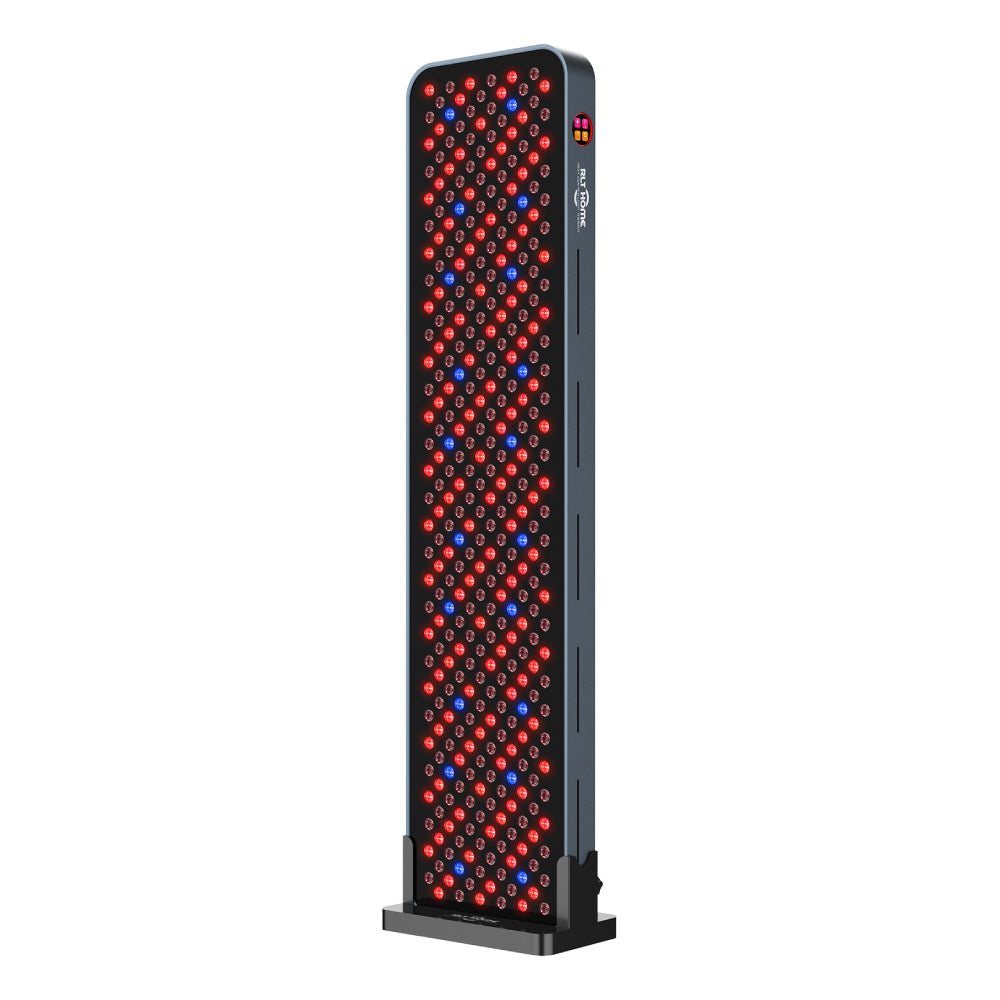
Ranked only on irradiance figures that state their measuring instrument, the strongest home panels in this site's database sit between about 82 and 100 mW/cm2 measured at 6 inches, well below the 130 to 165 mW/cm2 many brands claim before independent testing catches up with them. Four panels clear that bar with a named instrument behind their number: a large-format panel independently lab-tested at over 100 mW/cm2, a mid-size panel with the single highest independently measured peak reading, a brand-tested large panel with its own dual-disclosed figure, and a budget pick that still backs its number with a third-party spectrometer test.
Choosing a panel? Our ranking of the best red light therapy panels is computed from published, method-labeled specs across 188 devices. For raw irradiance specifically, the spec that matters is not the biggest number on a spec sheet, but whether that number names the instrument that produced it.
How these picks are ranked
Every model here is scored the same way this site scores every best-of list: an irradiance figure only counts if it names the instrument and the distance it was measured at. See how rankings work for the full method behind every list on this site. Among the panels that clear that bar, these four post the highest measured figures at a common 6-inch distance.
| Criteria | What it measures here |
|---|---|
| Method-labeled irradiance | mW/cm2 at 6in, with the instrument (spectrometer vs. solar meter) and whether the figure is peak or average stated |
| Independence of the reading | Whether the measurement came from a named third-party tester or the brand's own in-house instrument |
| Wavelength mix | Published bands and, where available, the percentage share in each |
| Price and buyer terms | Verified price, warranty length, trial window and restocking terms |
Why a solar meter reading does not belong on this list
Solar meters read light across a far wider band than the red and near-infrared LEDs in these panels actually emit, which is why this site's claimed-versus-measured analysis finds brand claims average 2.11 times higher than a spectrometer reading of the same panel, across 44 panels with both figures published. A panel that claims 165 mW/cm2 on an unlabeled or solar-meter figure is not necessarily stronger than one that publishes a spectrometer-verified 90 mW/cm2; it may simply be using a more generous instrument. Every figure below is a spectrometer reading, or in one case the brand's own dual-disclosed spectrometer-plus-integrating-sphere test, not a solar-meter or unlabeled claim.
The picks
1. RLT Home Total Spectrum MAX posts the highest single independently tested figure of the four: 100.53 mW/cm2 at 6 inches, measured by Electropossible Ltd with a named HP350IR spectrometer. The page does not split that reading into a separate peak and average, so it should be read as one representative center-panel figure rather than a best-case peak. Its published seven-band wavelength mix runs 480nm (6 percent), 630nm (19 percent), 660nm (19 percent), 810nm (19 percent), 830nm (14 percent), 850nm (9 percent) and 1064nm (14 percent), across a 49.2 by 11.8 inch array with 360 LEDs. At $1,795 (verified 2026-09-12) it carries a 3-year warranty and a 60-day trial with no restocking fee, and ships with a stand included.
2. PlatinumLED BioMax 900 (classic 9th gen) posts the highest independently measured peak reading of the four: Light Therapy Insiders measured 113 mW/cm2 peak and 90.3 mW/cm2 average at 6 inches, still around 75 mW/cm2 at 12 inches. The brand does not publish its own wavelength breakdown; LTI's independent reconstruction puts roughly 36 percent of output at 850nm and 39 percent at 660nm, with the remaining 810nm, 830nm and 1060nm sharing a smaller slice. At 36 by 12 inches it is the smallest panel on this list and needs a separately purchased stand. At $1,299 (verified 2026-08-13) it carries the weakest buyer terms here, a 20 percent restocking fee plus customer-paid return shipping on an elective return, alongside the same 3-year warranty and 60-day trial window.
3. Rouge Max G4 publishes a dual-disclosed figure of its own: 164 mW/cm2 on a solar meter and 90 mW/cm2 on a spectrometer, both at 6 inches, backed by an integrating-sphere lab report. Unlike the two picks above, this spectrometer figure comes from the brand's own testing rather than an independent third party, which is why it ranks below panels with outside verification despite a comparable number. Its published eight-wavelength mix, 630, 650, 660, 670, 810, 830, 850 and 1060nm, is the widest band spread on this list, though the brand does not publish a percentage split across them. At 71.65 by 11.81 inches with 576 dual-chip LEDs, it is the largest panel here. At $2,396 (verified 2026-09-13) it is the most expensive of the four, with a 3-year materials warranty (free replacement parts for 6 months) and a 60-day trial with no restocking fee on the panel itself.
4. Hooga ULTRA1500 is the budget pick and the only one under $1,500: its brand-claimed 165 mW/cm2 at 6 inches states no measurement method, but Light Therapy Insiders independently measured 104 mW/cm2 peak and 81.7 mW/cm2 average at the same distance, the lowest of the four verified figures but still a real spectrometer reading, roughly half the unlabeled claim. It covers four wavelengths, 630, 660, 810 and 850nm, with no published percentage breakdown. At 39.5 by 8.6 inches it is mid-sized, with a stand sold separately. At $1,399 (verified 2026-09-12) it carries a 3-year warranty and a 60-day trial; the site notes no restocking fee is stated, but a prepaid return label's cost is deducted from the refund, and open-box items are non-refundable.
Why the biggest number is not automatically the best session
A higher irradiance is not free of tradeoffs. Photobiomodulation research describes a biphasic dose-response pattern, where cellular response tends to improve as light dose rises, then plateaus or reverses past a certain point, a pattern this site's biphasic dose-response explainer covers with the underlying review evidence, which does not identify a single numeric ceiling for a home panel but does caution against reflexively maximizing intensity, since a higher-irradiance panel also reaches a given J/cm2 target faster, shortening the session length rather than automatically delivering a stronger effect at a fixed dose (PMID 22461763). The practical upshot is that a higher mW/cm2 figure mainly changes how long a session needs to run to hit the same dose, not how much benefit a longer session at a lower irradiance would have missed.
The dose calculator makes that tradeoff concrete: at a common 20 J/cm2 target dose, the Total Spectrum MAX's 100.53 mW/cm2 reaches that dose in about 3.3 minutes, the BioMax 900's 90.3 mW/cm2 average takes about 3.7 minutes, the Max G4's 90 mW/cm2 also takes about 3.7 minutes, and the ULTRA1500's 81.7 mW/cm2 average takes about 4.1 minutes. Roughly 45 seconds separates the fastest and slowest panel on this list at the same target dose, a real but modest difference, not the kind of gap the raw mW/cm2 numbers alone might suggest.
Picking between these four
A buyer who wants the highest independently verified single reading, plus a full published wavelength breakdown and the cleanest buyer terms, gets that from the RLT Home Total Spectrum MAX. A buyer chasing the single highest peak number, and willing to buy a stand separately and accept the weakest return terms here, gets that from the PlatinumLED BioMax 900. A buyer who wants the widest published wavelength spread and the largest panel, and can accept a brand-reported rather than third-party spectrometer figure, gets that from the Rouge Max G4. And a buyer who wants a still-verified spectrometer reading at the lowest price on this list gets that from the Hooga ULTRA1500. Since roughly a minute of session time is what actually separates the fastest and slowest panel here at a matched dose, coverage, wavelength mix and buyer terms are worth weighing at least as heavily as the irradiance figure itself.