The measurement distance is how far from the panel face the sensor sat when an irradiance figure was taken, and it is part of the number, not a footnote to it. This site compares panels at 6 inches because that is the distance most brands already publish: of the 188 models in the database, 114 state their headline figure at 6 inches or 15 centimeters, 13 state 3 inches, 6 state the panel surface, 4 state 12 inches, 3 use other centimeter distances, 13 publish no figure, and 35 publish a figure with no distance at all. A figure at 3 inches can look up to four times stronger than the same panel at 6 inches without a single extra photon, so a figure with no stated distance cannot be compared with anything.
Choosing a panel? Our ranking of the best red light therapy panels is computed from published, method-labeled specs across 188 devices. For comparing output between brands, the spec that matters is an irradiance figure that states both its distance and its instrument.
What "measurement distance" means
Irradiance is optical power per unit of area, in mW/cm2, at one point in space. Move the sensor and the point changes, so the reading changes. A panel does not have one irradiance; it has a different value at every distance and at every spot across its face. When a brand prints "100 mW/cm2", it is reporting one sample from that field, and the sample is only interpretable if you know where it was taken.
Two other things travel with the distance. One is the instrument: a solar power meter reads LED panels roughly twice as high as a spectrometer at the same spot, so a distance without a method is still only half a label. The other is where across the face the reading was taken, the center or an average of several points, which the peak vs average irradiance page covers. This page is about the first of the three.
How the database's 188 models state distance
The counts below come from the measurement notes on every model page in the database, recounted on 2026-11-13.
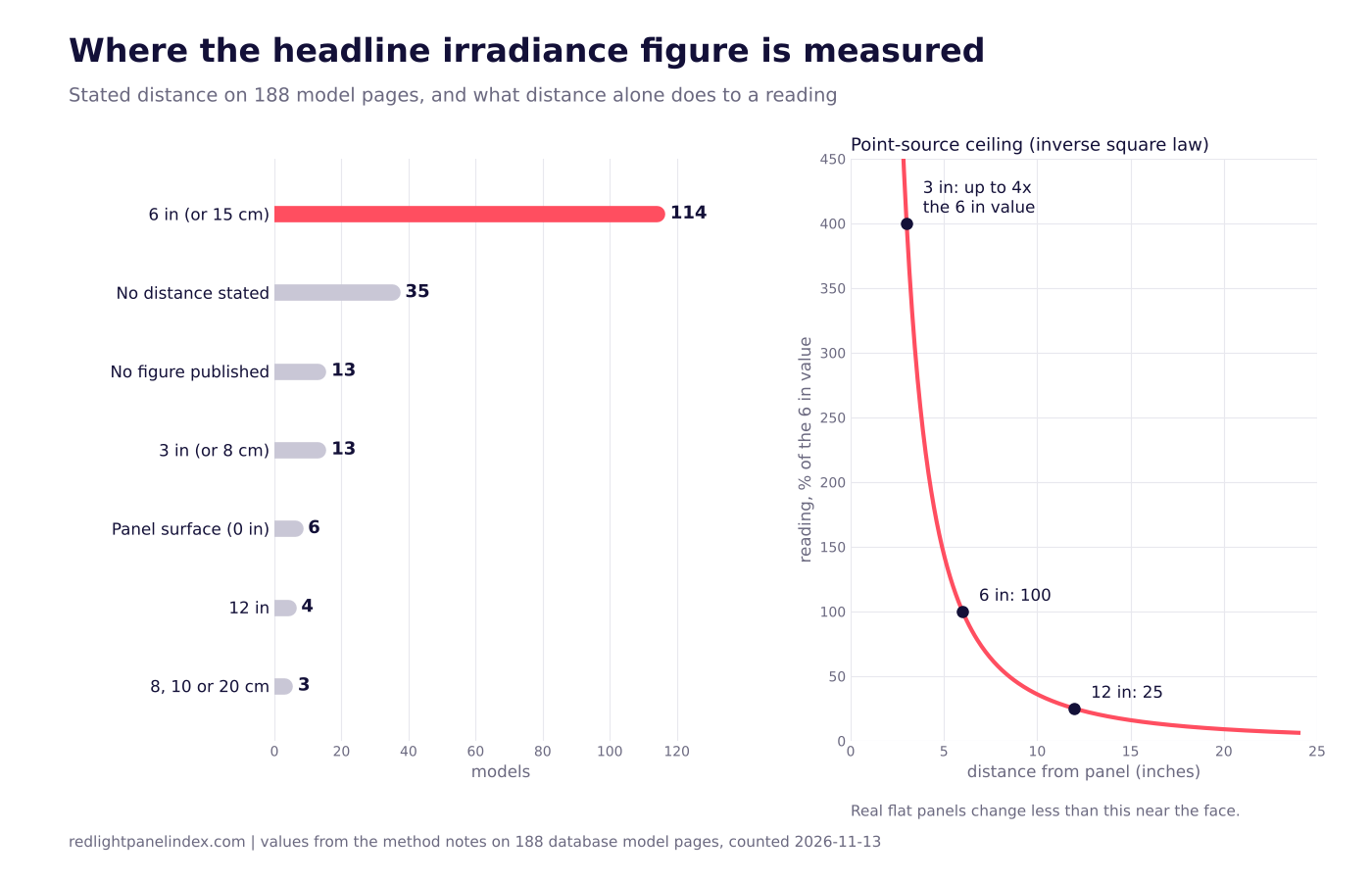
| Stated distance of the headline figure | Models |
|---|---|
| 6 inches, or 15 centimeters | 114 |
| No distance stated | 35 |
| No numeric figure published | 13 |
| 3 inches, or 8 centimeters | 13 |
| Panel surface (0 inches) | 6 |
| 12 inches | 4 |
| 8, 10 or 20 centimeters | 3 |
Six inches is a convention, not a standard. No regulator or industry body sets it; it became the default because the larger brands quote it and reviewers who test with a spectrometer adopted it so their numbers would line up. Fifteen centimeters is the metric version of the same habit and differs from 6 inches by about a tenth of an inch, which is far smaller than the other sources of error in a home reading, so this site groups them.
The other conventions cluster by brand. All five Bestqool panels and all four Scienlodic BIOEPIC panels quote 3 inches, as do the BlockBlueLight PowerPanel Mini, the MitoPRO Mobile and the Recover Red Power Stack; the Rouge Nano quotes 8 centimeters. LightPath LED quotes its four Gen3 panels at 12 inches, which it calls the ideal distance. Surface figures come from Kala, LightPath LED, LuminousRed and EMR-Tek. The 35 figures with no distance at all come from ten brands, among them every Joovv, Vital Red Light, BON CHARGE, Megelin and Vellgus model.
Moving the stated distance from 6 to 3 inches
The inverse square law sets the ceiling on what distance alone can do. For a point source, halving the distance quadruples the reading, so a panel that reads 60 mW/cm2 at 6 inches could be quoted at anything up to 240 mW/cm2 at 3 inches by the arithmetic alone. Doubling the distance to 12 inches does the reverse and cuts it to a quarter, 15 mW/cm2.
A flat panel is not a point source at these distances, and that same page explains why the real change is smaller: up close, the sensor sees light from LEDs spread across an area wider than the gap to the panel, so moving a few inches changes the distance to some LEDs much more than to others. The true 3-inch figure for a given panel will sit somewhere between its 6-inch figure and four times that. Nobody can say where without measuring that panel at both distances, and almost no brand does.
That is why this site never converts a 3-inch or 12-inch figure to a 6-inch one. The model pages print figures at other distances as they were published and mark them "not comparable to 6-in figures". Take the Bestqool PRO200, listed at 111 mW/cm2 at 3 inches with no method named. The figure is real as published, but it cannot be placed next to a 6-inch number on any scale this site trusts, so the panel competes on its other specs.
The 12-inch case shows the same rule from the other side. The LightPath LED Diesel Gen3 is listed at 76 mW/cm2 at 12 inches, and its page records an independent spectrometer reading of 56 mW/cm2 at the same 12 inches. Those two numbers can be compared with each other because they share a distance. Neither can be compared with a 6-inch figure from another brand, even though a panel quoting a strong 12-inch number may well be a strong panel.
Why a figure with no distance is unusable
A 3-inch figure is imprecise for comparison but still has a meaning; a figure with no distance has none. "Over 100 mW/cm2" could describe a reading taken at the panel face, where it is easy to reach, or at 6 inches, where it is a respectable claim, or at 12 inches, where it would be unusually high. The range of possible readings for one panel across those distances is wider than the gap between most of the panels in the database, so the figure cannot even place a panel in the right half of a ranking.
The Joovv Solo 3.0 is the clearest example on file. The brand's figure is listed as more than 100 mW/cm2 with the distance not stated, and the page also records an independent Light Therapy Insiders measurement of 72.4 mW/cm2 peak and 59.2 mW/cm2 average. Even that independent figure carries a distance question, because the page's table puts it at 6 inches while its measurement note describes it as at the surface. When a measured figure exists, this site works from it; when only a claim with no distance exists, the model page keeps the number but rankings that need irradiance leave the panel out. The claimed-vs-measured dataset shows how far claims can drift from measurements even when the distance is stated.
Surface figures sit in between. A reading at 0 inches is at least defined, but it is a distance nobody uses for a session and it depends heavily on whether the sensor sits over an LED or between two of them, which is why most testers back away to a few inches before they record anything.
What this means for your dose
A dose in J/cm2 is irradiance multiplied by time, and the irradiance you enter has to be the one at the distance you actually sit. If you treat at 12 inches and enter a 6-inch figure into the dose calculator, you will overestimate your dose, and the more the figure came from a solar meter or a 3-inch reading, the larger the overestimate. The distance guide explains how to choose a working distance for your goal and treat any longer-distance number as an estimate rather than a measurement.
The safest habit is to start from a 6-inch spectrometer figure where one exists, such as the 71 mW/cm2 spectrometer figure on the Helio Cure Helio Glow page, and adjust session time when you move further back, rather than trusting the brand to have measured at your distance.
How to check a brand's distance convention
Before comparing any two panels, check these on the brand's own product page or spec sheet:
- Find the distance in the same sentence as the number. "At 6 inches", "at 15 cm" or "at 3 inches" should sit next to the mW/cm2 figure. A distance mentioned elsewhere on the page, for example in usage instructions, is not the measurement distance.
- Look for a second figure. A few brands publish two distances or two instruments. If both exist, use the one at 6 inches and the one from a spectrometer.
- Read the small print on charts. Comparison charts against other brands sometimes quote 6 inches in a footnote while the headline figure on the same page is a surface reading.
- Convert centimeters. 15 cm is 6 inches for practical purposes; 8 cm is about 3 inches and 20 cm about 8 inches.
- Check the model page here. Every model page in the database prints the figure with its stated distance and method, and flags figures that are "not comparable to 6-in figures". The guide to reading irradiance labels explains each label.
If you own a meter, the home irradiance check walks through measuring your own panel at the brand's stated distance. Measuring at a different distance and comparing the result with the brand's claim tells you nothing about whether the claim is accurate.
The short version
Six inches is the comparison distance because most brands already use it, not because it is the right distance to sit. A figure at another stated distance is published here as-is and kept out of 6-inch comparisons. A figure with no distance cannot be ranked at all, and it is worth asking the brand for the distance before you treat the number as meaningful. The spec disclosure scorecard shows which brands publish a 6-inch figure and which do not.