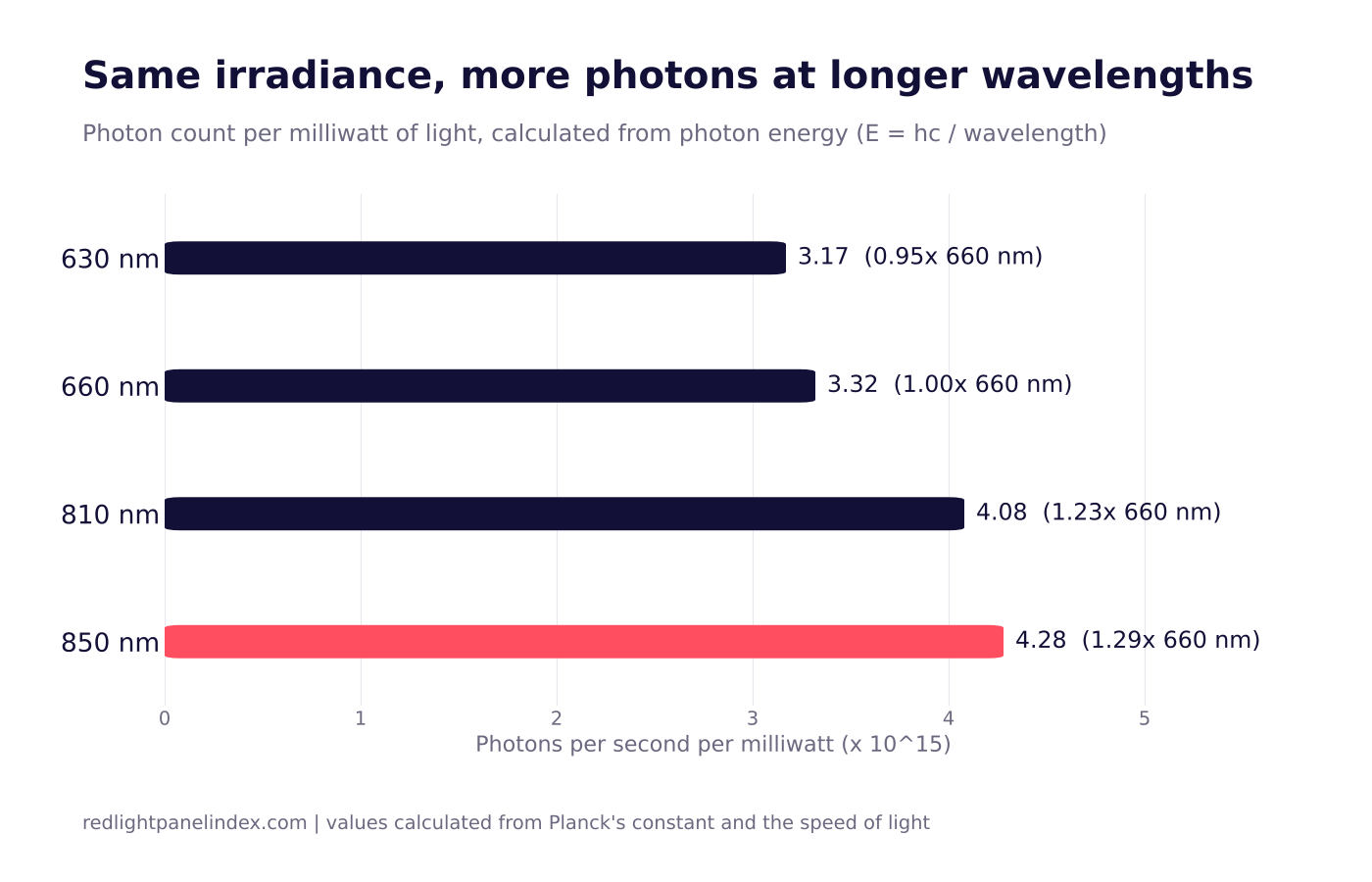
Irradiance measures how much light energy lands on each square centimeter per second, in mW/cm2, while photon flux counts how many photons land there per second. Because a near-infrared photon carries less energy than a red one, the same irradiance at 850nm delivers about 29 percent more photons than at 660nm and about 35 percent more than at 630nm, which is a real physical difference but rarely a reason to choose one panel over another.
Choosing a panel? Our ranking of the best red light therapy panels is computed from published, method-labeled specs across 188 devices. For comparing photon counts, the spec that matters is a spectrometer-measured irradiance with a published per-wavelength split, because photon flux can only be calculated band by band.
Two ways to count the same light
A panel's light can be described as energy or as particles. Irradiance is the energy view: watts per area, or for panels, milliwatts per square centimeter at a stated distance, as the irradiance explainer covers. Photon flux density is the particle view: photons per second per area. Researchers usually write it in micromoles of photons per square meter per second (µmol/m2/s), where one micromole is about 6.02 x 10^17 photons.
The two are linked by one fact: each photon's energy depends only on its wavelength. The photon energy page derives that relationship; the short version is that photon energy falls as wavelength rises. Divide irradiance by the energy of one photon and you get photon flux. Since an 850nm photon carries less energy than a 660nm photon, more of them fit into each milliwatt.
A handy shortcut follows from the same constants. Micromoles of photons per second per watt equals the wavelength in nanometers divided by about 119.6. One watt of 660nm light is about 5.52 µmol of photons per second; one watt of 850nm light is about 7.11.
The worked arithmetic
The table applies that conversion to the four wavelengths most panels in the database carry. The 850nm page counts 850nm and 660nm on 93 percent of the 188 panels, 630nm on 61 percent and 810nm on 52 percent. The last column assumes 50 mW/cm2 at the skin, an illustrative round figure, not a measurement of any device.
| Wavelength | Photons per second per mW | µmol/s per W | Relative to 660nm | µmol/m2/s at 50 mW/cm2 |
|---|---|---|---|---|
| 630nm | 3.17 x 10^15 | 5.27 | 0.95 | about 2,630 |
| 660nm | 3.32 x 10^15 | 5.52 | 1.00 | about 2,760 |
| 810nm | 4.08 x 10^15 | 6.77 | 1.23 | about 3,390 |
| 850nm | 4.28 x 10^15 | 7.11 | 1.29 | about 3,550 |
The ratio between any two wavelengths is simply the ratio of the wavelengths themselves: 850 divided by 660 is 1.29, so 850nm gives 29 percent more photons per watt. 850 divided by 630 is 1.35. Moving from 810nm to 850nm adds only about 5 percent.
The same scaling applies to dose. A dose of 10 J/cm2 is about 3.3 x 10^19 photons per square centimeter at 660nm and about 4.3 x 10^19 at 850nm, matching the figures on the photon energy page.
A worked example with a real panel
The claimed versus measured study lists the BlockBlueLight PowerPanel MID at 61 mW/cm2 at 6 inches from the brand's own spectrometer disclosure, next to a 158 mW/cm2 solar meter claim. Its database page lists a brand-published split by LED count: 660nm 40 percent, 850nm 40 percent, 630nm 10 percent, 830nm 5 percent and 810nm 5 percent.
Those are shares of LEDs, not of optical output, and LEDs of different wavelengths do not emit equal power, so the split below is an assumption made for the arithmetic, not a measurement:
| Band | Share | mW/cm2 at 6 in | µmol/m2/s |
|---|---|---|---|
| 660nm | 40% | 24.4 | about 1,350 |
| 850nm | 40% | 24.4 | about 1,730 |
| 630nm | 10% | 6.1 | about 320 |
| 830nm | 5% | 3.05 | about 210 |
| 810nm | 5% | 3.05 | about 210 |
| Total | 100% | 61 | about 3,820 |
The 850nm band carries the same assumed irradiance as the 660nm band but about 29 percent more photons. The total works out to roughly 3,820 µmol/m2/s, or about 2.3 x 10^17 photons per square centimeter per second. If the same 61 mW/cm2 were all 660nm it would be about 3,370 µmol/m2/s; if it were all 850nm, about 4,330.
The energy dose does not change with the mix. Ten minutes at 61 mW/cm2 is 36.6 J/cm2 whatever the wavelengths, which is the figure the dose calculator gives and the one you compare with trial doses on the joules per square centimeter page.
Why some researchers report photons
Light-driven chemistry works one photon at a time. A molecule absorbs a single photon, and that absorption event is what starts any downstream effect. From that angle, the count of photons absorbed is the more natural measure, and a photon count lets two wavelengths be compared on equal numbers of absorption chances rather than equal energy.
Plant lighting is the best-known example. Grow lights are specified in photosynthetic photon flux density (PPFD), in µmol/m2/s, because photosynthesis depends on photons captured. PPFD is defined only over 400 to 700nm, so a grow light's PPFD figure ignores near-infrared entirely and cannot be compared with a red light panel's 850nm output.
In photobiomodulation, the convention is energy: almost every trial reports irradiance and dose in J/cm2. That is why the site's dose tools work in joules.
Should a buyer care?
Mostly not, for four reasons.
- More photons is not more effect. Whether a photon does anything depends on whether a chromophore absorbs it, and absorption varies with wavelength. The cytochrome c oxidase page and the chromophores page explain why red and near-infrared are absorbed by different molecules to different degrees, so a 29 percent photon advantage at 850nm says nothing about which band works better for a given goal.
- Trial doses are in joules. To match a study, you match its J/cm2 at its wavelength. Converting to photons adds a step without changing the target.
- Measurement error is bigger. The site's dataset puts brand claims at a median 2.18 times spectrometer readings across 44 panels. A solar meter figure can overstate irradiance by more than the whole 630nm to 850nm photon difference, so the irradiance method matters far more than the photon arithmetic.
- Panels mix bands. Nearly every panel combines red and near-infrared, so its photon flux depends on a band split most brands do not publish as optical output.
Photon flux does matter in two cases: when you read a study that reports its dose in photons or einsteins, and when someone offers a grow light's PPFD as evidence it suits red light therapy.
What to look for on a spec sheet
- Irradiance with instrument and distance. A spectrometer figure at a stated distance is the starting point; the spectrometer page explains why.
- A per-wavelength split, and what it measures. Share of LEDs and share of optical output are different things.
- Units. mW/cm2 is energy; µmol/m2/s is photons; lux is neither, as the lux vs mW/cm2 page explains.
- PPFD on a "red light" product. It covers 400 to 700nm only and says nothing about near-infrared.
- Photon claims without a band. "More photons" means nothing unless the wavelength and irradiance are stated, because the count follows directly from those two numbers.