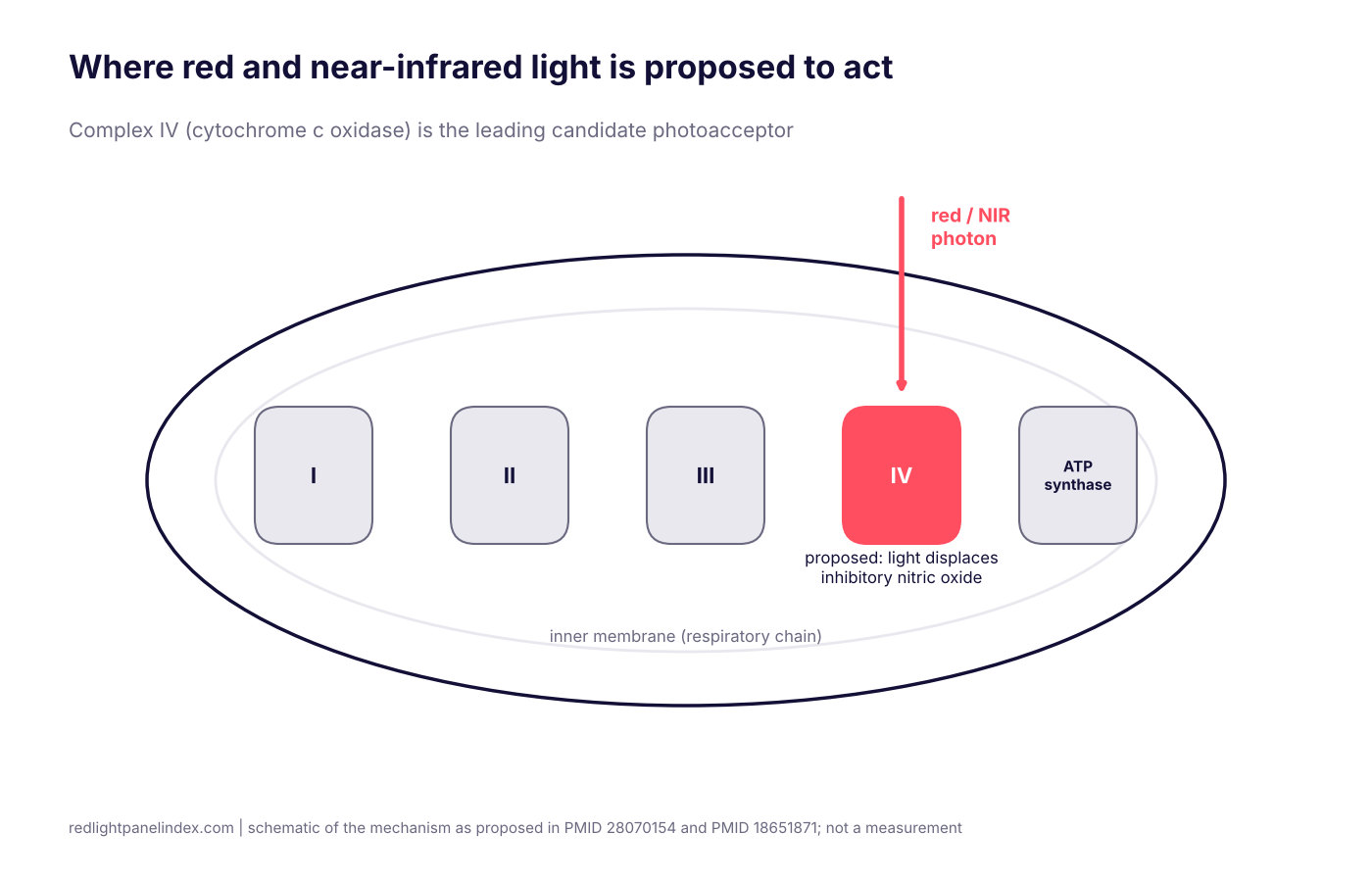
Cytochrome c oxidase is the last enzyme in the chain of proteins that mitochondria use to turn food energy into ATP, and it is the molecule most often proposed as the first thing red and near-infrared light acts on. "Proposed" is the operative word: the idea has laboratory support, but it is a working hypothesis, not a settled fact, and it says little about what any particular panel will do for a person.
Choosing a panel? Our ranking of the best red light therapy panels is computed from published, method-labeled specs across 188 devices. For a mechanism like this one, the spec that matters is the wavelength mix, because only wavelengths the enzyme can absorb are relevant to the proposal.
What the enzyme is
Inside each mitochondrion sits a set of protein complexes, usually numbered I to IV, along the inner membrane. Electrons pass down the chain, protons are pumped across the membrane, and ATP synthase uses the resulting gradient to make ATP. Cytochrome c oxidase is complex IV, the final step, where electrons are handed to oxygen. The diagram above shows where it sits relative to the other complexes. It is a schematic of the proposal, not a measurement.
The enzyme contains metal centers that give it color, and that is the root of the photoacceptor idea: a molecule that absorbs visible and near-infrared light can, in principle, be changed by it. A review of the field by Karu describes the enzyme as acting as both a signal generator and a signal transducer in irradiated cells (PMID 18651871). That review also covers the downstream readouts researchers have measured after irradiation, including mitochondrial membrane potential, reactive oxygen species, calcium, nitric oxide and intracellular pH.
How light is proposed to act on it
The most cited version of the story runs in four steps. These are the steps as described on the site's photobiomodulation overview, drawing on the mechanism review by de Freitas and Hamblin (PMID 28070154):
- Red or near-infrared photons are absorbed by cytochrome c oxidase.
- Absorption is proposed to release nitric oxide that was sitting on the enzyme and slowing it down (the blood-flow side of that idea is covered separately).
- With that brake removed, electron transport and ATP production are proposed to rise.
- Changes in signaling molecules and gene expression follow, which is where the longer-term effects in cells are thought to come from.
Step 2 is the part that is most debated, and step 4 is the least well pinned down. Treat the sequence as a map of hypotheses to test (the full chain from photon to gene expression is walked through in mitochondria, ATP and red light), not a description of what happens in a living person on a couch with a panel.
The neuron study that tied activity to light
The experiment most often cited for the enzyme's role comes from Wong-Riley and colleagues, published in the Journal of Biological Chemistry in 2005 (PMID 15557336). The researchers worked with primary neurons in culture. They used potassium cyanide, a poison that blocks cytochrome c oxidase, to functionally silence the neurons, then exposed them to far-red and near-infrared light from LED arrays.
According to the abstract, the LED treatment partially restored enzyme activity that cyanide had blocked, and it significantly reduced cell death caused by 300 micromolar cyanide, from 83.6 to 43.5 percent. It restored ATP content only at the lowest cyanide concentration tested, 10 micromolar, and not at higher concentrations. The logic of the design matters more than any single number: if light helps cells in which that specific enzyme is blocked, the enzyme looks like a plausible target of the light.
What this study does not show is also worth saying plainly:
- It was done in cultured neurons, not in animals or people.
- The cells were damaged with a toxin on purpose, which is not the situation of a healthy adult using a panel.
- The ATP result was partial and limited to the mildest toxin dose.
- It was a single laboratory's experiment using specific LED arrays at a specific dose.
Which wavelengths the proposal covers
The proposal is about absorption, so it applies to wavelengths the enzyme can take up, which the literature places in both the red and the near-infrared range. The site's wavelength guide lists the bands home panels use. Two matter most for this discussion:
- 660nm red light is the common surface-level band.
- 850nm near-infrared is the common deeper band, and the site's page on it notes that 660nm and 850nm are absorbed by the same enzyme, so they are not biologically distinct at the cellular level.
The difference between them, as the red versus near-infrared explainer lays out, is mostly how far light travels through tissue before it is absorbed in useful amounts. That depth advantage comes from tissue-optics modeling, not from a trial that measured light inside a living person, so it is best read as a rough guide. The penetration depth page covers the limits of that modeling.
Caveats worth keeping in mind
Other mechanisms are proposed, especially for near-infrared. The mechanism review by de Freitas and Hamblin (PMID 28070154) is titled as a review of proposed mechanisms, plural, and the authors discuss more than one route by which light might act. Some of those do not depend on this enzyme. If you read a confident sentence claiming that light "charges mitochondria" through one pathway, it is simplifying a field that has not settled.
Cells are not tissues, and tissues are not people. Showing an effect in a dish says light can change cellular behavior under those conditions. It does not tell you whether the light reaches the relevant cells in a person, at what dose, or whether the change matters clinically. For the question of what is actually supported in people, use the evidence hubs by condition, which grade each area separately.
Dose has two sides. The same mechanism that is proposed to help at a moderate dose is also described as fading or reversing at high doses. This is the biphasic dose response, and it is why more light is not automatically better. If you want to see what a given panel, distance and time add up to, the dose calculator does the arithmetic.
The mechanism does not rank panels. Even if the enzyme proposal is entirely correct, it does not make one panel better than another. What does separate panels is the thing the mechanism depends on in practice: how much light of the right wavelength actually arrives at the skin, and how that was measured. Manufacturer claims and independent readings can differ, as the irradiance explainer and the claimed versus measured comparison show.
Worked example: reading a claim
Suppose a product page says its light "activates cytochrome c oxidase." Three questions turn that into something checkable:
- Which wavelengths does the panel emit, and are they in the red or near-infrared bands the proposal covers? A panel's published peak wavelengths answer this.
- How much irradiance reaches the skin at the distance you will use, and was it measured with a spectrometer or a solar meter? The method changes the number, which is why the spectrometer page matters.
- Does the sentence stop at the mechanism, or does it go on to claim a result? A mechanism is a reason a result might happen. A claimed result needs a trial, ideally one with a sham arm, as covered in the page on reading sham-controlled trials.
If a claim only supplies the first step and skips the other two, it has told you the light is the right color and nothing more.
What this means for a home panel
For someone choosing or using a panel, the practical takeaways from the enzyme story are modest. Choose wavelengths in the red and near-infrared bands the proposal covers, check how irradiance was measured, keep dose in a moderate range rather than chasing the highest number, and weigh any health claim by the evidence for the condition, not by the mechanism. Eye safety applies regardless of mechanism; the eye protection guide explains why.
The mechanism is a good reason to take the question seriously and a poor reason to believe any single claim. It is the start of the explanation, and the rest has to come from trials.