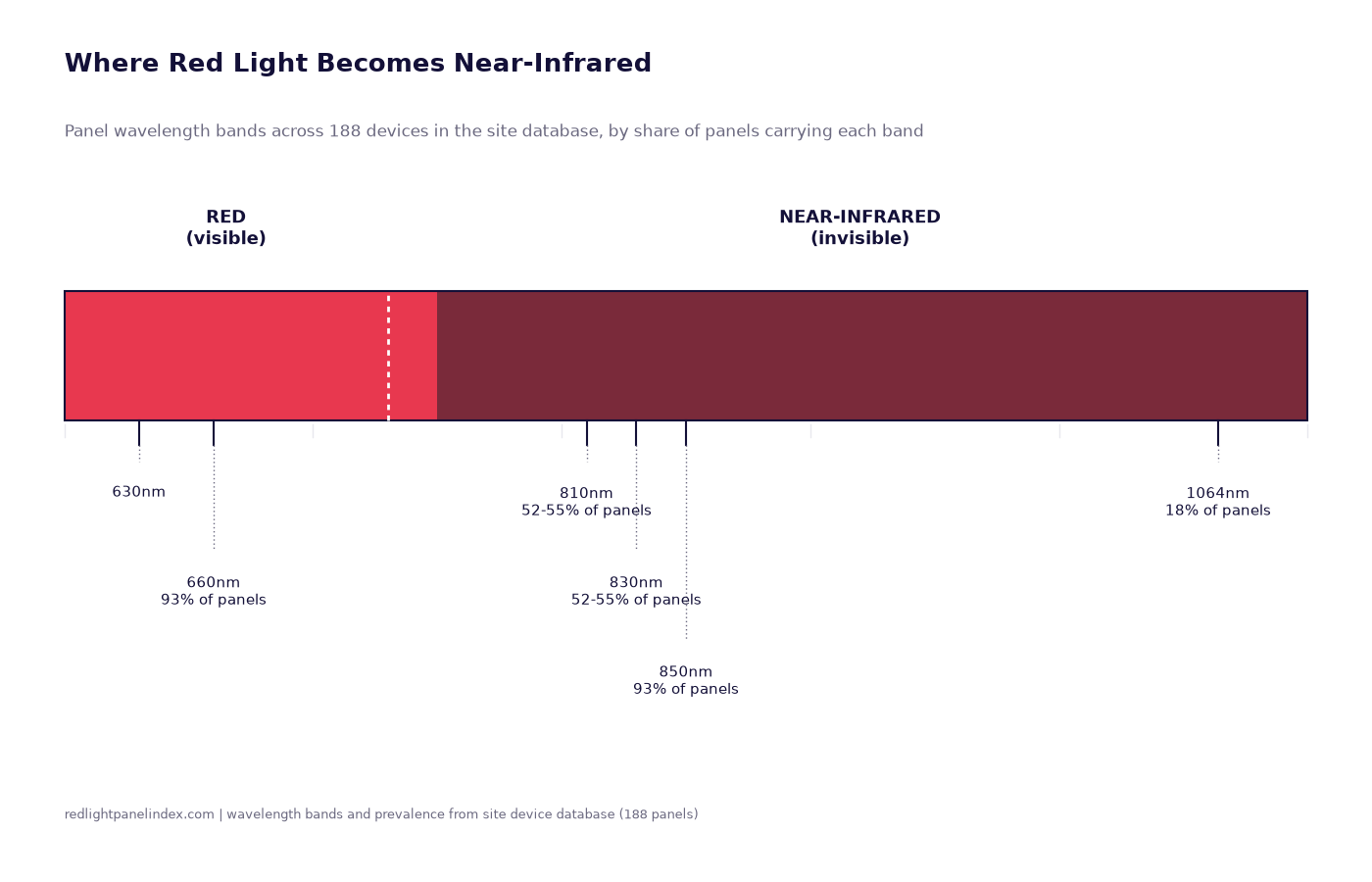
Red light, roughly 600 to 700 nanometers, and near-infrared light, roughly 700 to 1,100 nanometers, trigger the same core cellular reaction, but they are absorbed and scattered by different amounts of tissue on the way there. That is the entire practical difference between the two bands on a home panel: red light does most of its work at the skin and just beneath it, while near-infrared travels measurably farther before it is absorbed, reaching into muscle, joint capsule and other tissue below the surface.
Choosing a panel? Our ranking of the best red light therapy panels is computed from published, method-labeled specs across 188 devices. For red versus near-infrared, the spec that matters is the published density at each band, not just whether a wavelength appears on the label.
Where the line between the two bands sits
Red light is the last part of the visible spectrum before it shades into invisible near-infrared, so the boundary itself is a little arbitrary; most photobiomodulation literature and most panel spec sheets put it somewhere between 700 and 750 nanometers. The site's own wavelength breakdown tracks how the market actually clusters within those two bands across 188 devices: 630 and 660 nanometer red light and 850 nanometer near-infrared each appear on nearly every panel in the dataset (93 percent), 810 and 830 nanometer near-infrared appear on roughly half (52 to 55 percent), and a 1064 nanometer deep near-infrared band, which some researchers treat as a third category rather than part of "near-infrared" proper, shows up on about one in six panels (18 percent). In practice, "near-infrared" on a spec sheet almost always means one or more of 810, 830 or 850 nanometers, with 1064 nanometers as an uncommon extra.
Near-infrared light is invisible; a panel running only its near-infrared diodes can be fully powered on and delivering a real dose while looking dark to the eye, which is part of why a published density figure at each band matters more than what a panel looks like when it is switched on.
The 1064 nanometer band sits far enough past 850 nanometers that some researchers and brands treat it as its own category, "deep near-infrared" or simply "1064," rather than folding it into "near-infrared" generally. It is the least common of the bands the site tracks, and it is also the one most often paired with a claim about reaching joints or fascia specifically, which makes checking a panel's actual published density at 1064 nanometers, rather than assuming it is present because "near-infrared" is on the label, worth doing before paying a premium for it.
Why the two bands are usually sold together, not as alternatives
Almost no panel in the site's database ships red light without any near-infrared, or the reverse. The practical reason is straightforward: a single session aimed at a joint or a muscle group still passes through skin first, so a panel built only for depth would be sending near-infrared through a skin layer it never specifically targets, without the red band that layer is best suited to. Pairing the two bands on one panel is less a marketing flourish than a reflection of how a treatment area is actually layered, skin over muscle over joint, with each layer sitting in front of the next.
Same target, different reach
Both bands sit in the same narrow near-infrared sliver of the spectrum that a panel's LEDs are built to target, which is a different band entirely from the broad far-infrared heat an infrared sauna uses; our panel versus infrared sauna comparison walks through why those two device types do not overlap despite both being called "infrared." Red and near-infrared light are treated as a single mechanism in the research literature because both are absorbed by cytochrome c oxidase, the mitochondrial enzyme the site's photobiomodulation page describes as the accepted first step in the effect. Neither band does something biologically distinct from the other at the cellular level; a cell exposed to 660 nanometer red light and a cell exposed to 850 nanometer near-infrared are responding through the same enzyme and the same downstream chain.
What differs is how much tissue each wavelength has to pass through before it gets there in useful amounts. Shorter visible wavelengths, including most blue and green light, are absorbed and scattered heavily by blood and skin pigment within the first fraction of a millimeter. Red and near-infrared light sit in a band where that absorption drops off, which is why this range, and not blue or green light, is the one used for anything beneath the epidermis. A 2012 review of low-level laser and LED research traces how the field's practical wavelength range grew from laser-only red light to a broader set of LEDs spanning red and near-infrared, with effects that follow a biphasic dose response rather than a simple more-is-better curve at either end of the range (PMID 22045511).
What the modeling says about depth
The clearest direct evidence for "near-infrared reaches farther than red" comes from computational tissue-optics modeling rather than a single clinical trial measuring light at depth in a live human. A 2017 study built a Monte Carlo model of light transport through a multi-layered skin model, testing ultraviolet, visible and infrared wavelengths against a range of beam widths and skin tones, and found that calculated penetration depth increases with increasing wavelength, with a maximum modeled penetration depth of 5,378 micrometers, about 5.4 millimeters, at the longest wavelength tested (PMID 28900751). That figure is a ceiling from one modeled scenario, not a guaranteed depth for any specific panel or wavelength band; the site's penetration depth page goes further into what the modeling and measurement literature actually supports and where the limits are, including why marketing claims of light "penetrating two inches" go well past anything in that literature.
The same 2017 modeling also found that beam width stops mattering much past a certain point: a 10-millimeter beam produced 73 to 88 percent of the fluence, depending on depth, that an infinitely wide beam of the same intensity would produce at 1 to 3 millimeters deep (PMID 28900751). Wavelength, not panel size, is doing most of the work in how far the light actually reaches.
Use case: which band for which target
| Target | Band that reaches it | Why |
|---|---|---|
| Skin surface: fine lines, superficial healing, surface circulation | Red, 630-660nm | Absorbed close to the surface; the band most panels weight heaviest |
| Muscle, joints, tissue below the skin | Near-infrared, 810-850nm (some panels add 1064nm) | Passes through more tissue before being absorbed, per the modeling above |
| A typical home session covering both | Red and near-infrared together | Most panels on the site publish both bands rather than one alone |
For what the trial literature specifically reports at each of those deeper targets, see the site's joint pain and muscle recovery evidence pages, which grade the near-infrared studies on those conditions separately from the general mechanism described here. For a direct head-to-head look at the two most common bands on either side of this line, 660nm red against 850nm near-infrared, including how much of their output panels actually allocate to each, see 660nm vs 850nm.
A 2014 trial testing a broadband source spanning 570 to 850 nanometers against a narrowband red source found no advantage for the wider spectrum on skin outcomes (PMID 24286286), a result our full review of that trial covers in more detail; it is one more data point for treating red and near-infrared as complementary rather than assuming more bands automatically means a better result.
What this means for choosing a panel
A panel that lists "seven wavelengths" is not automatically covering skin and deep tissue equally; what matters is the density published at each band, since a panel can carry a near-infrared wavelength on its spec sheet while allocating only a small share of total output to it. Check the wavelength and FWHM page for how to read that density figure rather than the peak number alone, and check that any irradiance figure quoted for a given band states the measurement method, since claimed and independently measured numbers regularly diverge. Once you know the bands you need, filter the device database by wavelength directly, and use the dose calculator to convert a band's irradiance and your session length into an actual dose rather than assuming more minutes under any wavelength is automatically better.
There is no single "better" band between the two. A panel aimed at facial skin with no near-infrared is not under-built for that job, and a panel with no red light is missing a band most deeper-tissue protocols still pair with it for the skin layer the light passes through first. The right mix depends on the target, not on which band sounds more advanced on a box.