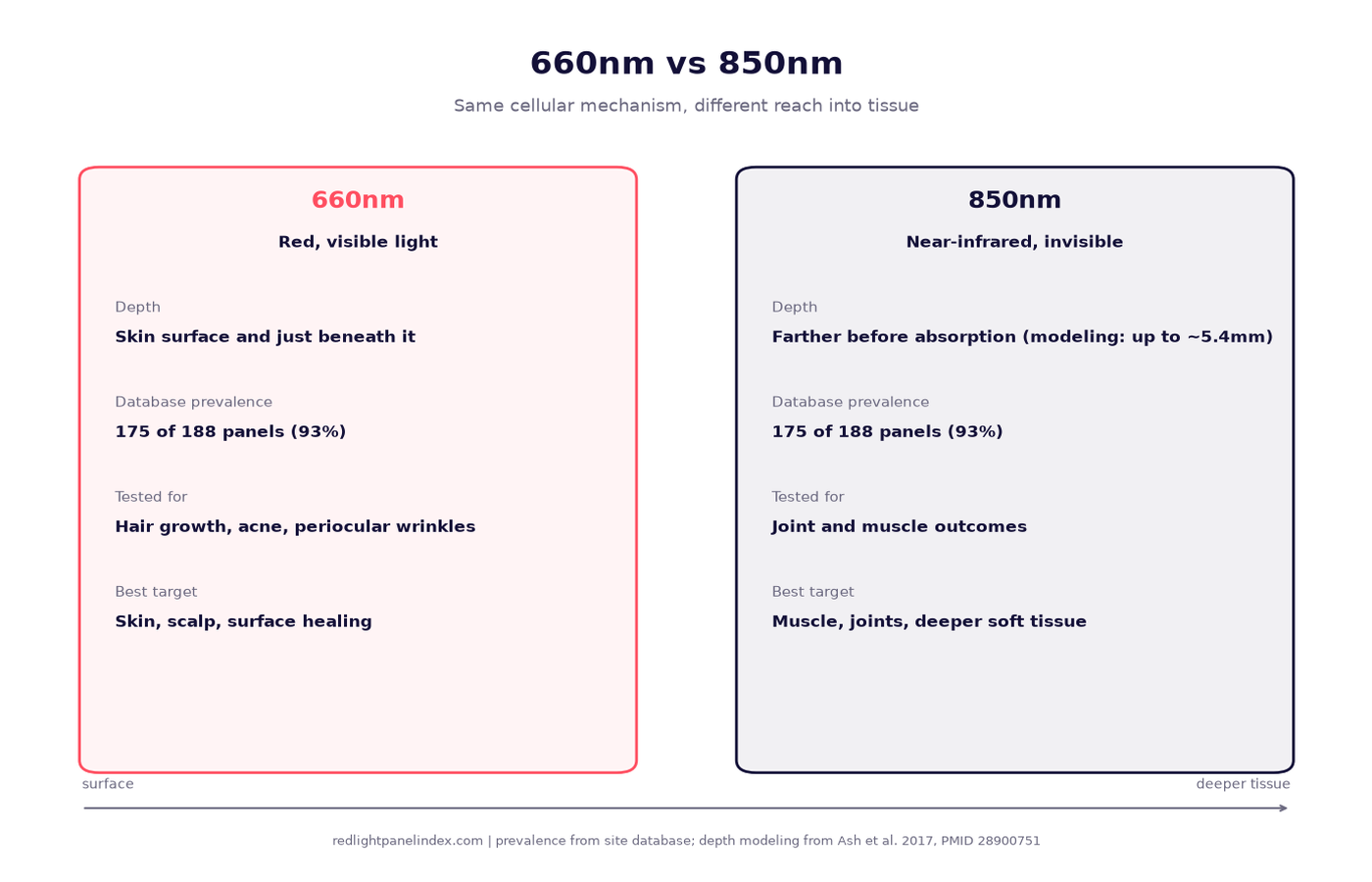
660nm and 850nm are tied as the two most common wavelengths on red light therapy panels, each appearing on 93 percent of the 188 devices in this site's database, and the trial literature treats them as targeting different depths of tissue through the same cellular mechanism rather than as competing options. 660nm, a red wavelength, does most of its work at the skin and just beneath it. 850nm, a near-infrared wavelength invisible to the eye, travels farther before it is absorbed, reaching toward muscle and joint tissue. Most panels ship both because most treatment areas layer skin over the deeper tissue a session is actually aimed at.
Choosing a panel? Our ranking of the best red light therapy panels is computed from published, method-labeled specs across 188 devices. For 660nm versus 850nm, the spec that matters is the published density at each band, not just whether both wavelengths appear on the label.
The short answer
Neither wavelength is biologically superior to the other. Both are absorbed by cytochrome c oxidase, the same mitochondrial enzyme this site's photobiomodulation page describes as the first step in the effect, so a cell responding to 660nm light and a cell responding to 850nm light are running through the same chain of reactions. What separates the two wavelengths is depth: how much skin, fat and tissue the light has to pass through before enough of it remains to matter. 660nm is the right choice for a surface goal, skin texture, fine lines, acne, wound healing. 850nm is the right choice when the target sits below the surface, a joint, a muscle group, a larger area of soft tissue. A panel that ships only one band is not broken; it is built for one kind of target, not the other.
Where each wavelength sits in the spectrum
Visible red runs roughly from 600 to 700 nanometers before shading into invisible near-infrared, a boundary this site's red-versus-near-infrared page puts at somewhere between 700 and 750 nanometers depending on the source. 660nm sits near the far edge of the red band, closer to the near-infrared boundary than to the start of the visible red range, which this site's 660nm page notes is part of why it penetrates slightly deeper than a shorter red wavelength like 630nm. 850nm sits well inside the near-infrared range, past the 810 and 830 nanometer bands that also appear on a majority of panels, but short of the far less common 1064 nanometer deep near-infrared band.
What the modeling says about the depth gap
The clearest evidence for a real depth difference between the two bands comes from computational tissue-optics modeling rather than a single clinical trial measuring light at depth in a living person. A 2017 study built a Monte Carlo model of light transport through a multi-layered skin model, testing ultraviolet, visible and infrared wavelengths against a range of beam widths and skin tones, and found that calculated penetration depth increases with increasing wavelength, with a maximum modeled penetration depth of 5,378 micrometers, about 5.4 millimeters, at the longest wavelength tested (PMID 28900751). Within the range a panel actually uses, that means 850nm is calculated to reach measurably farther than 660nm before it is absorbed, even though both wavelengths trigger the same cellular response once they arrive. This site's penetration depth page covers what that modeling does and does not support in more detail, including why depth claims quoted in inches go well beyond anything in the literature.
The same 2017 study also modeled beam width and found it matters far less than wavelength: a 10-millimeter beam produced 73 to 88 percent of the fluence, depending on depth, that an infinitely wide beam of the same intensity would produce at 1 to 3 millimeters deep (PMID 28900751). A bigger panel face does not meaningfully substitute for choosing the wavelength that actually reaches your target.
Why dose, not just wavelength, decides the result
A 2018 review of photobiomodulation dosing looked at the range of parameters, wavelength, energy density, power density, pulsing and treatment duration, used across published studies, and found a pattern tied to tissue type rather than wavelength alone: tissues and cells with higher numbers of mitochondria, including muscle, brain, heart and nerve, tended to respond to lower light doses than tissues with fewer mitochondria, including skin, tendon and cartilage (PMID 30550048). The review also found that ineffective results in the high-mitochondria tissues were more often explained by over-dosing than under-dosing. That has a direct implication for 660nm versus 850nm in practice: the deeper targets 850nm is typically aimed at, muscle in particular, may not need as much energy density to respond as a skin-level 660nm protocol does, which is one more reason to use the dose calculator for each band rather than assuming the same session length is correct for both.
What each wavelength has actually been tested for
The trials in this site's register cluster by wavelength in a pattern that matches the depth story. 660nm and the closely overlapping 655nm band, covered in more detail on the 660nm page, have controlled trials behind hair growth, acne and periocular wrinkles, all surface-level skin and scalp targets. 810 to 850nm near-infrared trials in the register concentrate on joint and muscle outcomes instead, the deeper targets the modeling above says that band is better positioned to reach. Neither wavelength has been tested across both kinds of targets in the same trial register this site tracks, so the division between "660nm for skin, 850nm for depth" reflects where researchers have actually pointed each wavelength, not just a theoretical depth argument. This site's 850nm page goes deeper into that near-infrared band on its own, including the market-share numbers and the specific exercise and whole-body pain trials behind it.
How panels actually split power between the two bands
Nearly every panel in the database ships both wavelengths, but the share of total output each one gets varies widely by brand and model. Three examples illustrate the range: the PlatinumLED BioMax 900 allocates about 39 percent of its published array to 660nm and about 36 percent to 850nm, a near-even split weighted slightly toward red. The Mito Red Light MitoPRO 1500X allocates about 22 percent to 660nm and about 17 percent to 850nm out of six wavelengths total, spreading power more thinly across a wider spectrum. The RLT Home Total Spectrum ULTRA allocates 20 percent to 660nm and 8 percent to 850nm, a wider gap favoring the red band, out of seven wavelengths published on that panel.
| Model | 660nm share | 850nm share | Total wavelengths |
|---|---|---|---|
| PlatinumLED BioMax 900 | ~39% | ~36% | 7 |
| Mito Red Light MitoPRO 1500X | ~22% | ~17% | 6 |
| RLT Home Total Spectrum ULTRA | 20% | 8% | 7 |
A panel listing both 660nm and 850nm on its box says nothing about which one it actually favors; two panels with identical wavelength lists can deliver very different doses at 850nm specifically, which matters most if your goal is a deeper target. Reading the published density at the specific band you need, rather than the wavelength count on the label, is the only way to tell which panel actually fits a skin-level or a depth-level goal. This site's wavelength and FWHM page covers why the peak number alone, without a density figure behind it, is not enough to compare two panels on either band.
Use case: which band for which target
| Target | Wavelength | Why |
|---|---|---|
| Skin surface: fine lines, acne, wound healing, hair follicle | 660nm red | Absorbed close to the surface; the wavelength most skin and scalp trials have actually tested |
| Muscle, joints, tissue below the skin | 850nm near-infrared | Calculated to reach farther before absorption, per the modeling above |
| A typical home session covering both | 660nm and 850nm together | Most panels on the site publish both bands, since a session aimed at deeper tissue still passes through skin first |
What this means for choosing a panel
If your goal is entirely surface-level, a panel weighted heavily toward 660nm, like the RLT Home Total Spectrum ULTRA's 20 percent to 8 percent split above, is putting more of its output where a skin-focused session needs it. If your goal is a joint or muscle target, look for a panel that publishes a strong density figure at 850nm specifically rather than one that simply lists the wavelength alongside six others. If you want one panel for both, a closer-to-even split like the BioMax 900's is a reasonable middle ground, though checking the actual measured irradiance at each band, not just the percentage share, is still worth doing before buying. Filter the device database by wavelength to compare published density at 660nm and 850nm directly, and once you have a panel, use the dose calculator to convert that density into a session length for whichever target you are actually treating, since the review above suggests the deeper, higher-mitochondria targets 850nm reaches may need a different dose than a skin-level 660nm protocol, not just a different wavelength.