850nm is a near-infrared wavelength, invisible to the eye, that sits past the boundary where visible red light ends. On a red light therapy panel it is the most common near-infrared label in the market, tied with 660nm as the single most frequent wavelength overall: 175 of the 188 panels in this site's database, 93 percent, list it.
Choosing a panel? Our ranking of the best red light therapy panels is computed from published, method-labeled specs across 188 devices. For 850nm specifically, the spec that matters is the published power density at that band, not just whether 850nm appears on the label.
Where 850nm sits in the spectrum
Visible red runs roughly from 600 to 700 nanometers before shading into near-infrared, a boundary this site's red-versus-near-infrared page puts at somewhere between 700 and 750 nanometers depending on the source. 850nm sits well inside that near-infrared range, past the 810 and 830 nanometer bands that also appear on a majority of panels, but short of the far less common 1064 nanometer deep near-infrared band. Because it is past the visible boundary, 850nm light from a panel is not seen as a glow the way 660nm is; a panel running only its near-infrared diodes can look mostly dark while still emitting a full dose.
850nm and 660nm are absorbed by the same mitochondrial enzyme, cytochrome c oxidase, the first step in the chain of reactions this site's photobiomodulation page describes. The two wavelengths are not biologically distinct at the cellular level; what separates them is how far each travels through tissue before it is absorbed in useful amounts, which this site's 660nm versus 850nm comparison covers directly.
Why 850nm is the near-infrared default
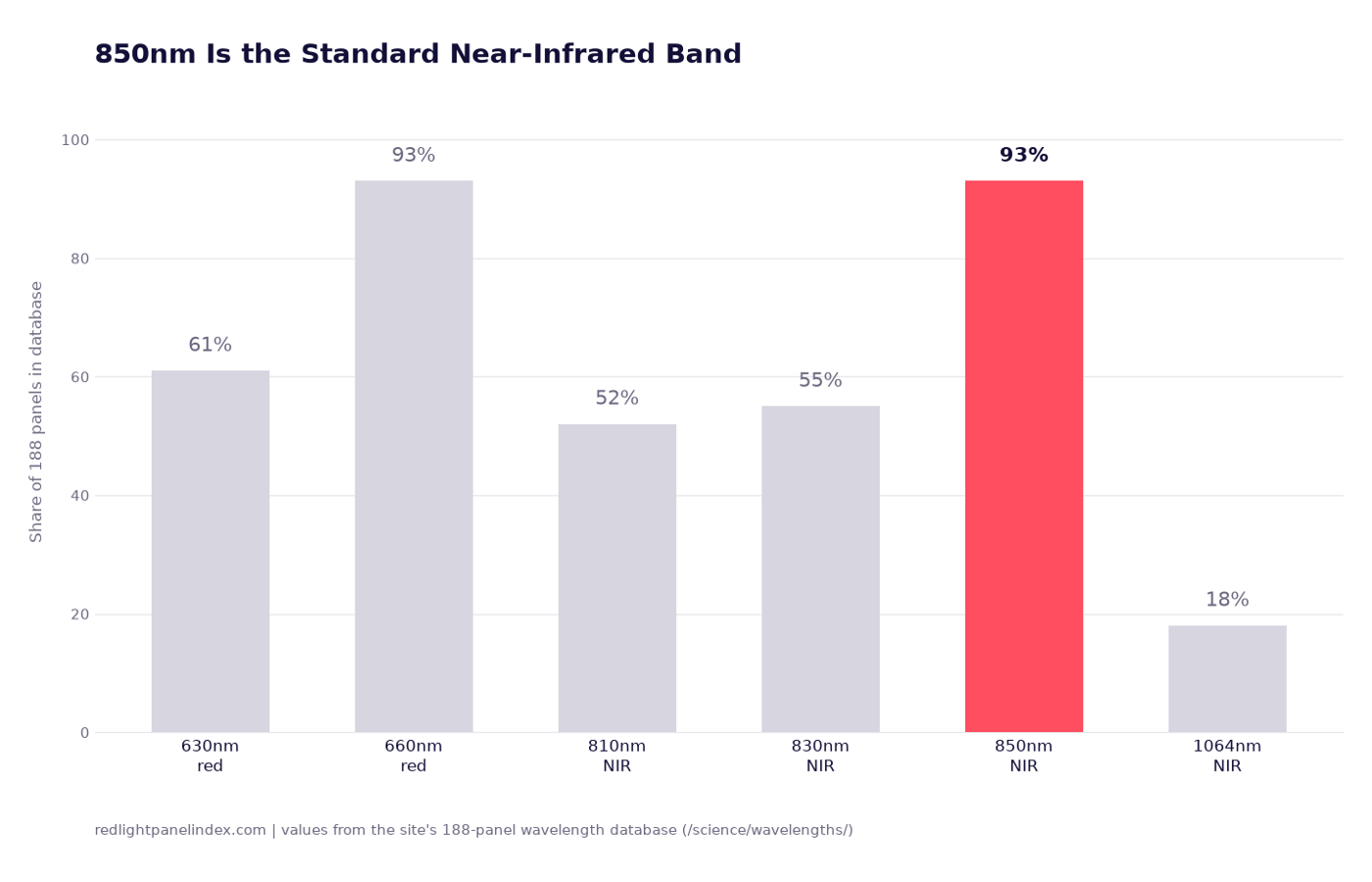
Counted across the 188 panels in this site's database, 850nm and 660nm are tied as the two most common wavelengths, each appearing on 93 percent of panels. Among the near-infrared bands specifically, 850nm is well ahead of the rest:
| Wavelength | Panels offering it | Share of database |
|---|---|---|
| 850nm near-infrared | 175 of 188 | 93% |
| 830nm near-infrared | 103 of 188 | 55% |
| 810nm near-infrared | 98 of 188 | 52% |
| 1064nm deep near-infrared | 33 of 188 | 18% |
| 660nm red (for comparison) | 175 of 188 | 93% |
| 630nm red (for comparison) | 114 of 188 | 61% |
This site's wavelength breakdown calls the 660-and-850nm pairing the market default: one red band anchored near the skin, one near-infrared band that reaches deeper, packaged together on nearly every panel sold. A panel that lists 830 or 810nm alongside 850nm is adding near-infrared bands close in depth and mechanism to 850nm itself, not a meaningfully different tool; 1064nm is the one band in this group that behaves differently enough to warrant its own consideration, and it remains the least common of the four.
What 850nm has actually been tested for
The trial literature this site tracks points 850nm, alongside the neighboring 810 to 830nm range, at deeper targets than 660nm: muscle performance, recovery, and whole-body pain rather than skin-level goals. Two trials illustrate that pattern directly.
Exercise performance and recovery. A 2015 meta-analysis pooled 13 higher-quality randomized trials on phototherapy applied around exercise and found that treatment before exercise increased time to exhaustion by a mean of 4.12 seconds (95% CI 1.21 to 7.02) and the number of repetitions completed by a mean of 5.47 (95% CI 2.35 to 8.59), both compared with placebo (PMID 24249354). The review found the most consistent results came from red or infrared wavelengths applied before rather than after exercise, at power outputs of 50 to 200 mW and doses of 5 to 6 joules per treated point. This site's full review of that meta-analysis covers what its pooled figures do and do not tell a home-panel user, including why the review's point-dose figures cannot be converted directly into a panel's irradiance.
Whole-body pain. A 2022 triple-blinded, placebo-controlled trial put 42 women with fibromyalgia through 12 sessions in a whole-body LED bed running 660nm and 850nm in a 50:50 ratio, at 28 mW/cm2 and 25.2 J/cm2 per session, and reported a large reduction in pain compared with a matched sham bed (Cohen's d = 2.06 immediately after treatment, growing to d = 2.87 at a two-week follow-up) (PMID 36369323). Quality of life, physical activity and kinesiophobia scores also improved with large effect sizes. The bed is a clinic device, not a panel, and its geometry surrounds the body from multiple angles at once rather than illuminating one side at a working distance, a gap this site's full review of the trial covers in more detail.
Neither trial used a flat panel of the kind sold for home use, and neither establishes that a panel reproduces the tested result. What they do establish is that 850nm, alongside 660nm, is the wavelength combination actually tested for exercise and whole-body pain outcomes in this site's trial register, which is consistent with why panel makers put both bands on nearly every model. The broader case for red light and muscle recovery, including trials that measured soreness and strength days after a workout, is graded Moderate on the muscle recovery evidence page.
Depth and heat: why 850nm is chosen for deeper targets
850nm's near-infrared wavelength is calculated to travel farther through tissue than a red wavelength like 660nm before it is absorbed, which is the basis for aiming it at muscle and joint tissue that sits below the skin's surface. That calculated depth advantage comes from tissue-optics modeling rather than a trial that measured light directly inside a living person, and this site's penetration depth page covers what that modeling supports and where claims quoted in inches go beyond it.
Because 850nm is invisible, it is easy to underestimate how much energy a panel is delivering at that band; there is no visible glow to signal intensity the way there is with 660nm. A session that feels comfortable under red light alone can still be delivering a full near-infrared dose, so the same heat and eye-exposure cautions that apply to any panel session, backing off to a greater working distance if skin feels warm, following the manufacturer's eye protection guidance, apply just as much to an 850nm-heavy session as to a visibly bright one.
How panels split power at 850nm
Nearly every panel in the database ships 850nm, but how much of a panel's total output actually sits at that band varies by brand. This site's 660nm versus 850nm comparison breaks down three examples: the PlatinumLED BioMax 900 allocates about 36 percent of its published array to 850nm, the Mito Red Light MitoPRO 1500X about 17 percent out of six wavelengths total, and the RLT Home Total Spectrum ULTRA 8 percent out of seven wavelengths published on that panel. A panel that lists 850nm on its box says nothing about which share of its output actually lands there; two panels with identical wavelength lists can deliver very different 850nm doses.
What this means for choosing a panel
850nm being on 93 percent of panels makes it close to a given, so it is rarely the wavelength worth comparing panels on by itself. What varies far more is the published power density at 850nm specifically, whether that figure states a measurement method, and how much of a panel's total output the 850nm band actually receives versus being one of several near-infrared bands sharing a smaller total. If your goal is a joint, a muscle group, or another target below the skin's surface, filter the device database for a panel that publishes a specific 850nm density figure rather than one that simply lists the number on a spec sheet, and use the dose calculator to turn that density and your session length into an actual dose you can hold consistent, since a wavelength this common is a starting point for a panel search, not the deciding factor.