630nm is a visible orange-red wavelength near the middle of the red band, listed by 114 of the 188 panels in this site's database (61 percent), and it is the band several skin and psoriasis trials used at 630 to 633nm. It is absorbed mostly in the upper layers of skin, so it is a surface wavelength, not a deep one. A panel that carries it is not better by default; what counts is how much of the panel's output goes to it.
Choosing a panel? Our ranking of the best red light therapy panels is computed from published, method-labeled specs across 188 devices. For 630nm, the spec that matters is the published share of output at that band, not its presence on the label.
What 630nm is
Visible red light runs from about 600 to 700 nanometers, and 630nm sits in the lower middle of that range. Like 660nm, it is absorbed by cytochrome c oxidase, the mitochondrial enzyme at the start of the effect described on the photobiomodulation page. A review of mitochondrial signaling activated by red and near-infrared radiation describes this shared red and near-infrared pathway (PMID 18651871). A "630nm" LED emits across a band rather than a single line, as the peak wavelength and FWHM page explains.
How deep it goes
Shorter wavelengths in the red band are absorbed sooner than longer ones. This site's wavelengths page summarizes the pattern: wavelength decides depth, with 630 to 660nm red working at the skin and 810 to 850nm near-infrared reaching muscle and joint tissue. Within the red band, 630nm is calculated to travel slightly less deep than 660nm. The penetration depth page covers what the modeling supports. For skin, collagen and surface work, that shallower reach is not a drawback, because the target cells are in the upper layers.
What the trials used
Two studies in the register used 633nm, the closest common trial wavelength to 630nm.
Skin rejuvenation. A prospective, randomized, placebo-controlled, double-blinded, split-face study compared three LED treatment settings for skin rejuvenation: 830nm alone, 633nm alone and a combination, against a sham light (PMID 17566756). It is a design that isolates the light from placebo, which is why it is cited often, but it was not built to rank 633nm against other red wavelengths. The full study review of the 2007 split-face LED trial covers the arms and findings.
Psoriasis. In nine patients with recalcitrant psoriasis, 830nm and 633nm LED arrays were applied sequentially in two 20-minute sessions across 4 or 5 weeks, at 60 J/cm² for 830nm and 126 J/cm² for 633nm, and clearance rates at the end of follow-up ranged from 60 to 100 percent (PMID 19764893). The authors called for a controlled study with more patients, and the site treats it as illustrative, as the skin and anti-aging evidence page does.
Both studies paired 633nm with 830nm, so neither isolates 630nm; the 830nm page looks at the same two studies from the near-infrared side. The honest reading is that 630 to 633nm has a respectable trial history as part of combined red and near-infrared protocols for skin, not that it has been shown to beat other red bands.
Which panels use it
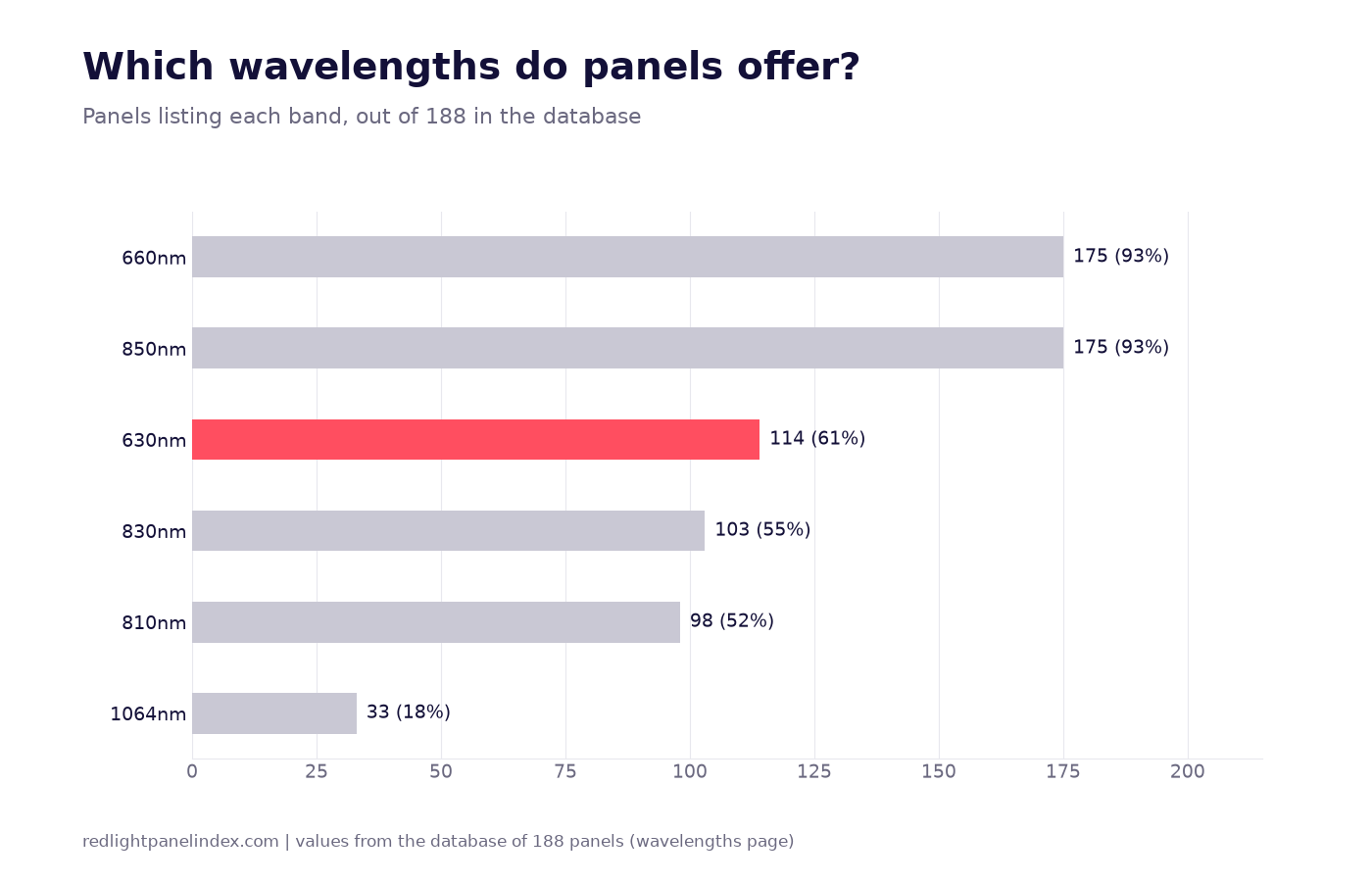
The share of panels listing each band shows where 630nm sits in the market.
| Band | Panels listing it (of 188) | Share |
|---|---|---|
| 660nm | 175 | 93% |
| 850nm | 175 | 93% |
| 630nm | 114 | 61% |
| 830nm | 103 | 55% |
| 810nm | 98 | 52% |
| 1064nm | 33 | 18% |
Presence on the label hides a lot. The published share of output varies widely.
| Model | 630nm share | Wavelengths published | Price (verified) |
|---|---|---|---|
| MitoPRO 1500X | 22% | 6 | $1,299 (2026-08-13) |
| RLT Home Total Spectrum ULTRA | 20% | 7 | $2,895 (2026-09-12) |
| PlatinumLED BioMax 900 | 9% | 7 | $1,299 (2026-08-13) |
Other models that list 630nm among their bands include the ATaPa Athena, the Bestqool Pro100, the BlockBlueLight PowerPanel MAX, the GembaRed Improve v1.1 and the Helio Cure Spark; check each record for its share, since the database does not publish one for every model. All three models in the table carry a 3-year warranty. Prices are as shown on each record on the verification date and change often. Where irradiance is published, it is whole-panel and method-labeled: the Total Spectrum ULTRA record shows 119.28 mW/cm² at 6 inches from an independent spectrometer test, and the BioMax 900 record shows an average of 90.3 mW/cm² at 6 inches from a spectrometer-based independent measurement. Those are not per-band figures. See the irradiance page for how to read them.
Reading a 630nm spec on a product page
Three checks turn the label into something you can compare. First, find the published share for the band; a panel that lists seven wavelengths may concentrate most of its output in two of them, a point the wavelengths page makes directly. Second, check whether the irradiance figure carries a method label (spectrometer, solar meter or brand claim) and a distance, because the same panel can read very differently under different methods. Third, work out the energy you will actually deliver at the distance you will sit, using the dose calculator, since irradiance drops quickly as you move back from the panel.
A worked example with database figures: the Total Spectrum ULTRA record publishes a 20 percent share for 630nm and an independent spectrometer reading of 119.28 mW/cm² at 6 inches across the whole panel. A rough per-band estimate is about 20 percent of that total, but that is arithmetic on a whole-panel number, not a measurement of 630nm, so treat it as a ceiling for planning rather than a spec. The BioMax 900 record publishes a 9 percent share, which makes the same arithmetic yield a much smaller figure for 630nm. Both records are labeled by method, which is the reason the comparison is possible at all.
Who should care about 630nm specifically
Someone following a skin protocol written around 630 to 633nm has a reason to look for a meaningful share at that band. Someone using a panel for general wellness, recovery or joint comfort has less reason, because those goals lean on near-infrared bands, and the 630nm share is a minor part of the decision. A buyer comparing two panels that list identical wavelengths should let the published shares, method-labeled irradiance, price and warranty terms decide, and treat 630nm presence as a tiebreaker, not a headline.
630nm or 660nm?
For most uses the two bands overlap enough that panel design matters more than the 30nm gap. The full comparison is on the 630nm versus 660nm page, and the 660nm page covers the more common band. If you follow a protocol written around 633nm, choose a panel with a substantial 630nm share, then set session length with the dose calculator at your actual distance.
What was not studied
No trial in the register isolates 630nm alone against a sham for a defined outcome, and none compares it with 660nm at matched dose. The psoriasis result comes from nine patients without a control group. Depth claims for 630nm are modeled, not measured in living tissue. Near-infrared bands such as 850nm address deeper targets and are not substitutes for a red band at the skin.
Cautions
Protect your eyes during red light sessions; the eye protection guide explains how. If you take photosensitizing medications, see the photosensitizing medications guide first, and talk with a clinician before using light on a skin condition such as psoriasis.